Patent translation is highly specialized, requiring both
technical accuracy and legal precision. However, it's also
costly and time-consuming, which is why AI-based patent translation
tools look so attractive. Discover how to leverage the latest
technologies safely and responsibly in our guide to AI and patent
translation best practices.
Global IP protection relies on precise translation, since even a
single mistranslated term can weaken protection. At the same time,
patent owners are under budget and time pressure to manage patent
translations cost-effectively. Could AI tools provide the
answer?
Our webinar on 'AI and Patent Translation: Opportunities, Risks,
and Best Practices' explored the key challenges facing
patent owners when seeking to balance quality and budget—and
set out some best practices for AI adoption in the patent
translation workflow. Here we summarize the key points
discussed.
The AI Patent Translation Challenge
When it comes to patent translations, the right words are critical. That's why subject matter expertise is so vital to the patent translation process.
Patent language is strategic, not just technical, so word choice can expand or limit the scope of rights. Translators must master both the art of patent translation and technology, as accuracy requires a deep knowledge of the invention's field, not just the language. The costs of getting it wrong are high, with errors and inconsistencies having a direct impact on enforceability, scope, and legal certainty in each individual jurisdiction.
At the same time, rising filings are putting brand owners under budget and time pressure. As more patents are filed worldwide, the demand for translation grows. Tight deadlines and budgets increase the risk of rushed work, so patent owners are understandably turning to technology to help expedite the process.
Given the high stakes involved, patent owners must be able to trust the experience, expertise, and tools of their chosen patent translation partner—including how they adopt the latest technologies, such as AI, to balance quality and cost-efficiency demands. But how and where should they start?
Maximizing the AI Opportunities for Patent Translation
By combining technology and human expertise, human-in-the-loop AI patent translation services enable IP owners to balance speed with precision. At Questel, for example, we combine advanced generative AI drafting workflows with expert review to deliver fast, accurate, enforceable patent translation services.
Combining human and AI-based patent translation also ensures that patent owners can sidestep the key risks of AI-only translation, such as:
- Complexity of patent language
Patent translations feature technical, legal, and industry-specific terminology that is not familiar to generic AI engines, while AI tools may misinterpret ambiguities and nuanced phrasing. - Insufficient understanding of context
Today's AI engines do not have the necessary depth of understanding of inventive concepts and can struggle to obtain context from the full text (e.g., from the description for the claims). - Technical limitations
Patent owners are rightly wary of the risk of 'hallucinations' whereby AI introduces false information into the text, but AI tools may also take an isolated approach rather than ensuring inter-claim consistency due to technical limitations. - Lack of confidentiality and risk of data
leakage
AI platforms that are not secure could reveal details of an invention before publication, while cross-border data transfer risks can raise compliance and sovereignty concerns. - Compliance and regulatory issues
Patent owners and their providers must also navigate the evolving regulatory landscape, such as the EU AI Act.
Filing-Ready Patent Translations: Discover Our Hybrid Model
As our subject matter experts discussed in our webinar on AI patent translation risks and opportunities, the real value comes when we use AI as a support tool. Specially trained AI algorithms handle and speed up routine tasks, freeing human translators to focus on where they have expertise, namely, nuanced legal/technical work.
With our hybrid model, AI is a part of the system, not the system itself. Human translators, with legal and technical expertise, review, correct, and refine AI output—combining speed with accuracy.
AI creates speed and efficiency, while 'human-expertise-in-the-loop' ensures translations meet filing standards, and quality assurance processes and ISO compliant systems uphold data security and confidentiality.
Four Benefits of Questel's Filing-Ready AI Patent Translation Services
- Cost Savings – Lower per-document translation costs and a more efficient translation process.
- Speed & Efficiency – Rapid turnaround of large patent portfolios or urgent filings, reducing time-to-market.
- Consistency – AI models trained on patent-specific corpora ensure terminology alignment across families and jurisdictions.
- Support for Human Experts – AI outputs can be used as a foundation for professional translators and attorneys, freeing them to focus on nuanced legal and technical issues.
Which AI Works Best for Patent Translations?
Questel has used patent-trained Deep Neural Machine Translation (DNMT) engines since 2018. The key difference between large language models (LLMs), such as ChatGPT, and Questel's DNMT solution can be found in the domain expertise:
- LLM = Jack of all trades, master of none
- DNMT = Master of patent application translations
The quality from Questel DNMT engines surpasses current LLM options when specifically applied to a patent application.
How Questel Leverages AI for Patent Translations
Questel continually evaluates AI options and will incorporate
any tool that makes our translators and revisers more efficient and
more accurate. We leverage AI while always ensuring security and
confidentiality:
- AI Translation Support
It is unlikely that we will see LLMs trained specifically for IP translations. Rather, we are making use of RAG models and context windows, which incorporate client-specific translation memories, terminology, style guides, etc., at the time of execution to influence the output. This also has the advantage of limiting data exposure during the training process. - Retrieval Augmented Generation
(RAG)
RAG provides the AI LLM with additional context (translation memories, terminology, style guides, etc.) that it can use to more closely align the translation with our expectations. RAG is vital for adding to and focusing the LLMs ability to translate in a tighter context. - Context Windows
Context Window describes the amount of text that an LLM can process and remember at one time, influencing its ability to generate coherent and contextually relevant responses. As with RAG, building the Context Windows is going to be critical in patent application translations. For example, we want the LLM to see the entirety of the application, thereby gaining context in the claims from the description (as opposed to taking a segment-by-segment view), building better coherence/consistency between individual claims rather than considering them in isolation. - AI Quality Evaluation
We use AI quality assessment workflows to pre-approve segments and focus translator efforts on text where human expertise is required. - AI Assisted Formatting
We employ pre- and post-translation automations to prepare document formatting and style to comply with foreign PTO requirements. - AI Linguistic Assistance
Our interactive assistant for translators aids with proofreading, accuracy, consistency, and adherence to style guides, providing real-time feedback, flagging potential mistranslations, and suggesting improvements to maintain the quality and coherence of the final output. - AI Compliance Check
We enhance final human QC with a RAG compliance check, ensuring client style, terminology, and formatting are followed, among other low-level quality assurance checks to ensure filing readiness. - Assuring Security/Secrecy
All AI implementations are vetted by the Translations Platform team, Questel's IT team, and require sign-off from the Questel Information Security team to ensure data security is never compromised.
Building the AI-Human Connection: Smarter Workflows with AI
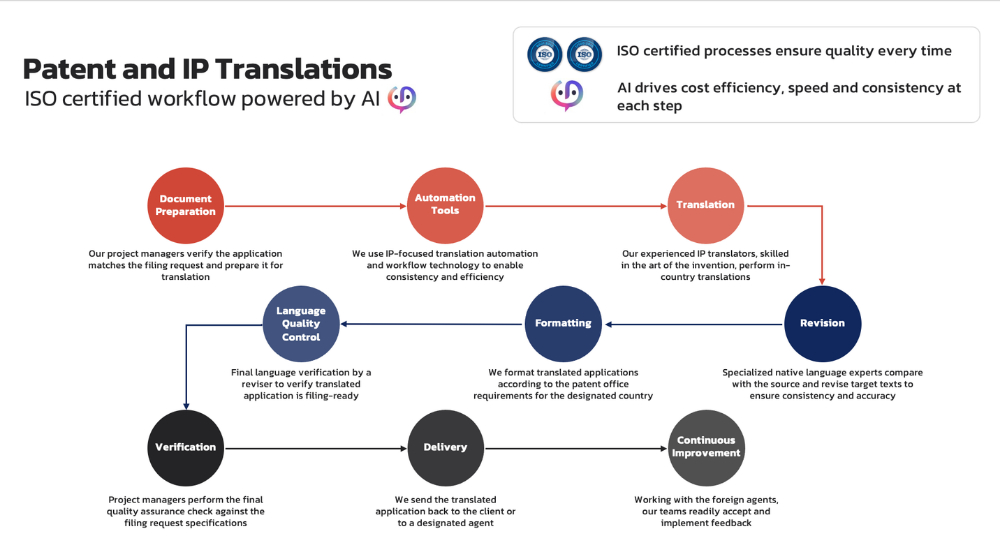
Our workflow ensures security and confidentiality by design:
- Developed in compliance with the strictest requirements: All supplier communication is encrypted; policies are aligned with client, legal, and regulatory standards.
- ISO 27001 certification: Full implementation of information security management systems.
- Data isolation: Case-specific storage with no mixing of client data.
- On-premises/internal hosting: AI engines run only on secure internal servers.
- Logging and auditing: Access and system activities are continuously monitored.
3 Best Practices for AI and Patent Translation
1. When using AI tools
- Choose secure enterprise-grade AI translation tools with strong encryption and data privacy protections.
- Treat pure AI translation as a first pass or for information purposes.
- Establish SOPs for when AI can be used as a first pass or for information (e.g., internal documents, prior art, preliminary analysis) vs documents with legal effect (e.g., for patent filing and prosecution, litigation evidence...)
2. When selecting vendors
- Look for proven expertise in the patent translation field, as well as efficient, compliant use of AI, robust processes and information security systems, and service levels with pricing tailored to requirements and budget.
- Opt for providers with added value solutions (e.g., integration with docketing systems, one stop IP offering, user friendly portal, flexible client-focused processes...)
3. Keep the 'human in the loop'
- AI is a tool, not a magic bullet; the human-in-the-loop approach is the gold standard for filing quality patent translation.
- Use AI for drafts, internal understanding, or bulk prior art, but always rely on human-expert-checked translations for filings.
- Ensure your provider follows strict confidentiality and QA protocols.
Key Reasons to Choose Questel for AI-Assisted Patent Translation
In Questel's 'human-expertise-in-the-loop' approach to AI patent translation, AI doesn't replace human intelligence; it amplifies it. In translation, AI handles the routine, while humans bring expertise, judgment, and nuance. Together, they unlock quality, speed, and scale that neither could achieve alone.
AI will continue to improve—integrating with IP management systems, becoming domain-specific, but the need for expert oversight won't disappear anytime soon.
Questel has pioneered the usage of technology in IP since 1998 and takes the role very seriously. We are strategic in our use of AI, with the goal of improving efficiency without compromising quality, and our teams are already accustomed to adopting technologies responsibly.
As the technology continues to evolve, patent owners can look forward to ever improving AI in translation, more efficiency, cost, and time savings, and increased integration of AI-powered IP services within their IP management software and other tools.
The content of this article is intended to provide a general guide to the subject matter. Specialist advice should be sought about your specific circumstances.