

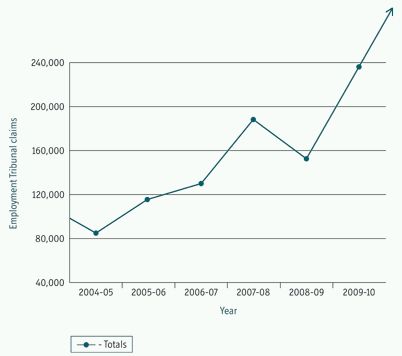
The number of employment tribunal claims has reached an all time high – 236,100 claims in 2009/2010 – up 56% on the previous year.
Statistics published by the Tribunals Service, show that much of this increase is due to a rise in "multiple" claims – where two or more people bring cases against a single employer arising out of the same or very similar circumstances. However, "single" claims have also increased.
UK employment tribunals deal with a wide range of claims, from discrimination and unfair dismissals, to issues around salary and working conditions. The number of claims most closely linked to the recession – unfair dismissal, breach of contract and redundancy – are 17% higher than for 2008/2009.
What should you do?
The maximum compensatory award for unfair dismissal is currently £65,300. There is no cap if discrimination is involved. One oil company executive won £2m when he was dismissed for "not being Norwegian."
As ex-employees have taken longer recently to secure alternative employment, the size of awards reflecting loss of earnings has increased. The management time lost in defending claims can also be significant.
The increasing cost for employers of getting it wrong, and increasing awareness by employees of their rights, mean it is more important than ever to manage human resources carefully and efficiently.
To show that a dismissal was fair it is, in general, necessary for employers to show both that the dismissal was for one of six reasons and that the dismissal was reasonable in all the circumstances.
Employers must familiarise themselves with the correct procedures beforehand. These vary according to the reason for dismissal. However, the following will nearly always be relevant:
- Proper consultation with the employee including a number of meetings.
- Right to be accompanied at meetings.
- Consistency in applying rules.
- Genuine consideration of alternative employment.
- Right of appeal.
Dismissal is a complex area of law, which is full of traps. Employers should take advice before dismissal. A small investment in legal fees can save much more money later on.
The content of this article is intended to provide a general guide to the subject matter. Specialist advice should be sought about your specific circumstances.
