

On December 29, 2025, the U.S. Department of Homeland Security (DHS) published a rule amending federal regulations that govern the process by which the United States Citizenship and Immigration Services (USCIS) selects foreign workers for the annual H-1B visa lottery. Through the rule, DHS is implementing a weighted H-1B selection process that will favor registrants with job opportunities at a higher wage level. Effectively, this means that H-1B registrants with job offers at higher salaries will have a significantly greater chance of selection than entry-level registrants and other registrants with lower wage offers. The wage-based process is expected to reduce the number of entry-level roles being selected in the H-1B lottery.
Each year, DHS allocates 85,000 new H-1B visas authorized by Congress, reserving 20,000 H-1Bs for foreigners who have earned a master's degree at a qualifying U.S. educational institution. Certain employers are exempt from the H-1B cap and may sponsor foreign workers without being subject to the annual numerical limitation. However, as the demand for cap-subject H-1B visas consistently exceeds the annual allocation, USCIS uses a lottery to select candidates. The H-1B registration window opens in March, and USCIS typically announces selections on March 31. Under the existing selection process, USCIS randomly chooses the 85,000 registrants, first selecting the 20,000 with U.S. master's degrees, followed by the remaining 65,000. Under this process, registrants with a U.S. master's degree had two opportunities for selection, with the overall selection rate at approximately 30% in recent years, while those without a United States master's degree had a selection rate below 25%.
The new rule replaces the random lottery selection with a weighted H-1B selection process based on the wage level assigned to the salary offered to the H-1B worker. To understand how this rule changes the lottery, it is important to understand the wages an employer must pay H-1B workers selected in the lottery. Employers must pay H-1B workers the higher of the "prevailing wage" (the average wage all employers in the area pay for the job) or the "actual wage" (what the employer pays its employees in the area) for the role. The prevailing wage for an H-1B position is calculated based on the occupation and the employer's requirements for the position. The U.S. Department of Labor's wage level framework consists of four wage levels, meant to reflect the role's seniority and complexity, evaluated by comparing the normal minimum education and experience requirements, specialized skills, and supervisory responsibilities for the position with the employer's requirements for the position.
Under the new weighted selection process, the chance of selection in the H-1B lottery will increase for employers offering above-market wages for lower-level positions, and offering market wages for higher-level positions. Specifically, under the new rule, H-1B registrations would be entered into the lottery pool as follows:
- Employer's wage offer meets average wage for entry-level role ("Level I" or 17th percentile of wages for the occupation): entered into the lottery pool 1 time.
- Employer's wage offer meets average wage for somewhat experienced role ("Level II" or 34th percentile of wages for the occupation): entered into the lottery pool 2 times.
- Employer's wage offer meets median wage for the role ("Level III" or 50th percentile of wages for the occupation): entered into the lottery pool 3 times.
- Employer's wage offer meets average wage for very experienced role ("Level IV" or 67th percentile of wages for the occupation): entered into the lottery pool 4 times.
With the change to the weighted H-1B selection process, job opportunities at higher wage levels will benefit from a significantly increased probability of selection. The job offers that will be advantageous may be for more senior roles, or may be for junior roles at employers who pay above-market salaries. The probability of being selected will change from approximately 30% across all wage levels to the following:
- Level I: 15.29%
- Level II: 30.58%
- Level III: 45.87%
- Level IV: 61.26%
Example with Two Similar Employers
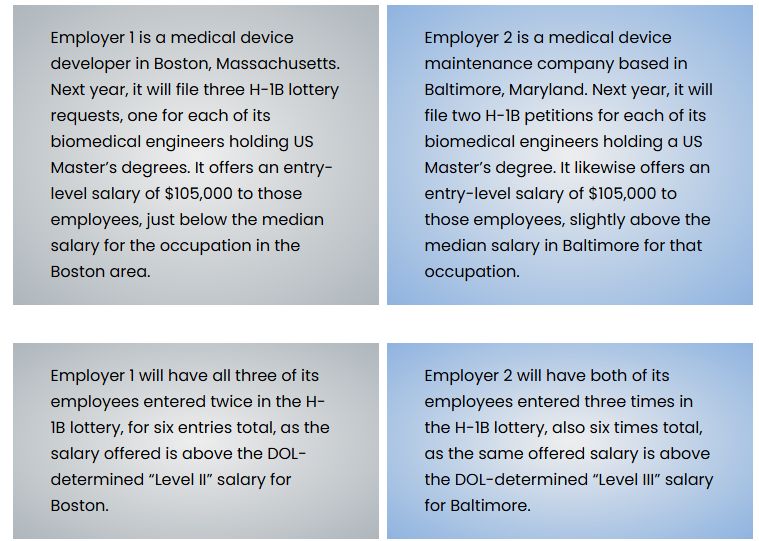
Employers will need to specify the offered wage, the wage level that the offered wage matches, the occupational classification, and the area of intended employment for the offered position in the H-1B registration. If a registration is selected in the lottery, the job offer details in the filed petition will need to be identical to those reflected in the registration.
Employers who sponsor H-1B workers for entry-level positions, including recent college graduates and early-career professionals, can expect increased challenges in securing work authorization for these employees unless they pay significantly above-market wages. Further, foreign graduates will need to effectively explore visa alternatives once their post-completion optional practical training (F-1 OPT) authorization runs out, as their chances for the H-1B visa are likely to decrease.
The rule is set to go into effect on February 27, 2026, in time for the upcoming Fiscal Year 2027 H-1B lottery. Our firm's guidance is to stay the course with existing H-1B cap planning strategies and to evaluate whether your individual workforces will be advantaged or disadvantaged by this change. While this development is significant, key operational details and implementation guidance will not be fully known until after publication and further agency clarification. As with prior regulatory changes affecting the H-1B program, additional insight is expected to emerge over time. A legal challenge to the rule is possible and could impact its timing, scope, or ultimate implementation.
The content of this article is intended to provide a general guide to the subject matter. Specialist advice should be sought about your specific circumstances.

