

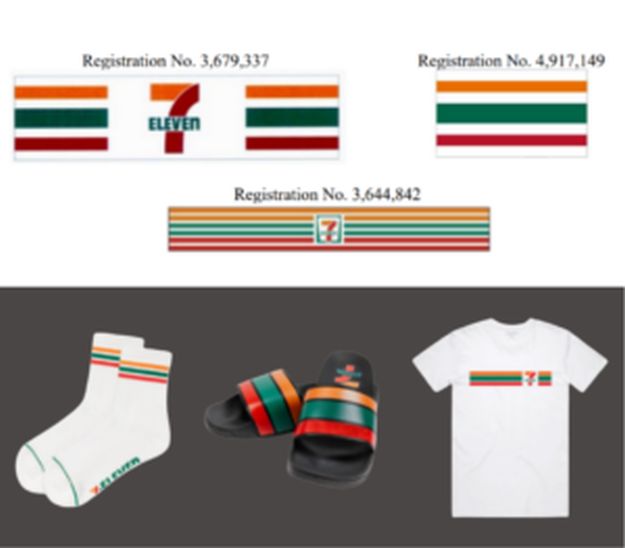
Images from Plaintiff’s Complaint (Civil Action No. 3:26-cv-2201)
At first glance, the dispute between 7-Eleven and Nike feels almost absurd.
Can a convenience store really claim rights in a colour combination?
That is the question many people have been asking since 7-Eleven filed a federal trademark lawsuit against Nike (Civil Action No. 3:26-cv-2201) over its upcoming Air Max 95 sneaker, alleging that the shoe’s orange, green and red striping creates an unauthorised association with the retailer’s long-established branding. The timing of the release has only added to the controversy, with Nike intending to launch the sneaker on 11 July, a date widely associated with the retailer’s annual “7-Eleven Day” promotions.
From a business perspective, it is easy to see why some commentators have reacted with scepticism.
After all, no company owns colours in the abstract.
If that were the case, branding departments around the world would have a difficult time creating anything new.
But that is not actually what 7-Eleven is claiming.
Rather, the retailer argues that consumers have come to associate a particular combination of orange, green and red striping with the 7-Eleven brand after decades of use across its stores, advertising, merchandise, apparel and even footwear. According to the complaint, that visual identity has become so closely linked to 7-Eleven that consumers immediately recognise it as indicating a connection to the retailer. 7-Eleven further relies on several trademark registrations incorporating those colours and stripe patterns as part of its claim.
The distinction is important because trademark law has never really been about colours in isolation.
It is about what consumers associate those colours with.
According to the complaint, consumers have come to associate the orange, green and red striped presentation exclusively with 7-Eleven after decades of continuous use and extensive promotion. The company goes so far as to characterise its Tri-Color Mark as iconic, famous and instantly recognisable.
The complaint does not stop there.
7-Eleven’s argument is built around the broader commercial context. The retailer points to the alleged 11 July launch date, a date deeply linked to the company’s annual promotions, as well as media coverage describing the shoe as a “7-Eleven” sneaker or as being inspired by the convenience store chain. It further alleges that consumers are accustomed to seeing authorised 7-Eleven collaborations with footwear and lifestyle brands, making an assumption of sponsorship or collaboration more likely.
Viewed individually, none of these facts may appear decisive.
Viewed collectively, they begin to paint a different picture.
The case therefore raises a broader question that extends far beyond sneakers and convenience stores:
At what point does a visual identity become so recognisable that consumers begin to assume a connection exists, even when the brand name never appears on the product?
According to 7-Eleven, that line was crossed when the colours, striping, launch date, and broader marketing context combined to create an impression that consumers would associate with the 7-Eleven brand. The retailer’s complaint is ultimately less concerned with colours in isolation and more concerned with the message those colours are alleged to communicate to consumers.
This is where it becomes particularly interesting from a South African perspective.
South African trademark law, much like trademark law in many other jurisdictions, is not limited to exact copies. Courts are generally concerned with whether consumers are likely to be deceived or confused regarding the origin, sponsorship, endorsement or association of goods and services.
In that respect, the legal starting point would look surprisingly familiar.
A South African court would likely ask a question similar to the one being asked in the United States: would the average consumer assume that there is some commercial connection between the sneaker and 7-Eleven?
However, the outcome may not be as straightforward as it appears in the United States.
One of 7-Eleven’s biggest challenges in a South African context would be proving the strength of the association between the colour scheme and the brand itself. In the United States, where the retailer operates thousands of stores and has used the colour scheme for decades, that claim may be easier to establish.
Whether South African consumers would make the same connection is a different question.
A South African court would likely focus heavily on evidence. How well known is the colour scheme locally? How many consumers actually associate it with 7-Eleven? Is that association strong enough that consumers would genuinely believe the sneaker was authorised, sponsored or endorsed by the retailer?
These questions become particularly relevant because Nike never used the 7-Eleven name.
The dispute is not about an identical word mark appearing on a competing product. Instead, it concerns broader visual cues and the overall commercial impression those cues create.
There is also the issue of timing.
In the United States, the planned launch date of 11 July carries obvious significance because of “7-Eleven Day” and the retailer’s well-known promotions.
In South Africa, however, that connection may not be nearly as strong. Many consumers would not immediately recognise the date as referring to the retailer and, as a result, the launch date may carry less evidential weight in a South African court than it appears to in the American proceedings.
None of this means that 7-Eleven would necessarily fail in South Africa.
Far from it.
If the company could establish that its colour combination has acquired sufficient distinctiveness and that consumers genuinely recognise it as indicating a connection to 7-Eleven, it may well have a credible case.
What the dispute ultimately demonstrates, however, is just how powerful brands can become.
When businesses invest consistently in visual identity over many years, consumers start recognising more than logos and names. They begin recognising colours, layouts, packaging and other subtle branding cues. That is often the hallmark of a successful brand and, perhaps unsurprisingly, it is also where trademark disputes become most interesting.
Because at some point, the conversation stops being about colours.
It becomes about what those colours mean.
And whether consumers see a sneaker… or another brand.
The content of this article is intended to provide a general guide to the subject matter. Specialist advice should be sought about your specific circumstances.
[View Source]