- within Employment and HR topic(s)
- with Senior Company Executives, HR and Finance and Tax Executives
- in Oceania
- with readers working within the Law Firm industries
- within Law Department Performance topic(s)
Duane Morris Takeaway: Government enforcement litigation is similar in many respects to class action litigation. In lawsuits brought by the U.S. Equal Employment Opportunity Commission (EEOC), as well as the U.S. Department of Labor (DOL), the government asserts various claims on behalf of or as a representative of numerous allegedly impacted individuals. These cases typically present numerous claimants, as well as significant monetary exposure.
The video below featuring DMCAR editor Jerry Maatman explains this trend in detail:
While plaintiffs in private party class actions must meet the requirement of Rule 23 to secure class certification, the law does not require the government to clear such hurdle. For example, systemic "pattern or practice" lawsuits brought by the EEOC follow a framework established by the U.S. Supreme Court in International Brotherhood Of Teamsters v. United States, 431 U.S. 324 (1977), rather than Rule 23. Nonetheless, EEOC systemic lawsuits present similar issues and similar risk for corporate defendants.
While the EEOC and DOL historically have been among the most aggressive litigants in terms of their pursuit of claims, the Trump Administration has had a profound impact on these agencies and their enforcement agendas. President Trump ran for election on a platform that runs counter to many of the "emerging issues" on the EEOC's priority list, foreshadowing a realignment of litigation priorities.
The Trump Administration has kept its promise of less government oversight and regulation and has shifted the priorities of these agencies to more closely match the administration's objectives.
- Litigation And Settlement Trends
In fiscal year (FY) 2025, which ran from October 1, 2024, to September 30, 2025, the EEOC's litigation enforcement activity stalled significantly as compared to previous years.
By the numbers, the EEOC filed a total of 94 lawsuits, far fewer than it filed at the height of filings in FY 2018, when it filed 217 lawsuits.
The decline in enforcement activity shows that, for President Trump's second term in office, companies should expect the EEOC to be less aggressive as compared to past regimes in terms of the volume of enforcement lawsuits filed.
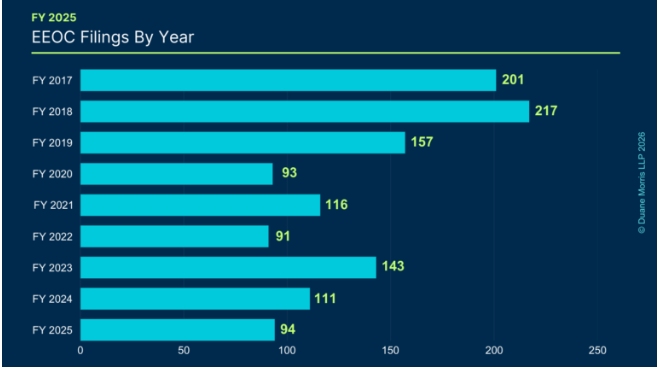
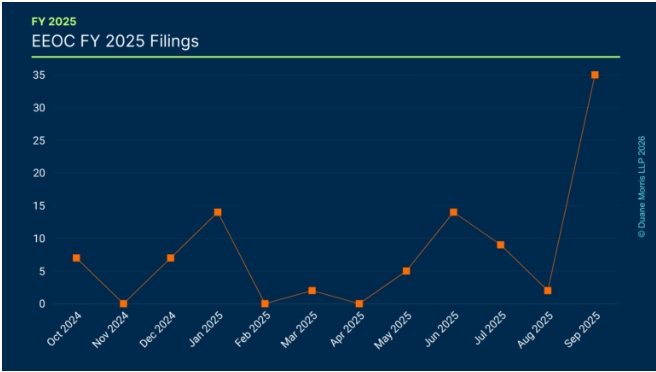
Each year, the EEOC's fiscal year ends on September 30, and the agency engages in a sprint to the finish as it files a substantial number of lawsuits during the month of September. In FY 2025, the EEOC filed 94 lawsuits. Of these, it filed 35 – or 37% of the annual total – during September, the last month of its fiscal year. The overall number represents a decrease from prior years, but the filings followed a somewhat similar pattern. In FY 2024, the EEOC filed 110 lawsuits. It filed 67 of these actions, or more than 60%, during the month of September. By comparison, in FY 2023, the EEOC filed 144 lawsuits, with a similarly heavy September tranche of 35.We track the EEOC's filing efforts across the entire fiscal year from its beginning in October through the anticipated filing spree in September.
Unlike other fiscal years, during 2025, the EEOC's filing patterns were consistent in the first half of FY 2025, peaking with 14 lawsuits in January. Filings again slowed until the summer, when the EEOC filed another 14 lawsuits in June 2025. Thereafter, lawsuit filings dipped until the "eleventh hour" in September. The following shows filing activity by month:
- Lawsuit Filings By EEOC District Office
In addition to tracking the total number of filings, the litigation filing patterns of the EEOC's 15 district offices are telling. Some districts tend to be more aggressive than others, and some focus on different case filing priorities. The following chart shows the number of lawsuit filings by each of the EEOC district offices in FY 2025.
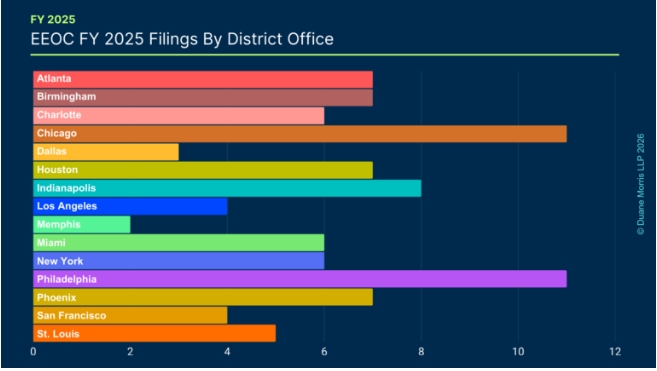
In FY 2025, Philadelphia and Chicago led the pack in filing the most lawsuits, with 11 each, followed by Indianapolis with eight filings, then Atlanta, Birmingham, Houston, and Phoenix with seven filings, and Charlotte, New York, and Miami each with six filings.
St. Louis had five filings, Los Angeles and San Francisco had four filings, and Dallas had three filings. Memphis had the lowest amount with only two filings.
As in FY 2024, Philadelphia proved itself as a leader in EEOC enforcement filings. Chicago remained steady with 11 filings, the same as FY 2024. St. Louis (two filings in FY 2024) and Phoenix (four filings in FY 2024) showed increases in filing numbers as compared to FY 2024.
Other offices comparatively lagged in enforcement activity. Atlanta (11 filings in FY 2024), Indianapolis (nine filings in FY 2024), and Houston (eight filings in FY 2024) showed slight decreases in enforcement activities. Across the board, filings generally became more even for district offices compared to FY 2024, but filing activity decreased.
- Lawsuit Filings Based On Type Of Claim
The types of claims the EEOC filed in FY 2025 provides a window into its shifting strategic priorities.
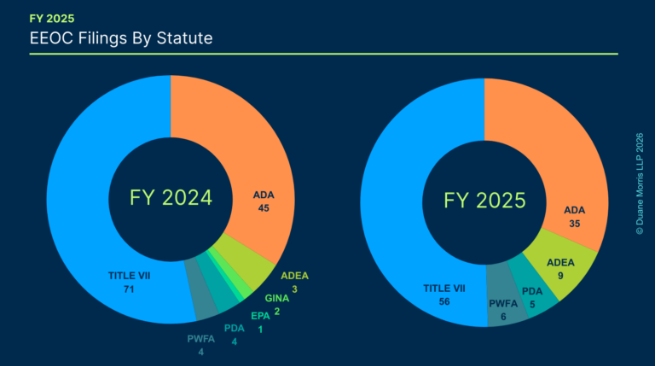
When considered on a percentage basis, the distribution of cases filed by statute skewed significantly in favor of Title VII cases when comparing FY 2025 to prior years.
The EEOC again based most of its claims on alleged violations of Title VII, but these claims comprised 50% of its filings in FY 2025, compared to 58% of its filings in FY 2024. Those numbers represent a significant decrease from FY 2023 and FY 2022, when Title VII claims represented 68% of the EEOC's filings in FY 2023 and 69% of its filings in FY 2022.
Overall claims for alleged violation of the ADA made up the next most significant percentage of the EEOC's FY 2025 filings – totaling 31.5%. This share again shows a decrease from prior years when ADA claims comprised 42% of filings in FY 2025, 34% of filings in FY 2023, and 37% of filings in FY 2021. The percentage is marginally higher than FY 2022, when ADA filings on a percentage basis comprised 29.7% of all filings.
The EEOC filed more claims for alleged violation of the ADEA in FY 2025. It filed nine ADEA cases in FY 2025, as compared to six ADEA age discrimination cases in FY 2024, but it filed 12 ADEA age discrimination cases in FY 2023 and seven in FY 2022.
As in FY 2024, this past year the EEOC pursued claims under the Pregnant Worker's Fairness Act. It filed six cases, compared to three in FY 2024. In addition, the EEOC filed slightly more claims for alleged violation of the Pregnancy Discrimination Act in FY 2025. It filed five such cases, as compared to four in FY 2024.
Notably, the EEOC refrained from filing any claims for alleged violation of the Equal Pay Act in FY 2025 and any cases for alleged violation of the Genetic Information Nondiscrimination Act.
The following graph shows the number of lawsuits filed according to the statute under which they were filed.
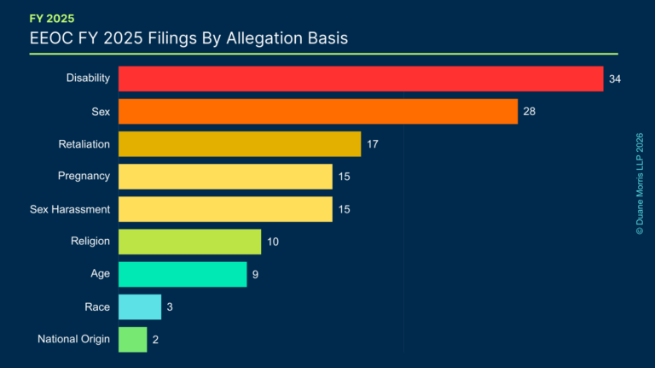
The grounds for such claims are reflect the stated priorities of the Trump Administration, including by reflecting a decreased emphasis on targeting alleged racial discrimination, and an increased emphasis on routing out disparate treatment based on gender and health-related and family-related conditions. Claims based on alleged disability discrimination, sex discrimination, and retaliation led the way. Collectively, these three theories provided the foundation for 59.4% of FY 2025 EEOC filings.
Notably, in FY 2025, the EEOC filed only three lawsuits asserting discrimination based on race or national origin, a total of 2.3% of the lawsuit filings. In FY 2024, 8.9% of all filings included claims based on race. The following graph shows a breakdown of the allegations underlying the FY 2025 filings.
- Lawsuits Filings Based On Industry
In terms of filings by industry, FY 2025 aligned with prior years and reflected the EEOC's focus on a few major industries. In FY 2025, two industries remained among the EEOC's top targets – hospitality and healthcare.
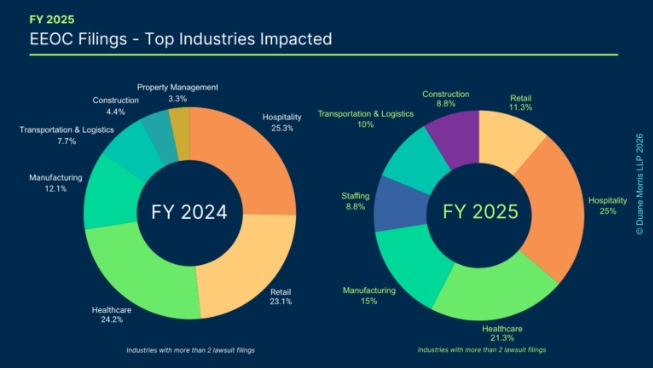
On a percentage basis, hospitality industry employers (restaurants / hotels / entertainment) were recipients of 25% of EEOC filings, and healthcare industry employers received 21.3%. In FY 2025, manufacturing (15% of FY 2025 filings, 12.1% of FY 2024 filings) overtook retail (11.3% of FY 2025 filings; 23.1% of FY 2024 filings) as the next most targeted industry, with retain experiencing a double-digit decline. Only one other industry, transportation & logistics received a double-digit percentage share of EEOC-initiated lawsuits (with 10%). Filings against employers in staffing and construction remained flat in terms of relative percentage in FY 2025 as compared to FY 2024 (8.8% and 8.8% of filings, respectively). As in FY 2024, in FY 2025, the EEOC did not file any of its enforcement lawsuits against employers in the automotive, security, and/or technology industries.
- Strategic Priorities
Moving into FY 2026, the EEOC's budget justification includes a $19.618 million decrease from FY 2025. This move is reflective of the Trump Administration's stated priority of returning to the "agency's true mission." The EEOC aims to return to its founding principles and restore evenhanded enforcement of employment civil rights laws on behalf of all Americans.
Every new presidential administration brings with it an array of objectives focused on different priorities. Since President Trump's inauguration, the Trump Administration has taken unique steps to significantly reshape the EEOC. Among its moves to overhaul the agency, President Trump dismissed two Democratic-appointed EEOC commissioners and its General Counsel and replaced them with officials viewed as more aligned with his agenda. The Administration appointed new leadership, including Chair Andrea Lucas and Acting General Counsel Andrew Rogers. On October 7, 2025, Brittany Panuccio was confirmed by the Senate as a commissioner, thereby restoring a quorum.
President Trump has issued a series of executive orders reflecting its shift in enforcement priorities, particularly against DEI initiatives. On January 20, 2025, the White House issued an executive order, "Ending Radical and Wasteful Government DEI Programs and Preferencing," and, on January 21, 2025, the White House issued, "Ending Illegal Discrimination and Restoring Merit-Based Opportunity." The latter's stated purpose is to end "dangerous, demeaning, and immoral race- and sex-based preferences under the guise of so-called 'diversity, equity, and inclusion' (DEI) or 'diversity, equity, inclusion, and accessibility' (DEIA) that can violate the civil-rights laws of this Nation." President Trump ordered all executive departments and agencies to terminate all "discriminatory and illegal preferences" and to "combat illegal private-sector DEI preferences, mandates, policies, programs, and activities."
Shortly thereafter, in February 2025, the EEOC took prompt action to implement the Administration's shift in direction. Citing the Trump Administration's Executive Order on "gender ideology extremism," the EEOC announced that it would withdraw seven lawsuits it had filed across the country, including:
EEOC v. Sis-Bro Inc.,No. 25-CV-968 (S.D. Ill.)
EEOC v. Harmony Hospitality LLC,No. 24-CV-357 (M.D.
Ala.)
EEOC v. Brik Enterprises, Inc., et al.,No. 24-CV-12817
(E.D. Mich.)
EEOC v. Reggio's Pizza Inc.,No. 24-CV-8910 (N.D.
Ill.)
EEOC v. Lush Handmade Cosmetics LLC, No. 24-CV-6859 (N.D.
Cal.)
EEOC v. Boxwood Hotels, LLC,No. 24-CV-902 (W.D.N.Y.)
EEOC v. Starboard Group Inc.,No. 24-CV-2260 (S.D.
Ill.)
On February 18, 2025, inEEOC v. LeoPalace, No. 25-CV-4 (D. Guam), the EEOC settled a lawsuit for more than $1.4 million and entered into a three-year consent decree with LeoPalace Resort, a large hotel in Guam. The EEOC alleged that LeoPalace provided employees of non-Japanese national origin with less favorable wages and benefits than their Japanese counterparts. This lawsuit is significant because it was the first seven figure settlement that the Commission procured after President Trump took office in January 2025 – and because it was accompanied by a statement from Chair Andrea Lucas announcing the Commission's new enforcement agenda and its intent to protect all workers from national origin discrimination and "Anti-American Bias."
In the accompanying press release, Chair Lucas announced that "Federal anti-discrimination laws ensure equal employment opportunity for jobs performed by all workers regardless of national origin. . . . This case is an important reminder that unlawful national origin discrimination includes discrimination against American workers in favor of foreign workers." This was the Commission's first publicized settlement since Lucas was appointed Acting Chair of the EEOC. One day after the settlement was announced, the EEOC published a second press release on its Newsroom "putting employers and other covered entities on notice" that the Commission was committed to protecting all workers from unlawful national origin discrimination, including American workers.
The Commission has stated that it is committed to carrying out President Trump's policy agenda, consistent with his executive orders related to (1) "unlawful DEI-motivated race and sex discrimination," (2) "defending the biological and binary reality of sex and related rights," (3) "protecting workers from religious bias and harassment, including antisemitism," and (4) "anti-American national origin discrimination."
Further evidencing these stated objectives, among other things, Acting Chair Lucas has announced that one of her priorities for compliance, investigations, and litigation is to defend the biological and binary reality of sex and related rights, including women's rights to single-sex spaces at work. She likewise removed the agency's "pronoun app," a feature in employees' Microsoft 365 profiles, which allowed an employee to opt to identify pronouns, which then appeared alongside the employee's display name across all Microsoft 365 platforms, including Outlook and Teams. This content was displayed both to internal and external parties with whom EEOC employees communicated. She also has ended the use of the "X" gender marker during the intake process for filing a charge of discrimination and directed the modification of the charge of discrimination and related forms to remove "Mx." from the list of prefix options.
On December 19, 2025, Chair Lucas announced in an interview with Reuters that, "[i]f you have a DEI program or any employee program that involves taking an action in whole or in part motivated by race or sex or any other protected characteristic, that's unlawful." She confirmed that federal inquiries into corporate diversity programs are underway and warned that initiatives tied to hiring, promotion, or marketing may come under scrutiny. Lucas reiterated the White House's position that white men have been subject to discrimination in the workplace through DEI programs and encouraged the submission of complaints.
In several respects, FY 2025 represented a hard pivot in enforcement targets. While total filings decreased, the new administration foreshadowed a new direction and targeted approach in upcoming EEOC enforcement.
Disclaimer: This Alert has been prepared and published for informational purposes only and is not offered, nor should be construed, as legal advice. For more information, please see the firm's full disclaimer.
[View Source]