
Recently, the Turkish Competition Authority (“TCA”) announced the conclusion of its investigation into the Casting Agencies Association (“KASTDER”) and undertakings active in the casting agency and talent management markets.1 By its decision, the Turkish Competition Board (“Board”) found that the parties had infringed Article 4 of Act No. 4054 on the Protection of Competition (“Competition Act”) by jointly determining agency commission rates and terms of service and by exchanging competitively sensitive information. Administrative fines totalling TRY 42,163,586.70 (approx. EUR 800,000) were imposed on 36 undertakings and on KASTDER itself.
Measured against the Board’s recent enforcement record, neither the cartel finding nor the level of the fines is what makes the decision remarkable. What sets it apart is the remedial package adopted "in order to ensure the establishment of effective competition in the market: A set of obligations that raise two distinct concerns this article will examine. First, the measures appear to constitute structural remedies within the meaning of Article 9 of the Competition Act, yet they have been imposed without any prior behavioural remedy having been tried and having failed. Second, the obligations are addressed not only to the investigated parties but, in the Authority’s own words, to all undertakings active in the casting directing and casting agency/management sectors, whether or not they were parties to the proceedings. The Authority’s own news service captured the spirit of the decision in a headline phrased like a rule of general application: “From now on, casting directing and casting management can no longer be carried out together."2
This article examines both features of these remedies in turn and the questions they raise for rights of defence, legal certainty and the boundary between individual adjudication and regulation of general application.
The remedies imposed
Under the operative part summarised in the announcement, every undertaking active in the market must, within three months, ensure that casting directing and casting agency/management activities are no longer carried out within the same economic unit. Undertakings currently combining the two must remove one of the activities from their articles of association and bring it to an end in practice. The same separation applies to production and casting agency/management activities; in addition, casting agents and managers may not perform any other function on behalf of the producer (consultancy, accounting, supervision, public relations or otherwise) in productions to which they supply talent. Finally, the casting of one talent may not be made conditional upon the engagement of other talents represented by the same agency.
The compliance clock runs from the notification of the decision for the investigated parties and, for everyone else in the market, from the publication of the reasoned decision on the Authority’s website. KASTDER, for its part, must redesign its membership structure so that only undertakings carrying out casting agency/management activities may be members, inform its members of the separation requirements and of the prohibition on conditional casting, and publish an information note on its website addressing the underlying competition concerns.
Two features of this remedial architecture deserve closer attention: The nature of the measures imposed, and the breadth of their addressees.
Structural measures and the sequencing rule of Article 9
Article 9(1) of the Competition Act empowers the Board, upon finding an infringement, to indicate in its final decision the behaviours to be performed or avoided, as well as structural remedies in the form of the transfer of certain activities, shareholdings or assets. Both categories are subject to an express proportionality and necessity standard: Remedies must be proportionate to the infringement and necessary for bringing it to an end effectively. Crucially, the provision then adds a sequencing rule: Structural remedies may be resorted to only where behavioural remedies previously imposed have failed to produce results, and where such failure is established by a final decision, the undertakings concerned must be granted at least six months to comply with the structural remedy.3
This design is deliberately stricter than its European counterpart. Article 7(1) of Regulation 1/2003 permits structural remedies where no equally effective behavioural remedy exists or where such a remedy would be more burdensome; the Turkish legislature opted instead for a strict temporal sequence in which structural intervention is a remedy of last resort, available only after behavioural measures have been tried and have demonstrably failed.4
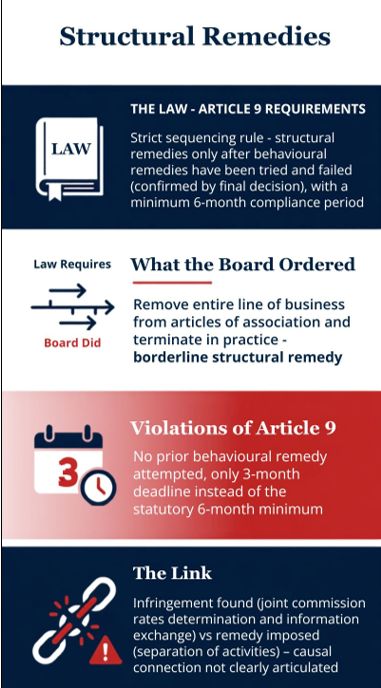
Against this backdrop, the obligations imposed in the casting decision raise a genuine question of characterisation. An order requiring an undertaking to remove an entire line of business from its articles of association and to terminate it in practice sits at the very least, on the borderline of the statutory notion of a structural remedy. The announcement does not refer to any behavioural remedies previously imposed in this sector that proved ineffective, nor to the six-month minimum compliance period that the statute attaches to structural measures; instead, a three-month deadline applies across the board. If the reasoned decision characterises the separation obligations as behavioural, it will be interesting to see how a measure obliging market exit from an activity can be reconciled with that label; if it characterises them as structural, the sequencing rule of Article 9 would appear to be engaged. Either way, the characterisation and permissibility of these measures is poised to become one of the defining debates in Turkish competition law in the period ahead.
A related point concerns the relation between the infringement found and the remedy imposed. According to the announcement, the infringement finding is confined to the joint determination of commission rates and service conditions and the exchange of competitively sensitive information. The combination of casting directing, production and agency activities was among the allegations investigated, yet the announcement records no infringement finding directed at the co-existence of these activities as such, nor any detailed account of how their combination within the same economic unit gives rise to a distinct competitive harm. One may intuit that the structural overlap between casting directing and agency services creates the conditions in which the joint determination of commission rates and service conditions becomes possible or is facilitated; yet the announcement offers no articulation of that causal link. The reasoned decision will therefore merit careful reading for how it establishes the necessity of the separation obligations for bringing the infringement effectively to an end within the meaning of Article 9.
Remedies addressed to undertakings that were not investigated
The second distinctive feature is the decision’s reach. An investigation decision is, by its nature, an individual administrative act: It establishes whether identified undertakings have breached the rules and, where a breach is found, imposes remedies necessary to bring that specific breach effectively to an end. Turkish administrative law draws a clear line between such individual acts, which produce concrete and subjective effects for identified persons, and regulatory acts, which create general, abstract and objective norms. The Board holds both types of power: Article 27 authorises it to conduct investigations and impose remedies and fines on the undertakings concerned, but also, through a separate instrument and procedure, to issue communiqués and make the necessary regulations on the implementation of the Act. Rules of general application are ordinarily adopted through the latter route, which carries its own procedural framework, including publication in the Official Gazette and, in practice, public consultation.
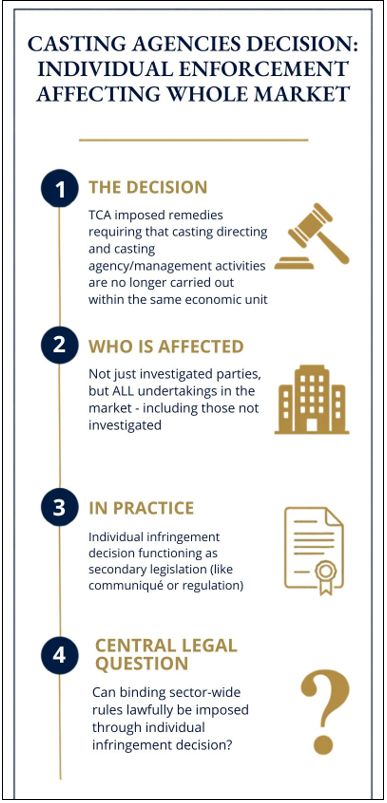
In the casting decision, however, what has emerged is something qualitatively different: Conduct rules of general application (a sector-wide incompatibility regime between three professional activities) have been introduced through an individual enforcement decision. The decision thus operates, in substance, as a piece of secondary legislation comparable to a communiqué or regulation, yet it has been adopted without the procedural safeguards that ordinarily attend instruments of general application. This raises a threshold question: Whether binding rules addressed to an entire sector can lawfully be imposed through an individual infringement decision, or whether such measures must, by their very nature, be promulgated through the regulatory instruments and procedures that the Competition Act specifically provides for that purpose.
Additionally, the decision carries significant implications, and raises equally significant questions, for the undertakings upon whom these sector-specific obligations are imposed. Undertakings that were not parties to the investigation had no opportunity to exercise rights of defence, to comment on the proposed measures or to participate in any market test; they will learn of obligations requiring them to restructure their corporate purpose from the publication of a reasoned decision on the Authority’s website, with three months to comply. The legal certainty implications are equally significant. Because the obligations derive from an investigation decision rather than from a regulatory instrument of defined scope, their precise contours, conditions of application and temporal limits remain uncertain for addressees who had no part in the proceedings and no access to the file. Beyond the immediate compliance burden of the companies within the sector, this raises the broader question whether undertakings active in any sector may now need to monitor infringement decisions addressed to their competitors with the same attention they devote to secondary legislation, and, if so, whether the procedural architecture of competition enforcement is equipped to bear that weight.
Part of a broader enforcement trend
The casting decision did not emerge in a vacuum. A series of recent Board decisions display a similar tendency for remedies to move beyond restoring the status quo ante and towards actively shaping market structures, a phenomenon recently examined by our team members at Bilgi University’s Competition Law in Practice Seminars under the title “Can the Turkish Competition Board Establish Rules of General Application Through Its Individual Decisions?”5
In Frito Lay6 (February 2025), the Board coupled a substantial fine with detailed behavioural remedies governing stand arrangements and financial benefits at retail outlets, the implementation of which Frito Lay must secure contractually vis-à-vis third-party sales points, in effect extending the decision’s discipline to parties outside the proceedings. In the third white meat7 investigation (September 2025), the behavioural remedies on the announcement and timing of price lists operate, in practice, as a market-wide compliance standard for the poultry sector. In Tetra Pak8 (August 2024), the Board went so far as to require the dominant undertaking to relinquish registered three-dimensional trademark and design rights and to withdraw pending applications. In Google9 (December 2024), the remedy obliges Google to offer third-party supply-side platforms conditions no less favourable than those applied to its own services; an ongoing, access-style obligation reminiscent of ex ante regulation. The Board’s commitment practice points in the same direction, from the separate-operation commitments accepted in the cinema sector in 2025 to the 2021 Philips decision reinstating obligations first imposed on the medical imaging market in 200910.
The Authority does not appear uncomfortable with this trajectory. Its leadership has publicly emphasised that the institution’s significance should not be measured by its fines alone, pointing to the regulatory dimension of its decisions and its interventions in business models as the more consequential part of its work11. The casting decision, with its industry-wide prohibition and the rule-like language of its public communication, may be the clearest expression of that self-understanding to date.
Why This Decision Matters
The casting decision matters because it crystallises, in a single enforcement action, a series of novel issues that Turkish competition and administrative law have not previously had occasion to address. The characterisation of the separation obligations within the taxonomy of Article 9 of the Competition Act, the procedural framework governing the imposition of conduct rules that apply across an entire sector, and the position of undertakings that were not parties to the investigation yet find themselves subject to obligations requiring them to restructure their corporate purpose within three months of publication; each of these points raises questions of first impression for Turkish enforcement practice.
As the broader enforcement trend surveyed above illustrates, the Board's remedial practice is developing rapidly across sectors. The casting decision thus stands as a signal that a single investigation may now produce obligations extending well beyond the investigated parties to an entire sector, with immediate practical significance for undertakings operating in concentrated or conflict-prone markets.
The reasoned decision has yet to be published, and once it is available, a more thorough assessment of the legal basis, proportionality and procedural soundness of the remedies can be undertaken. Whether the decision will be challenged before the administrative courts, and on what grounds, remains equally uncertain at this stage. What can already be said, however, is that the casting decision, situated at the intersection of competition enforcement, administrative law and the scope of remedial powers exercisable through individual adjudication, is poised to generate a rich body of discussion and scrutiny among competition law and administrative law practitioners alike.
Footnotes
1. Turkish Competition Authority, “The Investigation Conducted into the Casting Agencies Association and the Undertakings Operating in the Casting Agency/Management Sector Has Been Concluded”, announcement of 9 June 2026 (in Turkish), available at https://www.rekabet.gov.tr/tr/Guncel/kast-ajanslari-dernegi-ile-kast-ajansi-m-296e71ef0164f11193eb0050568549fa. The investigation was initiated by the Board’s decisions No. 24-53/1175-M of 12 December 2024 and No. 25-31/741-M of 14 August 2025; the final decision is dated 21 May 2026 and numbered 26-19/585-225.
2. Rekabet Haber (the Authority’s official news service), “Artık kast direktörlüğü ve kast menajerliği birlikte yapılamayacak” [“From now on, casting directing and casting management can no longer be carried out together”], 9 June 2026, available at https://haber.rekabet.gov.tr/haber/artik-kast-direktorlugu-ve-kast-menajerligi-birlikte-yapilamayacak.
3. Act No. 4054 on the Protection of Competition, Article 9, as amended by Act No. 7246 of 16 June 2020. The consolidated text (in Turkish) is available at https://www.rekabet.gov.tr/tr/Sayfa/Mevzuat/4054-sayili-kanun.
4. Council Regulation (EC) No 1/2003 of 16 December 2002, Article 7(1), available at https://eur-lex.europa.eu/legal-content/EN/TXT/?uri=celex%3A32003R0001. Under EU law, structural remedies may be imposed where there is no equally effective behavioural remedy or where an equally effective behavioural remedy would be more burdensome; Turkish law goes further and requires that behavioural remedies must first have been imposed and have demonstrably failed.
5. Ş. Ardıyok and N. Yaldır Ok, “Rekabet Kurulu Birel Nitelikteki Kararlarıyla Geneli Etkileyen Kurallar Koyabilir mi?” [“Can the Turkish Competition Board Establish Establish Rules of General Application Through Its Individual Decisions?”], presented at the Applied Competition Law Seminars (Uygulamalı Rekabet Hukuku Seminerleri), Istanbul, 2026 spring term; on the seminar series, see https://www.rekabetdernegi.org/. Video recordings of the presentations delivered in the previous programmes can be accessed at https://www.youtube.com/@RekabetHukukuMerkezi
6. Turkish Competition Board decision of 13 February 2025 numbered 25-06/152-78 concerning Frito Lay Gıda San. ve Tic. A.Ş.; available at https://www.rekabet.gov.tr/Karar?kararId=5b4c1c20-3a14-4cb9-a814-416a05a5fa85.
7. Turkish Competition Board decision of 18 September 2025 numbered 25-35/837-492 concluding the white meat (poultry) investigation; available at https://www.rekabet.gov.tr/Karar?kararId=d4c36fa7-ef4c-4f6f-8754-ce9e121899ab.
8. Turkish Competition Board decision of 15 August 2024 numbered 24-32/758-319 concerning Tetra Pak Paketleme San. ve Tic. Ltd. Şti. and Tetra Laval Holding & Finance SA; available at https://www.rekabet.gov.tr/Karar?kararId=6fe5fb88-8ff9-4579-abfc-63703441aa9a.
9. Turkish Competition Board decision of 12 December 2024 numbered 24-53/1180-509, concerning the Google/Alphabet economic unit; available at https://www.rekabet.gov.tr/Karar?kararId=682a68e4-ed54-465d-92a8-a220d107a739.
10. See, respectively, the Turkish Competition Board’s commitment decision of 14 August 2025 numbered 25-31/745-443, concerning CJ ENM/Mars in the cinema sector, and its decision of 26 August 2021 numbered 21-40/589-286 concerning Philips in the medical imaging and diagnostics market, which reinstated obligations comparable to those imposed in the decision of 18 February 2009 numbered 09-07/128-39. Both decisions are accessible through the Authority’s decisions database at https://www.rekabet.gov.tr/tr/Kararlar.
11. Please refer to the interview with Birol Küle, President of the Turkish Competition Authority, on A Para’s Economy Table program, particularly the section starting at 02:18, as published on the TCA’s official YouTube channel: https://www.youtube.com/watch?v=2aY2PL2-SH0&t=1s.
The content of this article is intended to provide a general guide to the subject matter. Specialist advice should be sought about your specific circumstances.

