

SENER ISSUES THE SECOND CALL FOR THE PRIORITY PROCESSING OF APPLICATIONS FOR ELECTRICITY GENERATION PERMITS AND INTERCONNECTION TO THE SEN1
On May 11, 2026, the Ministry of Energy (“SENER”) published in the Official Gazette of the Federation the “Second Call for the priority processing of applications for electricity generation permits and interconnection to the National Electric System, aligned with binding planning” (the “Second Call”).
Prior to the Second Call, on October 17, 2025, SENER published the first call, a transparent and streamlined process for interested parties to obtain an electricity generation permit from the National Energy Commission (“CNE”), as well as to obtain the corresponding interconnection studies from the National Energy Control Center (“CENACE”).
Through the aforementioned first call, the CNE granted 18 electricity generation permits for power plants expected to come online between 2027 and 2030. Based on the results obtained on the first call, SENER decided to issue this Second Call with the objective of prioritizing applications for electricity generation permits corresponding to projects that contribute to compliance with the binding planning of the electricity sector and the expansion objectives of the National Electric System (“SEN”).
In light of the foregoing, the following is an executive summary of the most relevant aspects of the Second Call and its implications for participants in the electricity sector:
A. Objectives and scope of the Second Call
Through the Second Call, SENER and the CNE will identify the electricity generation projects eligible to obtain electricity generation permits and interconnect to the SEN during the 2027–2030 cycle, based on criteria of reliability, energy sovereignty, social justice, environmental sustainability, and technological innovation.
This is in line with the Electricity Sector Development Plan (“PLADESE”), which sets out a long-term vision for the period 2025–2039, calling for the addition of 76,000 MW of new capacity and 1,800 MW of replacement, of which approximately 80% will come from clean technologies.
In this context, the Second Call aims to streamline and expedite the procedures for registration, evaluation, and monitoring of projects associated with applications for electricity generation permits that: (i) comply with applicable legal requirements; (ii) align with the binding planning of the electricity sector; and (iii) are developed in accordance with the technical and regulatory criteria set forth in the call itself.
It should be noted that the Second Call does not impose additional requirements beyond those established in applicable regulations but rather incorporates elements that will allow for differentiation among applications based on their technical soundness, their alignment with binding planning, and their technical and operational viability.
- Eligible Projects: The Second Call is aimed at electricity generation projects with a capacity of 0.7 MW or greater that intend to interconnect to the SEN, which must meet, among others, the following criteria: (i) align with the binding planning, including their location in the designated regions; (ii) use renewable energy; (iii) have an Battery Energy Storage System whose capacity represents at least 30% of the power plant’s capacity; (iv) provide for a commercial operation start date as early as possible within the period between 2027 and the first half of 2030; and (v) have documentary evidence of the procedures related to technical, social, and environmental feasibility filed with the competent authorities (i.e., SENER, CENACE, and SEMARNAT).
- Excluded Projects: Distributed Generation projects, Self-Consumption projects (in all its modalities), Cogeneration projects, projects developed under the Mixed Development Scheme, and those associated with generation permits granted prior to the publication date of the Second Call are expressly excluded.
- Electronic portals: The procedures set forth in the Second Call are managed through two electronic platforms: (i) the Single Window for Strategic Energy Sector Projects (“VUPE”), through which interested parties must register their expression of interest and submit their application for interconnection studies to CENACE; and (ii) the Electronic Registry Office (“OPE”), which is the exclusive channel for submitting applications for electricity generation permits and other related procedures before CNE.
B. Timeline for the Second Call
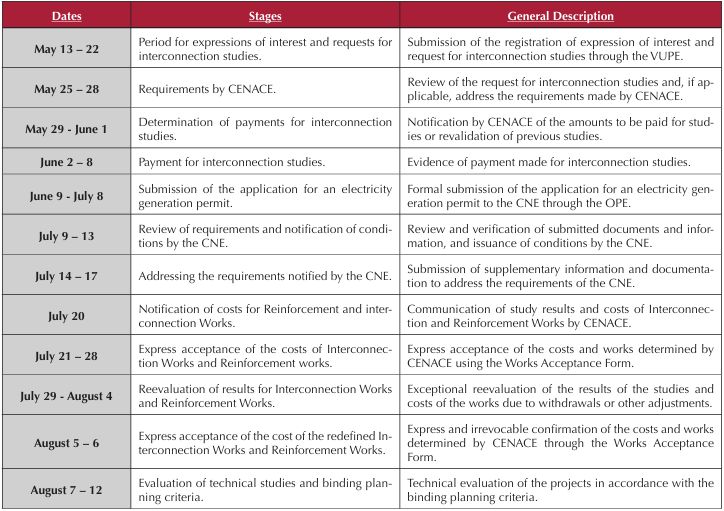
The Second Call establishes a specific timeline for each stage of the procedure, including the registration of expressions of interest, the submission of permit applications, the resolution of objections, the issuance of interconnection study results, the acceptance of Interconnection Works and Reinforcement Works, as well as the issuance of permits granted by the CNE.
Below is a summary of the dates and most relevant stages outlined in the Second Call:

- Obligations following the issuance of the permit. Once the permits for electricity generation have been issued under the Second Call, permit holders will be subject to compliance with various regulatory, technical, and operational obligations. Among the main obligations are the following:
- Submission of guarantees. Submission to CENACE of the corresponding financial guarantees related to the execution of Interconnection Works and Reinforcement Works.
- Signing of the interconnection contract. Execution of the corresponding interconnection contract, following the provision of the applicable guarantees.
- Execution of Interconnection Works and Reinforcement Works. Development and completion of the works determined by CENACE in accordance with the results of the interconnection studies.
- Compliance with the Works Program. Execution of the project in accordance with the deadlines and conditions established in the corresponding permit.
- Interconnection to the SEN. Carrying out the necessary actions to achieve the interconnection of the power plant to the SEN.
- Commercial Operation. Compliance with the technical, regulatory, and operational conditions necessary to achieve Commercial Operation within the deadlines set forth in the corresponding permit.
Footnote
1 Capitalized terms used in this document that are not expressly defined herein shall have the meanings assigned to them in the Second Call.
The content of this article is intended to provide a general guide to the subject matter. Specialist advice should be sought about your specific circumstances.
[View Source]





