Download a PDF copy of this Blog here.
"Costs" are awarded to successful litigants in tax litigation, as in most forms of litigation, but are not well understood by the public. Indeed, many litigants may head to the Tax Court of Canada (“TCC”) without first understanding the rules behind cost awards and without contemplating how these "costs" awards work when on the losing end of the litigation and/or appreciating that they may well be on the hook for the government’s legal bills when they do lose.
In this Tax Appeals Report, we break down some of the basics of TCC cost awards that prospective tax litigants should know.
The Basics
The TCC has discretion to award costs for matters heard under General Procedure Rules (used in larger cases) or Informal Procedure Rules (used in smaller cases).
Because costs are discretionary, they vary with each case.
Some variables the Court will generally look at are listed in the General Procedure Rules, and vary from who won in the proceeding, to how much was at issue, the importance of the issues, whether (and by whom) settlement offers were made, and the complexity and amount of work required. Ultimately, however, the TCC can and will make a costs decision that it sees fit.
Paying Costs to the Crown
Recent Federal Court of Appeal (“FCA”) jurisprudence in Aslam v. The King, 2026 FCA 44 (“Aslam”) demonstrates that an unsuccessful litigant will generally have to pay the government's legal costs, no matter their financial difficulties. Aslam disputed the costs he was ordered to pay the Crown after his unsuccessful 2024 appeal of a TCC’ decision denying him a charity-related tax credit. Aslam represented himself at each level of court and had lost. Once it reached the Assessment Officer (whose job is essentially to calculate the total bill after a judge has set the general framework for who will be awarded costs, and at what rate), Aslam argued that the financial and power imbalance between him and the Crown should be considered in setting the appropriate costs award.
The Assessment Officer disagreed, citing several past cases establishing that a losing party’s “limited resources” is entirely irrelevant to a cost assessment. A harsh procedural reality for self-represented taxpayers.
Successful Litigants Could Still Pay Costs!
Other procedural rules can result in surprising cost awards. For example, a successful litigant may still pay costs due to unreasonable conduct, or if they win an amount less than what the losing side had already offered as a settlement.
Takeaways
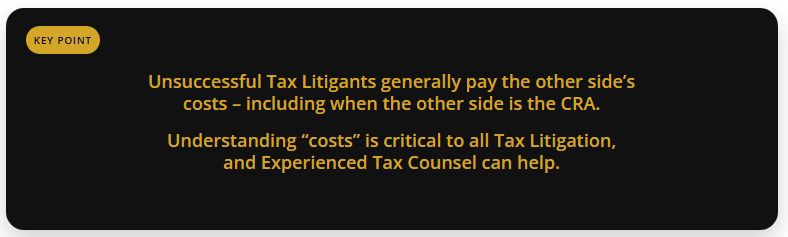
Costs are generally awarded to the winning side in tax litigation, even when the winning side is the CRA. Cost awards are also subject to multiple procedural rules, which can confuse results, even when a party has been successful.
Understanding "costs" is critical to all Tax Litigation, and Experienced Tax Counsel can help.
For help with Tax or Trade Appeals, please click here.
For an updated Index of our Tax Appeals Series, click here.
The content of this article is intended to provide a general guide to the subject matter. Specialist advice should be sought about your specific circumstances.
[View Source]