
Corporate Emigration Tax: At a Glance
If your corporation is planning to continue to another jurisdiction, or CRA has flagged a corporate continuance as part of a review, the stakes just increased. In Canada v. DAC Investment Holdings Inc., 2026 FCA 35, the Federal Court of Appeal confirmed that a continuance transaction structured mainly to shed Canadian tax status can be struck down under the general anti-avoidance rule (GAAR), layered on top of the departure tax and corporate emigration tax that already apply on a true emigration. Here is what changed and what it means for planning.
Corporate Emigration From Canada: Departure Tax and Corporate Emigration Tax Explained
When a corporation resident in Canada decides to emigrate, it triggers significant tax implications under Canadian tax law. Emigration for tax purposes involves the corporation being deemed to dispose of its property and reacquire it immediately afterward. Unlike individuals, corporations do not benefit from exclusions for certain types of property in this deemed disposition process.
This article explores the tax consequences of corporate emigration from Canada, the continuance rules that go with it, the Federal Court of Appeal’s 2026 decision in Canada v. DAC Investment Holdings Inc. applying the general anti-avoidance rule to corporate continuance, strategies to mitigate tax liabilities, and practical tips for effective tax planning.
How Departure Tax and Corporate Emigration Tax Apply to a Canadian Corporation
The departure tax is a critical aspect of Canadian tax law that applies when a corporation (or an individual) ceases to be a resident of Canada for tax purposes. Under subsection 128.1(4) of the Income Tax Act, this tax is triggered by the deemed disposition of the corporation’s property at fair market value immediately before departure. The gains or income resulting from this deemed disposition are subject to taxation under the Income Tax Act.
Under Canadian tax law, all property of the corporation is generally subject to the departure tax upon emigration. This includes tangible assets such as real estate and equipment, including cryptocurrencies, as well as intangible assets such as intellectual property rights and goodwill. Certain exemptions or deferral mechanisms may apply in specific circumstances, which should be carefully assessed with the guidance of tax professionals.
In addition to the departure tax, Canadian tax law imposes a separate corporate emigration tax. Under section 219.1 of the Income Tax Act, this tax is levied at a flat rate of 25% on the difference between the fair market value of all the corporation’s property and the sum of the paid-up capital for all shares, debts or payment obligations owed by the corporation (excluding dividends owed to shareholders), and amounts related to branch tax for prior tax years.
Under section 219.3, any additional tax on non-resident corporations that may otherwise apply under section 219.1 is subject to possible reduction by an applicable tax treaty, unless one of the main purposes of the emigration was to reduce tax under Part I or Part XIII of the Act.
If the corporation was incorporated in Canada after April 26, 1965, emigration also requires continuing the corporation under the corporate law of the destination jurisdiction, under subsection 250(5.1) of the Act. Once continued, the corporation is deemed to have been incorporated in that other jurisdiction from the time of continuation, and tax-treaty tie-breaker rules must also be considered.
See also: Canadian Controlled Private Corporation: Canadian Tax Lawyer Analysis
A separate point worth flagging for shareholders: Canadian-resident shareholders generally do not have a deemed disposition of their shares, and the shares’ adjusted cost base is unaffected, when the corporation itself continues to another jurisdiction. This is confirmed in CRA Ruling 2005-0147131R3 (“Continuance — Subdivision i”), which rules that a continuance does not, in itself, result in a disposition of the corporation’s assets, liabilities, or of any share of the corporation held by its shareholder.
The DAC Investment Holdings Decision: GAAR Now Reaches Corporate Continuance
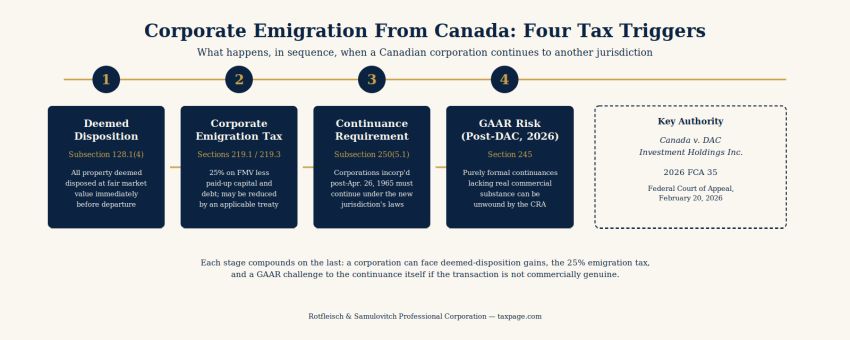
Figure: The four sequential tax triggers of Canadian corporate emigration, culminating in GAAR risk under the 2026 DAC Investment Holdings decision.
Corporate continuance planning became materially riskier following the Federal Court of Appeal’s decision in Canada v. DAC Investment Holdings Inc., 2026 FCA 35, released February 20, 2026. The case did not involve a full change of tax residence — the corporation’s central management and control stayed in Ontario — but it turned on the same continuance mechanism, subsection 250(5.1), that a Canadian-incorporated corporation must use whenever it truly emigrates.
The corporation had been a Canadian-controlled private corporation (CCPC). Shortly before disposing of shares with a significant accrued gain, it continued from Ontario to the British Virgin Islands. Under subsection 250(5.1), the continuance deemed the corporation to be incorporated outside Canada, so it ceased to be a “Canadian corporation” and, in turn, no longer qualified as a CCPC. It then reported the resulting capital gain as a non-CCPC private corporation, avoiding the refundable tax on investment income under section 123.3 and accessing the general rate reduction under section 123.4.
The Tax Court of Canada had sided with the taxpayer, reasoning that Parliament created distinct tax regimes for different categories of corporations and that a taxpayer may legitimately reorganize to move between them. The Federal Court of Appeal reversed, holding that the general anti-avoidance rule applied. The FCA found that the continuance was a purely formal step, taken with no meaningful change in the corporation’s economic or commercial circumstances, undertaken solely to circumvent the CCPC anti-deferral regime in sections 123.3 and 123.4 — and that this frustrated the object, spirit, and purpose of those provisions and of subsection 250(5.1) itself.
The decision matters well beyond its specific facts. It signals that the CRA and the courts will look past the legal form of a continuance to the underlying economic substance, whether the continuance is used to shed CCPC status, to change tax residence outright, or as one step in a larger reorganization. A number of similar CCPC-continuance appeals remain in the pipeline, so this is an area to watch, not a closed question.
See also:
- Federal Court of Appeal Strikes Down CCPC Continuance Planning Under GAAR in Canada v. DAC Investment Holdings Inc.: Guidance from Canadian Tax Lawyer
- Tax Court Shuts Down Foreign Continuance Loophole: Lessons from Somerset Limited v The King, 2026 TCC 123
Practical Implications for Canadian Corporations
For a corporation actually planning to emigrate — as opposed to a narrower continuance used only to change regimes — the combination of departure tax, the 25% corporate emigration tax, and now heightened GAAR scrutiny of continuance transactions means the analysis has to go beyond the mechanical tax calculation. CRA and the courts will ask whether the continuance reflects a genuine change in the business, or whether it is a paper step timed around a transaction to obtain a tax result Parliament did not intend.
“The DAC decision doesn’t close the door on corporate continuance, but it does close the door on treating continuance as a pure paper exercise. If a corporation is genuinely relocating its operations, that’s still sound planning. If the continuance is really just there to change which tax regime applies right before a sale, the Federal Court of Appeal has now said clearly that GAAR can unwind it.”
— David J. Rotfleisch, Certified Specialist in Taxation Law (Law Society of Ontario).
This does not mean legitimate emigration or reorganization planning is off the table. Pre-emptive disbursement of retained earnings, amalgamation or rollover transactions under sections 85 to 87, and share-for-share exchanges under section 85.1 remain available tools.
What has changed is the margin for error: transactions that are purely formal, without a corresponding change in commercial reality, are now more exposed to a GAAR challenge even where they technically comply with the specific provisions in play.
Strategies to Minimize Tax Liability
Effective tax planning is crucial for minimizing the tax liability associated with corporate emigration from Canada. Several strategies can be employed, each with its own benefits and considerations.
Pre-emptive Disbursement
One strategy is for the corporation to pre-emptively disburse its retained profits to shareholders before emigration, converting assets into cash distributed to shareholders and reducing the tax base exposed on emigration. This requires careful consideration of dividend tax implications, particularly for amounts distributed beyond the paid-up capital, and of the shareholders’ own residency and applicable treaties.
Transferring Assets via Amalgamation or Rollover
Amalgamating with another corporation or using rollover provisions under sections 85 to 87 of the Income Tax Act can defer tax liabilities until a later date. This is particularly useful for preserving tax attributes such as capital losses or surplus profits within the corporate structure, provided the transaction satisfies the legal requirements of the applicable federal or provincial business corporation legislation and reflects genuine commercial purpose rather than form alone.
Share for Share Exchange
Under section 85.1 of the Income Tax Act, a share for share exchange allows shareholders to transfer their shares in one Canadian corporation to another taxable Canadian corporation without triggering immediate tax consequences, deemed to occur at the adjusted cost base of the shares. This can be advantageous for shareholders holding controlling interests, allowing them to transfer ownership and control while maintaining an economic interest through shares in the intermediary entity.
See also: Thin Capitalization Rules
The Paragraph 88(1)(d) Bump in an M&A Context
In a non-arm’s-length M&A structure, it may be possible to reduce the tax arising on the subsection 128.1(4) deemed disposition using a bump in tax cost under paragraph 88(1)(d) of the Act.
A common structure runs as follows: a non-resident parent forms a Canadian acquisition corporation (Acquireco); Acquireco purchases all the shares of a Canadian target corporation (Target); Target and Acquireco then amalgamate, and the tax cost of the property Target held is increased, up to fair market value, under paragraph 88(1)(d); and the resulting corporation continues into another jurisdiction.
For this planning to be effective, the accrued capital gains within Target must be associated with non-depreciable property, such as land or shares, and the bump-denial rules must not be engaged. Note that the initial share sale to Acquireco is itself a taxable disposition for the vendors, so this strategy is best suited to a genuine M&A transaction rather than a standalone emigration plan, and the sequencing and documentation matter as much as the mechanics given the heightened GAAR scrutiny discussed above.
“The 88(1)(d) bump is a legitimate, well-established tool, but it only works if every step is done in the right order for the right commercial reason. Structuring it backward from the tax result, rather than forward from an actual transaction, is exactly the kind of planning DAC tells us to be careful about.”
— David J. Rotfleisch, Certified Specialist in Taxation Law (Law Society of Ontario).
Takeaway
Navigating the tax implications of corporate emigration from Canada requires careful planning that now goes beyond the mechanics of departure tax and the corporate emigration tax. The DAC Investment Holdings decision confirms that a continuance lacking real commercial substance can be unwound under GAAR even where it technically complies with the specific provisions involved.
Understanding the departure tax, the corporate emigration tax, the continuance requirement under subsection 250(5.1), and the GAAR risk that now attaches to continuance transactions, and employing effective tax planning strategies such as pre-emptive disbursement, asset transfer through amalgamation or rollover, share for share exchanges, and the section 88(1)(d) bump in an M&A context, allows corporations to optimize their tax positions while managing audit risk.
Consulting with tax professionals before implementing any of these steps can provide valuable insight and ensure compliance with Canadian tax law throughout the emigration process.
Pro Tax Tips
- Effective tax planning for corporate emigration in Canada requires meticulous timing and expert advice, and that advice now has to account for the DAC decision as much as the underlying tax calculation.
- Initiating tax planning well in advance allows a corporation to capitalize on available deferral strategies and to build a genuine commercial record supporting the continuance or reorganization, not just a favourable tax outcome.
- Consulting with experienced Canadian tax lawyers before a continuance is implemented, rather than after CRA raises questions, ensures compliance with complex tax rules and materially reduces the risk that a later GAAR challenge succeeds.
Frequently Asked Questions (FAQs)
What triggers departure tax for a Canadian corporation?
Departure tax is triggered under subsection 128.1(4) of the Income Tax Act when a corporation ceases to be a resident of Canada for tax purposes. The corporation is deemed to have disposed of its property at fair market value immediately before departure, and any resulting gains are taxable.
How is the corporate emigration tax under section 219.1 calculated?
It is calculated at 25% of the excess of the fair market value of all the corporation’s property over the total of the paid-up capital of its shares, outstanding debt (excluding dividends owed to shareholders), and any prior branch-tax amounts.
Can the 25% corporate emigration tax rate be reduced?
Yes. Under section 219.3, the rate can be reduced under an applicable tax treaty, unless one of the main purposes of the emigration was to reduce tax under Part I or Part XIII of the Income Tax Act.
Does a corporation need to continue under the law of another jurisdiction to emigrate?
If the corporation was incorporated in Canada after April 26, 1965, yes. Subsection 250(5.1) requires it to continue under the corporate law of the destination jurisdiction, at which point it is deemed incorporated there from the time of continuation.
Do shareholders face tax consequences when their corporation emigrates?
Generally no. CRA Ruling 2005-0147131R3 confirms that a continuance does not, by itself, result in a disposition of the corporation’s assets or of the shares held by its shareholders, and the shareholders’ adjusted cost base is unaffected.
How did the DAC Investment Holdings decision change the risk of continuance planning?
In Canada v. DAC Investment Holdings Inc., 2026 FCA 35, the Federal Court of Appeal held that a continuance undertaken purely to shed CCPC status ahead of a share disposition, without any real change in commercial circumstances, was abusive tax avoidance under GAAR. It signals that continuance transactions generally will be tested against economic substance, not just legal form.
Does GAAR apply even if a continuance technically complies with the Income Tax Act?
Yes. GAAR under section 245 can apply where a transaction technically complies with specific provisions of the Act but frustrates their object, spirit, and purpose. DAC shows that a technically compliant continuance can still be unwound if it lacks genuine commercial substance.
Can pre-emptive dividends reduce departure tax exposure?
Distributing retained profits to shareholders before emigration can reduce the property base subject to departure tax, but the distribution itself may trigger dividend tax consequences depending on the amount distributed and the shareholders’ residency and applicable treaties.
What reporting obligations apply after a corporation emigrates from Canada?
The corporation must file final tax returns reflecting the deemed disposition, disclose the emigration to the CRA, and meet all related compliance requirements. Failing to comply can result in penalties and additional tax liabilities.
Are there deferral options for corporations that cannot pay departure tax immediately?
Certain deferral mechanisms may be available in limited circumstances, including through rollover provisions or amalgamation transactions, but eligibility depends heavily on the specific facts and should be assessed with professional tax advice.
What is the section 88(1)(d) bump and when does it apply to corporate emigration?
It is a mechanism used in a non-arm’s-length M&A structure that increases the tax cost of a target corporation’s property up to fair market value on an amalgamation, reducing the gain otherwise realized on the deemed disposition when the resulting corporation continues to another jurisdiction. It applies only where the accrued gains relate to non-depreciable property and the bump-denial rules are not engaged, and it is best suited to a genuine M&A transaction rather than a standalone emigration plan.
Should a corporation consult a tax lawyer before continuing to another jurisdiction?
Yes. Given the departure tax, the corporate emigration tax, and the GAAR exposure confirmed in DAC, a corporation should obtain tax advice before implementing a continuance, not after the CRA has raised questions about it.
Can a Canadian corporation avoid both departure tax and corporate emigration tax entirely?
It is difficult to avoid these taxes entirely, but strategic planning can defer them or reduce their impact through pre-emptive disbursement, amalgamation or rollover transactions, and share for share exchanges, provided the planning reflects genuine commercial substance.
Published: July 2, 2024
Last Updated: August 19, 2026