

Businesses in NSW that use, or are considering the use of, digital work systems will need to plan ahead in response to the new Work Health & Safety (WHS) duties relating to technology, currently before NSW Parliament.
Expected to pass in the new year, the Work Health and Safety Amendment (Digital Work Systems) Bill 2025 (NSW) (Bill) reflects a growing regulatory focus on the psychosocial risks associated with algorithmic management and workplace surveillance. If enacted, the Bill will require employers to more closely examine how their digital work systems affect employee health and safety, particularly in relation to workload, monitoring and decision-making.
The new framework: What businesses need to know
The Bill introduces specific duties requiring Persons Conducting a Business or Undertaking (PCBUs) to ensure that the use and allocation of work by a 'digital work system' are without risks to health and safety. A 'digital work system' is broadly defined as an algorithm, AI, automation or online platform. Common digital tools, which are likely to fall within this definition include automated rostering and performance tracking software.
Importantly, the Bill clarifies that core WHS duties apply to the technology itself. This means that the law treats the algorithm, AI, or the automated scheduler not just as a piece of equipment, but as a system of work that the PCBU must actively design, monitor and control to prevent harm, just like any other hazard in the workplace.
Under the proposed framework, the PCBU must ensure that outputs generated by the relevant digital work system does not result in:
- unreasonable workloads
- excessive performance metrics or tracking
- excessive monitoring or surveillance
- discriminatory practices.
How the new WHS duties could apply in practice
The main challenge for businesses in complying with the proposed WHS obligations lies in interpreting the ambiguous legal terms, such as what constitutes 'unreasonable workloads' or 'excessive monitoring & metrics'. To illustrate how these duties could apply in your workplace, we outline some scenarios below:
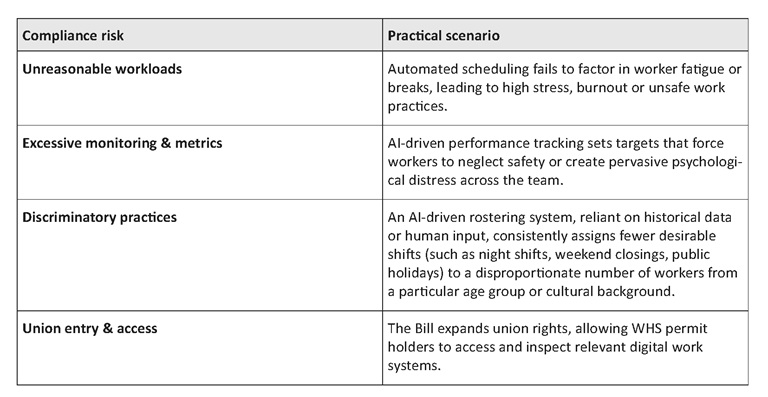
How to prepare your business for the new WHS duties
Meeting your existing 'reasonably practicable' WHS obligation requires forward planning, including integrating the new duties relating to digital work systems into your business's existing WHS framework.
To prepare, businesses may consider the following steps:
- identify and assess digital risks: Map out all relevant digital work systems that could be captured by the proposed legislation (e.g. AI, automated scheduling, performance tracking) and conduct a targeted psychosocial risk review to identify compliance gaps, particularly concerning unreasonable workloads and discriminatory outcomes
- integrate systems and controls: Update your WHS management system and policies to document controls for digital risks. Establish clear protocols for managing new duties, such as mandatory consultation with workers on digital systems, and prepare for the expanded right of entry and inspection for WHS permit holders
- training and governance: Ensure HR, managers and system owners understand how to use the relevant systems responsibly, comply with officer due diligence obligations in relation to digital risks, and make defensible decisions regarding what constitutes "unreasonable" or "excessive" system use.
If you would like to discuss how the new WHS duties mayimpact your business, or need assistance implementing the essential changes ahead of the new duties becoming law, please contact us here.
This publication does not deal with every important topic or change in law and is not intended to be relied upon as a substitute for legal or other advice that may be relevant to the reader's specific circumstances. If you have found this publication of interest and would like to know more or wish to obtain legal advice relevant to your circumstances please contact one of the named individuals listed.

