

As artificial intelligence (AI) transforms healthcare and life sciences, how can regulation keep pace with innovation while maintaining high standards of safety, accountability and transparency? From diagnostics and clinical decision-making to drug discovery and operational efficiency, AI technologies are advancing rapidly, creating both significant opportunities and new regulatory challenges.
Two recent initiatives from the Medicines and Healthcare products Regulatory Agency (MHRA) provide important insight into how the UK is seeking to address these challenges: its Call for Evidence on the future regulation of healthcare AI and AI sandbox to accelerate medicines development and improve safety, which allows innovative technologies to be tested in real-world settings. Together, they offer an early view of the UK's emerging regulatory framework for healthcare AI.
Here, we take a look at the key themes emerging from both initiatives and what they mean for those involved in developing, deploying or investing in AI-enabled technologies. Focusing on what matters most as businesses strive to gain early mover advantage in this market, we highlight the regulatory trends organisations should be preparing for now as the UK evolves its approach to AI in healthcare.
What should the future regulatory framework for healthcare AI look like?
When the MHRA issued its 'Call for Evidence' last December on the regulation of AI in healthcare it provided a window of opportunity for both the public and all interested stakeholders to contribute views. Key areas it sought perspectives on to inform the recommendations of the National Commission into the regulation of AI in healthcare were:
- whether current rules are sufficient;
- how safety should be assessed once AI is in real‑world use;
- how responsibility and liability should be allocated across developers, users and providers; and
- what principles should guide a modernised regulatory regime.
It received a strong response with 761 individuals and organisations sharing their views and expertise to help. The resulting report, published in June, identifies ten key findings to inform the MHRA's final recommendations to the National Commission into the Regulation of AI in healthcare.
The overarching message is that healthcare AI requires a regulatory framework that differs from those designed for areas such as traditional medical devices. Stakeholders consistently highlighted that existing frameworks are not well suited to adaptive, AI systems that can evolve after deployment. The regulatory framework for AI in healthcare needs to be safe, fast and trusted – one that keeps pace with the speed of developments in this space, while maintaining safety, accountability and public confidence.
The ten key findings:
- Regulation must be proportionate and lifecycle based
The regulatory approach should be lifecycle-based, risk-proportionate and balance innovation with patient-safety. The consensus was that it should be flexible enough for iterative and adaptive AI systems, providing clear guidance and with oversight extending throughout the product lifecycle.
- A consensus for significant regulatory reform
While a 'complete overhaul' isn't needed, findings highlight the current framework requires substantial changes to better accommodate AI and digital technologies – particularly given the adaptive nature and potential for ongoing change after deployment.
- Strengthen continuous post-market surveillance and monitoring
An ongoing and continuous approach is important to track performance, monitor safety and manage compliance. AI systems should also be monitored throughout their use in real-world settings to identify performance drift, emerging risks and safety concerns over time.
- Clarify and share responsibility across the AI ecosystem
A comprehensive approach to accountability is needed to address current gaps and to ensure accountability is distributed across the lifecycle and is proportionate. Views highlighted the importance of having clarity over roles and liability.
- Retain human oversight and clinical judgment
AI should support the work of healthcare professionals and not be fully responsible for clinical decision making. Human involvement in care and the checking and validation of decisions involving AI by a human clinician is crucial.
- Improve trust, transparency and explainability
Users, providers and patients need clearer information about how AI systems work, their limitations, and how decisions or recommendations are generated – integral to helping build trust, enabling deployment and ensuring the safe use of these systems. AI systems should not operate in a 'black box'.
- Address data access, governance and public concerns
Respondents recognised that healthcare data is both an enabler of AI and a barrier to the development and use of AI systems in healthcare. Areas for improvement included stronger governance, clearer standards, and safeguards around consent, privacy and the commercial use of NHS data.
- Build AI literacy and workforce capability
Ongoing training is needed for clinicians, managers and governance teams to ensure AI is deployed and monitored safely and effectively. It was noted that a lack of AI-specific training can bring increased risk of automation bias.
- Improve incident reporting and organisational learning
There is a need for standardised mechanisms to report AI-related errors, adverse events and performance issues, enabling faster identification of systemic risks. Clearer guidance on how incident reporting works and even a national reporting system for AI incidents is also proposed.
- Prioritise patient engagement, trust and communication
Public trust was identified as a critical enabler of AI adoption. Respondents emphasised transparency (see finding 6 above), clear communication, informed consent and meaningful patient involvement in decisions about AI use.
What is the MHRA AI sandbox and why does it matter?
Alongside policy development, the MHRA has launched a new AI sandbox, designed to help accelerate medicines development and improve safety – giving companies and researchers a controlled testing ground to work with regulators and explore how AI tools might support this goal.
Announced in June, the initiative allows innovators to explore AI models that predict how medicines behave in the body and assess how clinical data can support safety and regulatory decision-making. It will also generate insights to inform future regulation.
The sandbox's value extends beyond supporting innovation. It allows regulators, developers and healthcare organisations to work together to better understand how AI technologies perform in real-world settings and where existing regulatory frameworks need to adapt. It also shows the UK is at the forefront of tackling these tough questions, and will give companies the confidence to invest in innovation here.
This is one of several AI-focused sandboxes that the MHRA is currently involved in. There is also, for example, the AI Airlock, which is the MHRA's regulatory sandbox for AI as a medical device (with a phase three of the programme currently being designed) and the London Region I sandbox. The latter is a collaboration between the MHRA, NHS England and the London Health Innovation Networks to accelerate innovations that will address key challenges facing London's health and care system. It is designed to safely test AI-enabled devices in a real-world environment, so that patients can benefit more quickly.
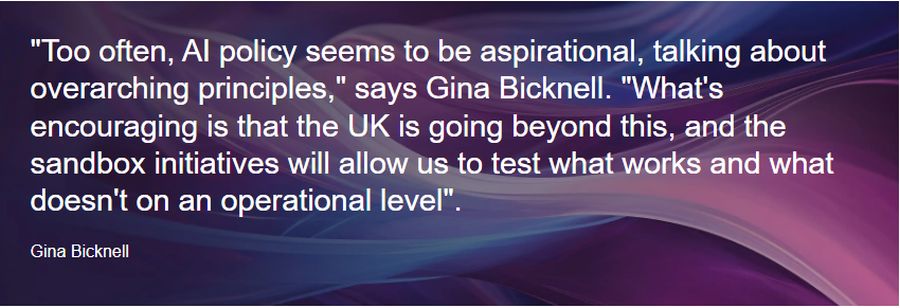
Bicknell remarks that hand-in-hand with the help the sandbox will provide to businesses and research organisations is a wealth of new guidance, particularly in the public sector.
For example, the NHS has an AI knowledge repository containing a wealth of practical guidance notes and templates for organisations navigating AI adoption in health and care settings.
For businesses, the sandbox offers an opportunity to engage directly with regulators, test assumptions, identify compliance challenges and help shape future requirements.
How regulatory reform and real-world testing are shaping AI regulation
The AI sandbox will support the Government's AI for Science Mission One to speed up drug discovery and ensure safe, effective, treatments reach patients faster – a key priority within the UK's 10-Year Health Plan. Its focus closely reflects themes emerging from the MHRA's Call for Evidence, particularly the need for ongoing monitoring, transparency and accountability.
Together, these developments point to a more adaptive approach to AI regulation – moving beyond one-off regulatory approvals and ensuring ongoing monitoring in real-world settings. Findings from the Call for Evidence stressed the importance of understanding how AI performs after deployment, particularly where systems may learn, adapt, or behave differently across clinical environments.
For businesses, this means demonstrating not only that AI products are safe and effective at launch, but that they remain so in practice. Strong governance, clear accountability and transparency around how AI systems operate and manage risk are likely to become regulatory expectations. Overall, the direction is towards principles-based regulation – focusing less on measurable end‑states and more on the qualities and values that should inform decision making.
From the authors' perspective, the UK's approach of allowing AI regulation to be shaped and applied by existing sector regulators, rather than the EU's approach of codifying detailed requirements through the EU AI Act, has allowed for flexibility that is already benefiting industry and, ultimately, patients. This adaptability enables the UK's framework to keep pace with fast-evolving AI technologies without waiting for lengthy legislative reform.
The MHRA's report suggests a 'complete overhaul' of the existing regulatory framework is not needed but rather adaptation to better address AI-specific risks, provide clarity and proportionality. The direction of future regulation is likely to see a focus on continuous oversight, evidence generation and accountability throughout the product lifecycle.
What will happen next? The findings from the Call for Evidence will be considered alongside wider research to inform the MHRA's recommendations on the future regulatory framework later this summer. It will then work with the health system, regulators and government to consider implementation.
What healthcare, medtech and digital health businesses should be doing now
While the final regulatory framework is still being developed, several practical priorities are already emerging for innovators and developers of AI systems to note.
- Build governance into product development
Organisations should consider accountability, transparency, risk management and human oversight from the outset and across the AI supply chain.
- Strengthen evidence generation strategies
Businesses should be thinking beyond initial validation and considering how they will generate and maintain evidence of performance throughout a product's lifecycle.
- Plan for post-market monitoring
Future regulatory expectations are likely to include continuous monitoring, incident reporting and performance assessment in real-world settings. Organisations should begin building the systems and capabilities required to support this.
- Review transparency and communication practices
Developers should be prepared to explain how their systems work, what data they use, their limitations and how risks are managed. Greater transparency is likely to become both a regulatory expectation and a commercial differentiator.
- Engage early with regulators and healthcare stakeholders
Organisations that engage early with regulators, healthcare providers and policymakers will be better placed to understand emerging expectations and influence future frameworks.
If you'd like to explore what these changes will mean for your business or to discuss other sector developments impacting your organisation, contact Gina Bicknell or Robert Breedon in our Life Sciences & Healthcare team.
How ready are you for the UK's emerging healthcare AI framework?
The UK is moving towards a more agile, proportionate and evidence-based approach to healthcare AI regulation. The MHRA's Call for Evidence highlights growing consensus around the need for lifecycle oversight, real-world evidence, shared accountability and greater transparency, while the AI sandbox is helping regulators and industry understand how these principles should operate in practice.
For healthcare AI developers, medtech companies, digital health businesses and investors, preparing for the future regulatory framework should be viewed as a priority. Those that begin building robust governance, evidence-generation and monitoring capabilities today will be best placed to navigate the next phase of healthcare AI regulation and bring innovative products to market with confidence.
Read the original article on GowlingWLG.com
The content of this article is intended to provide a general guide to the subject matter. Specialist advice should be sought about your specific circumstances.
[View Source]
