

Every few months, I find myself in a familiar conversation with a foreign investor who is approaching a French transaction for the first time. They have done cross-border deals before, and have done their research. They usually arrive with a version of the same assumption: that France is more complicated than it needs to be, that the regulatory environment is from a different era, and that with the right advisors, the complexity can be “figured out.”
The first part of that assumption is not wrong. France can certainly be complicated. The second part, that the complexity can be worked around rather than worked through, is where deals typically run into trouble.
After more than fifteen years of advising foreign investors in the French market, I’ve learned that the companies and investors who do best here are not the ones who diminish France’s regulatory requirements. They are the ones who understand the regulations well enough to build them into their strategy from the beginning.
A Lingering Apprehension
To France’s credit, the investment environment has markedly improved in the past decade. Recent reforms have simplified certain administrative processes, and the French tech, healthcare, and sustainability sectors have produced a generation of entrepreneurs and executives who’ve grown comfortable working with international investors and their respective expectations.
In turn, foreign investors have become more sophisticated about France. They’re no longer surprised by works councils, and the foreign investment control regime, which requires prior authorization for acquisitions in sensitive sectors, is now anticipated and factored into deal timelines by experienced investors.
What continues is a lingering apprehension about French labor law and regulatory complexity that I see revealed in two distinct ways:
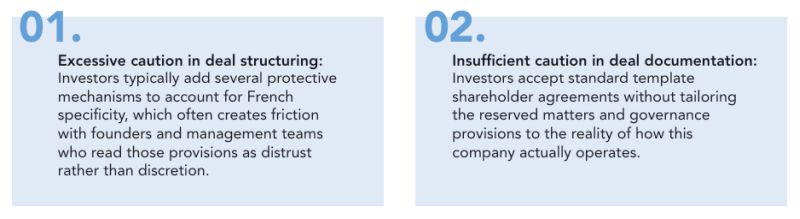
Both errors are avoidable with the right preparation.
Where Deals Are and What They Require
The sectors driving the most meaningful French M&A activity right now reflect a specific moment in France’s industrial and technological development. Strategic defense has seen significant uptick, driven by European rearmament dynamics and France’s position as one of the continent’s primary defense industrial bases. Healthcare and life sciences continue to generate transactions, from early-stage biotech to established medical device companies. AI and data infrastructure, including cloud, data centers, and the companies building the technical capacity to support them, are attracting major investor interest, including from US technology companies that see France as a meaningful European beachhead.
Each of these sectors carries its own regulatory issues. Defense transactions are subject to foreign investment controls that often require advance engagement with French authorities. This can, in some cases, significantly affect deal structure and timeline. Works council consultation requirements apply to any transaction involving a change of control, regardless of sector. If not properly sequenced into the deal timeline, they can delay closing or create employee relations issues that outlast the transaction itself.
None of this is restrictive, but all of it requires planning.
Governance and Documentation Discipline That Matters
The single most consistent source of post-closing friction I see in French transactions is shareholder agreement drafting that did not account for how the company would actually operate. Reserved matters lists, typically provisions that require investor approval before management can take certain actions, are frequently drafted from a standard template rather than tailored to the target company’s operating context.
The end result is predictable:
- Founders who need investor approval to make routine decisions that no reasonable investor would actually want to block
- Investors who are called for approvals they did not anticipate
- A governance dynamic that creates tension where the deal was supposed to create alignment
Getting this right at the term sheet stage costs very little, but getting it wrong compounds across the life of the investment.
The same principle applies to who specifically will represent the investor on the board after closing. Investors often confirm which fund is investing without confirming which individual from that fund will be in the room. Personality mismatches between board representatives and founding teams are one of the most underappreciated sources of venture friction.
It is a question worth asking before the documents are signed, not after.
Why This Matters, and How Cohen & Gresser Can Help
France represents a growing opportunity for foreign investors who are willing to engage with a market on its own terms. The sectors driving French M&A activity today, such as defense, healthcare, AI, and data infrastructure, are areas where France’s industrial and regulatory environment creates advantages for companies and investors who understand it well.
Cohen & Gresser’s Paris office brings deep experience advising foreign investors and multinationals on French transactions, from initial market entry and regulatory navigation through shareholder agreement structuring, works council management, and post closing governance. We are a firm built around long-term client relationships rather than individual transactions, not just the closing.
If you are evaluating a French investment, considering your first transaction in the market, or navigating a deal that has become more complex than anticipated, we would welcome the conversation
The content of this article is intended to provide a general guide to the subject matter. Specialist advice should be sought about your specific circumstances.
[View Source]