
Overview
Canadian tax law asks, over and over again, whether two people are “related.” The answer decides whether a home purchaser can claim the GST/HST New Housing Rebate, whether two corporations must share a single small business deduction limit instead of each claiming their own, and whether income shifted to a family member gets attributed back to the person who really earned it.
What most people do not realize is that all of these questions, and many more scattered across the Income Tax Act and the Excise Tax Act, trace back to the exact same statutory definition, and that definition is considerably narrower than most people’s everyday sense of “family.”
Background – The Statutory Definition of “Related Persons”
Subsection 251(6) of the Income Tax Act defines when individuals are connected by blood relationship, marriage, v partnership, or adoption, and subsection 251(2) uses that definition to determine when two people, or a person and a corporation, are “related” for purposes of the Act generally. The Excise Tax Act imports this same Income Tax Act definition by reference for GST/HST purposes.
The blood relationship branch is the one that catches people off guard. Under paragraph 251(6)(a), two individuals are connected by blood relationship only if one is the child or other descendant of the other, or if one is the brother or sister of the other. That is the entire test. It does not extend to aunts, uncles, nieces, nephews, cousins, or any more distant relation, no matter how close the actual family relationship is in practice. The marriage branch extends this same narrow blood-relationship test to a spouse: someone is connected by marriage to their spouse’s blood relatives under the same restrictive definition, which is how a sister-in-law can become “related” to her spouse’s sibling’s spouse, while an aunt remains unrelated to her niece under the same provision.
There is one narrow exception worth flagging. The Income Tax Act’s extended meaning of “child” in subsection 252(1) includes a child of the taxpayer’s spouse or common-law partner, among other categories. A stepchild who falls within that extended meaning is treated as a child of the stepparent for purposes of the blood relationship test, even without any actual blood tie, which means a stepchild is not automatically excluded the way a niece or nephew is. Outside that kind of extended relationship, however, the CRA’s own position, set out in Income Tax Folio S1-F5-C1, confirms that a niece, nephew, aunt, uncle, or cousin is simply not connected to the individual under the Act.
Relatedness also has a start and an end date, and the two branches of the definition do not end the same way. A common-law partnership ceases to exist for tax purposes once the couple has lived separate and apart because of a breakdown in the relationship for a period of at least 90 days, at which point they stop being related as spouses under this test. A legal marriage works differently: separated spouses remain related to each other for as long as the marriage remains legally intact, even through a lengthy separation, and only an actual divorce ends the relationship. A married couple who has been separated for years, but never divorced, is still related for purposes of this definition, while a common-law couple separated for only three months is not.
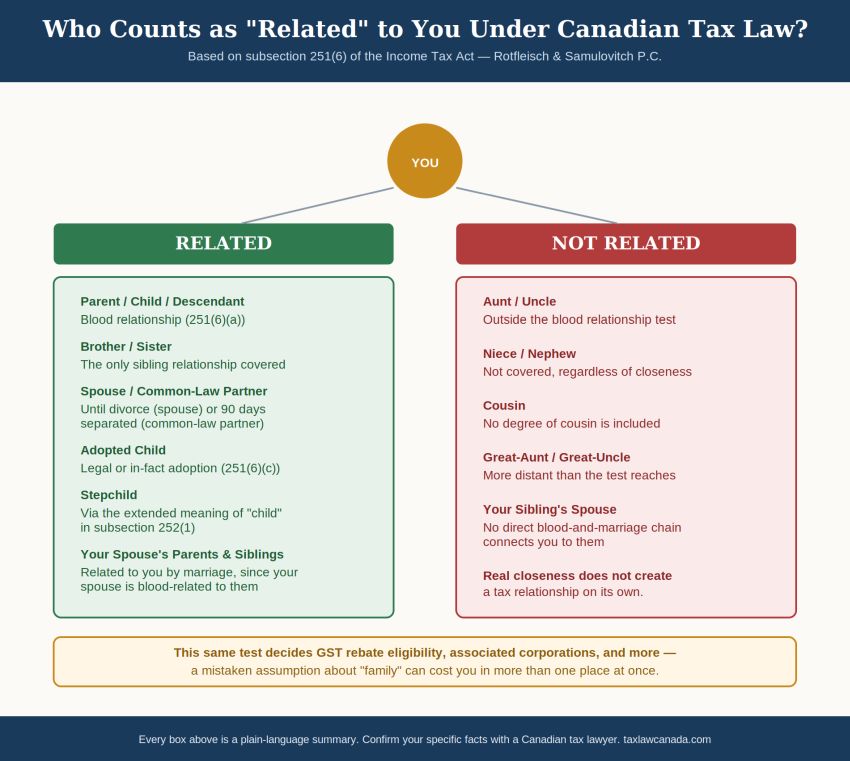
Figure: Who counts as “related” under subsection 251(6) of the Income Tax Act.
Where This Definition Actually Shows Up
The GST/HST New Housing Rebate
The GST/HST New Housing Rebate is available where a purchaser, or “a relation of” the purchaser, will use the home as a primary residence. Because “relation” imports the same section 251(6) test, a purchaser who adds an aunt, uncle, niece, or nephew to a purchase agreement to help secure financing, without that person qualifying for the rebate independently, can lose the entire rebate. This is exactly what happened in Gay-Ann Reeves v The Queen, 2021 TCC 74, where the Tax Court held that an aunt who co-signed to help with financing was not a qualifying relation, and in Her Majesty the Queen v Cheema, 2018 FCA 45, where a friend who signed purely as a bare trustee to help with financing was held to the same standard, since the rebate conditions apply to every signatory, not only the one who intends to occupy the home. Our companion articles on the GST/HST New Housing Rebate and the bare trustee problem and on Reeves and the co-signing relative problem cover this specific trap, and the broader rebate rules, including the 2026 first-time buyer enhancements under Bill C-4, in much more depth than this general overview can.
Associated Corporations and the Small Business Deduction
The same related-persons test is also the foundation for two distinct corporate concepts that are worth telling apart. Two corporations are “related” to each other where the same person, or group of related persons, has de jure control, meaning legal, voting control, of both. “Associated” corporations are a narrower, more consequential category: it captures related corporations but also extends to certain situations involving de facto control, meaning actual influence over a corporation’s affairs even without a formal majority of voting shares, and it is associated status specifically, not merely being related, that forces two corporations under section 125 of the Income Tax Act to share a single small business deduction limit rather than each claiming their own. Where a person who controls one corporation is related, under the same section 251(6) test, to a person who controls another corporation, and certain ownership thresholds are met, the two corporations will generally be associated.
The small business deduction reduces the federal corporate tax rate on up to $500,000 of active business income per year, and that $500,000 limit is a single, shared number across an entire associated group, not a separate $500,000 for each corporation. A group of three associated corporations does not get $1,500,000 of reduced-rate room between them; they divide up the same $500,000, however they choose to allocate it among themselves. That allocation has to be made formally, using Form T2SCH33, Agreement Among Associated Canadian-Controlled Private Corporations to Allocate the Business Limit, filed under subsection 125(3); only one corporation in the group needs to actually file it, but the allocation shown must be consistent across every associated corporation’s return. Skipping this filing does not simply default to an even split among the associated corporations; under subsection 125(2), the business limit for every corporation in an associated group that has not filed a valid agreement is reduced to nil, eliminating the small business deduction entirely for all of them until a valid Schedule 23 is filed. Our article on the consequences of failing to file a valid business limit allocation agreement covers this risk in more depth.
The limit is also reduced on a straight-line basis once the associated group’s combined taxable capital employed in Canada exceeds $10 million, disappearing entirely at $15 million, and separately reduced where the group’s combined adjusted aggregate investment income exceeds $50,000, disappearing at $150,000. A business owner who structures multiple corporations around family members assuming a broader, more intuitive sense of “family” than the statute actually uses can be surprised to learn that a cousin’s corporation is not associated with theirs under this test, while a sibling’s corporation is, and that the sibling’s corporation’s income can meaningfully erode the shared deduction room in a way the cousin’s corporation’s income never would.
Our guide to qualifying for the small business deduction covers the associated corporations rules in more detail, and our broader guide to the small business deduction covers the taxable capital and passive investment income grind-downs and how they interact with the associated corporations rules.
Ontario’s Employer Health Tax
The associated corporations concept is not limited to the federal small business deduction. Ontario’s Employer Health Tax exempts a portion of an employer’s payroll from the tax, but associated employers, determined using the same underlying related-persons framework, must share a single exemption amount rather than each claiming their own, the same structural mechanic as the small business deduction. This can catch business owners by surprise in ways that go beyond simple sibling-versus-cousin scenarios. In one illustration used by the Ontario government, a woman’s aunt served as the sole trustee of a family trust, and because the woman’s adult children were beneficiaries of that trust, the shares the trust held in one business were deemed, under a specific attribution rule for trusts, to be owned by each of those children as well.
Since one of those children also controlled a second business, the two businesses ended up associated with each other, and had to share a single Employer Health Tax exemption, even though the connection ran through a trust and an aunt who was never herself related to anyone else in the structure. A corporate group should not assume its exposure to this kind of associated-employer sharing is limited to the more obvious cases of siblings or spouses controlling separate companies.
A related but separate concept, “affiliated persons” under section 251.1 of the Income Tax Act, applies a narrower test again for specific purposes such as certain loss-restriction rules, layering yet another definition on top of the related and associated tests rather than replacing either of them.
Income Splitting and the Attribution Rules
Canada’s attribution rules, which can reattribute income or capital gains back to the person who transferred property to a family member, generally turn on the same related-persons concept, extended in some provisions to a broader list of family members but still built on the same statutory core. A taxpayer relying on the definition of “related” to decide whether an income-splitting arrangement will hold up, without checking the specific provision’s own scope, risks assuming a family member is covered when the rule in question does not actually reach that relationship, or vice versa. Our articles on the tax attribution rules and specialized attribution rules cover how these rules apply to spouses, minors, and trusts.
Even Customs Valuation Uses the Same Test
The same Income Tax Act definition of related persons is imported by reference into Canada’s customs valuation rules under the Customs Act, where it helps determine whether the price paid between a buyer and seller can be relied upon for duty purposes or must instead be tested against an arm’s-length benchmark. A business importing goods from a family-owned supplier abroad is subject to the same blood-relationship test that determines GST rebate eligibility and associated corporation status, illustrating just how far this one definition reaches across otherwise unrelated areas of Canadian law.
The Definition Reaches Beyond Tax Law Entirely
This same statutory test even governs a professional conduct rule for lawyers. Ontario’s Rules of Professional Conduct generally prohibit a lawyer from acting for both a lender and a borrower in the same real estate transaction, but carve out an exception where the two clients are “related persons” as defined in section 251 of the Income Tax Act. A real estate lawyer determining whether that exception is available is applying the identical blood-relationship test that decides a GST rebate claim or an associated corporations question, which shows this is not simply a tax-law curiosity but a definition that surfaces in professional regulation as well.
A Contrast: Toronto’s Vacant Home Tax Does Not Use This Test at All
Not every occupancy-based rule imports this narrow definition, and Toronto’s Vacant Home Tax is a useful contrast to keep in mind precisely because it looks so similar on the surface.
A Toronto property avoids the tax if it is occupied as a principal residence for at least six months of the year, by the owner, a tenant, or simply a friend or family member, with no requirement that the occupant fall within the section 251(6) definition at all. A property loaned to a cousin, a niece, or a close friend to live in full-time can qualify for this exemption just as readily as one occupied by a sibling, because the City’s test asks only whether someone genuinely lives there as their own home, not whether that person is “related” to the owner in the Income Tax Act sense.
Anyone relying on a family or friend occupying a Toronto property to avoid the tax should not assume the GST rebate’s narrower family test has any bearing on this exemption, since the two rules are built on entirely different foundations despite both turning on a personal relationship to the property. Our guide to Toronto’s Vacant Home Tax covers the exemption categories, deadlines, and audit and appeal process in more detail.
The Opposite Surprise: The Canada Caregiver Credit Is More Generous
Every example so far involves a family relationship being narrower than expected. The Canada Caregiver Credit runs the other way. The CRA’s own definition of a qualifying dependant for this credit explicitly includes your, or your spouse’s or common-law partner’s, aunt, uncle, niece, or nephew, alongside the more obvious parent, grandparent, sibling, and child, provided that person depends on you for the basic necessities of life and resided in Canada at some point in the year. A taxpayer who has internalized the narrower section 251(6) definition from a GST rebate purchase or a corporate structuring exercise, and assumes the same boundary applies to every family-related credit, could wrongly conclude that supporting a niece or nephew does not qualify for anything, when in fact this specific credit was deliberately drafted to reach further than the core related-persons test does.
Practical Implications
Because the same narrow definition recurs across so many unrelated provisions, a mistake made assuming a broader, more intuitive sense of “family” can surface in more than one place at once. A business owner who incorporates separate companies for a sibling and a cousin, believing both to be equally “family,” may find the sibling’s corporation associated with theirs while the cousin’s is not, with real consequences for the small business deduction, since the sibling’s income now erodes a shared $500,000 limit that the cousin’s income never touches. A purchaser co-signing a home purchase with a niece or nephew to help with financing faces the identical blood-relationship boundary that a corporate reorganization or an income-splitting plan would face, even though the three scenarios have nothing else in common.
The reverse mistake is just as costly, and it cuts both ways: assuming a rule like Toronto’s Vacant Home Tax carries the same family restriction can needlessly discourage letting a cousin or friend occupy a property, while assuming the Canada Caregiver Credit is limited the same way the GST rebate is can cause a taxpayer to miss a credit they were always entitled to claim for a niece or nephew. It is also worth remembering that “related persons” is only one of the ways a relationship can fail the Act’s arm’s-length test; the Act separately addresses certain personal trusts and their beneficiaries, and unrelated persons can still be found, on the specific facts, not to deal with each other at arm’s length even though none of the related-persons categories apply to them.
Takeaway
Whether two people are “related” for Canadian tax purposes almost always comes back to the same statutory core: blood relationship limited to descendants and siblings, extended through marriage, common-law partnership, or adoption. This definition, not an intuitive sense of family closeness, governs eligibility for the GST/HST New Housing Rebate, whether corporations or employers must share a small business deduction or payroll tax exemption, and how the attribution rules treat transfers to family members, among other areas. It does not, however, govern everything with a family flavour to it: the Canada Caregiver Credit deliberately reaches further than this core test, and Toronto’s Vacant Home Tax does not use it at all. Confirming the actual statutory relationship, and the actual test the specific provision in question uses, before relying on it, in any of these contexts, is worth doing before a transaction closes rather than after the CRA disagrees.
Pro Tax Tips
- Before relying on a family relationship in any tax-planning context, whether a home purchase, a corporate structure involving multiple family members, or an income-splitting arrangement, confirm whether that specific relationship actually falls within the blood relationship, marriage, common-law partnership, or adoption categories in subsection 251(6), rather than assuming a close family relationship is automatically enough.
- Where a plan depends on two people being treated as either related or unrelated, get that specific question confirmed before the transaction closes, since correcting a structure after the fact is generally far more difficult than structuring it correctly from the outset.
- If a CRA reassessment turns on whether you and another person are related, whether in the context of a denied rebate, an associated corporations determination, or an attributed amount, the specific facts of the relationship and the specific provision at issue both matter, and a Canadian tax lawyer should review both before you respond.
“People assume ‘family’ is a single, common-sense concept that means the same thing everywhere in the tax system, and that assumption gets expensive,” says David J. Rotfleisch, founding tax lawyer and CPA at Rotfleisch & Samulovitch, and a Law Society of Ontario Certified Specialist in Taxation. “The same narrow test shows up in a home purchase, a corporate reorganization, and an income-splitting plan, and it draws the line in a place most people don’t expect. An aunt is not a sibling. A cousin is not a brother or sister. Those distinctions sound almost too technical to matter, until they’re the reason a rebate gets denied or a small business deduction gets split in half. People also forget that being ‘related’ has a start date and, sometimes, an end date, and the two family-status branches don’t end the same way,”
“A common-law relationship stops counting after 90 days apart. A marriage keeps counting through years of separation, right up until an actual divorce. We’ve seen clients structure a plan around a spouse they’ve been separated from for years, without realizing that separation alone never ended the relationship for tax purposes. Getting the timing wrong is just as costly as getting the family relationship itself wrong.”
FAQ
What is the legal test for whether two people are “related” under Canadian tax law?
Under subsection 251(6) of the Income Tax Act, individuals are connected by blood relationship only if one is the child or other descendant of the other, or if one is their brother or sister. This is extended to a spouse’s blood relatives through the marriage branch of the same definition, and separately to common-law partners and adopted children.
Does this definition include aunts, uncles, nieces, and nephews?
No. The blood relationship test is limited to descendants and siblings. Aunts, uncles, nieces, nephews, and cousins fall outside the definition entirely, regardless of how close the family relationship is in practice.
Why does it matter whether my aunt or uncle is considered “related” to me?
Many tax rules, including the GST/HST New Housing Rebate and the associated corporations rules for the small business deduction, turn on this exact statutory definition. If a rule requires a “relation” or “related person” and your aunt or uncle does not meet the definition, a tax benefit that depends on that relationship can be denied even though the family relationship itself is genuine.
Can my aunt or uncle co-sign my new home purchase without affecting my GST/HST rebate?
Only if your aunt or uncle also independently satisfies the rebate conditions, since every signatory to the purchase agreement must meet them. In Gay-Ann Reeves v The Queen, 2021 TCC 74, the Tax Court denied the rebate because the purchaser’s aunt, who co-signed to help with financing, did not qualify as a relation and did not occupy the property herself.
What does “related persons” have to do with corporate tax planning?
Two corporations can be treated as “associated” for purposes of the small business deduction where the people who control them are related under this same test. Associated corporations must share a single $500,000 small business deduction limit rather than each claiming their own, and that shared limit is further reduced once the group’s combined taxable capital or passive investment income crosses certain thresholds, which can significantly increase the combined corporate tax bill of a family business structured across multiple companies.
Does Toronto’s Vacant Home Tax use the same “related persons” test?
No. The Vacant Home Tax exemption for occupancy by someone other than the owner applies to any tenant, friend, or family member who genuinely lives in the property as their own principal residence for at least six months, with no requirement that the occupant be a “related person” under the Income Tax Act at all. A cousin or friend living in the property qualifies just as well as a sibling.
Does the associated corporations concept apply to anything besides the small business deduction?
Yes. Ontario’s Employer Health Tax uses the same associated-employer framework to require related businesses to share a single payroll exemption rather than each claiming their own. The connection between two businesses can arise in less obvious ways than direct sibling or spousal control, including through a family trust whose beneficiaries are deemed to own shares the trust holds.
Are any family-related tax credits broader than the aunt/uncle/niece/nephew exclusion?
Yes. The Canada Caregiver Credit is a notable exception that runs the opposite direction from most of the rules discussed in this article: its definition of a qualifying dependant explicitly includes an aunt, uncle, niece, or nephew, provided that person depends on you for the basic necessities of life. Do not assume the narrower GST/HST or corporate definition of “related” limits this credit the same way.
Does the attribution rules definition of “related” work the same way?
The attribution rules are built on the same core concept but are not identical to the GST/HST or associated corporations tests in every respect; some provisions extend to a broader list of family members. The specific attribution provision at issue needs to be checked on its own terms rather than assuming the GST/HST or corporate definition applies automatically.
Is a sister-in-law considered “related” to me under this test?
Potentially yes, through the marriage branch of the definition, since you can become connected by marriage to your spouse’s blood relatives. This is a narrower and more specific rule than a general sense of in-laws being “family,” so it should be confirmed on the specific facts rather than assumed.
Is a stepchild treated the same as a niece or nephew, or excluded the same way?
Neither, exactly. A stepchild generally falls within the Income Tax Act’s extended meaning of “child” under subsection 252(1), which means a stepchild is treated as the stepparent’s child for purposes of the blood relationship test, unlike a niece or nephew, who is not connected under the Act at all absent some other qualifying relationship.
Does a separation end a spousal relationship for tax purposes the same way it ends a common-law one?
No, and the difference matters. A common-law partnership ends for tax purposes once the couple has lived separate and apart because of a relationship breakdown for at least 90 days. A legal marriage does not end this way at all; separated spouses remain related to each other until an actual divorce, no matter how long the separation lasts.
If two of these tax rules disagree about whether someone is “related” to me, which one applies?
Each provision has to be checked on its own terms. The Excise Tax Act generally imports the Income Tax Act’s definition for GST/HST purposes, but other provisions, including some of the more specialized attribution rules, extend to a different or broader group of relatives. The fact that you are treated as related for one purpose does not automatically mean the same is true for another.
Does this definition apply outside of income tax and GST/HST?
Yes. The same Income Tax Act definition of related persons is imported into Canada’s customs valuation rules to help determine whether a transaction price between a buyer and seller can be relied upon for duty purposes, and it even defines an exception to a professional conduct rule that otherwise prevents a lawyer from acting for both sides of a real estate transaction, which shows how broadly this single definition is used across otherwise unrelated areas of law.
Should I get legal advice before relying on a family relationship in a tax plan?
Given how often this exact, narrow definition trips people up across very different contexts, from home purchases to corporate structuring to income splitting, it is generally worth confirming the specific relationship against the specific provision at issue with a Canadian tax lawyer before finalizing a transaction or a corporate structure, rather than after the CRA disagrees with the assumption.
The content of this article is intended to provide a general guide to the subject matter. Specialist advice should be sought about your specific circumstances.
[View Source]