- within Insolvency/Bankruptcy/Re-Structuring and Strategy topic(s)
- with Senior Company Executives, HR and Inhouse Counsel
- with readers working within the Banking & Credit, Healthcare and Law Firm industries
Canada is well-positioned to become a leading global supplier of LNG as the demand for reliable sources of natural gas surges around the world. Canada is the world’s fifth-largest producer of natural gas but ranked 19th out of 24 countries in exporting LNG in 20251. This will change as Canadian LNG production ramps up over the coming years. Many countries are looking to diversify their supply of LNG, making Canada’s secure, stable and long-term resources increasingly attractive.
Current and proposed Canadian LNG facilities
LNG Canada in Kitimat, BC, is currently Canada’s lone export facility and began operations in June 2025. It has a full capacity of 14 million tonnes per year but could increase to 15 million through operational efficiencies. The proposed Phase 2 expansion would double production. It was one of the first projects referred to Canada’s Major Projects Office (MPO), and a final investment decision on Phase 2 is expected by the end of 2026.
The proposed $30B Ksi Lisims LNG Facility was referred to the MPO in November 2025. It will become the country’s second-largest LNG facility if constructed, with a capacity of 12 million tonnes per year. Two other LNG export facilities are currently under construction—Cedar LNG in Kitimat and Woodfibre LNG near Squamish.
In the US, eight LNG export terminals have opened since 2016, and eight more have been approved and are under construction. The US has been the world’s top LNG exporter for the past three years and became the first ever to ship out more than 100 million tons of LNG in 20252.
2025 total LNG exports, in millions of tonnes
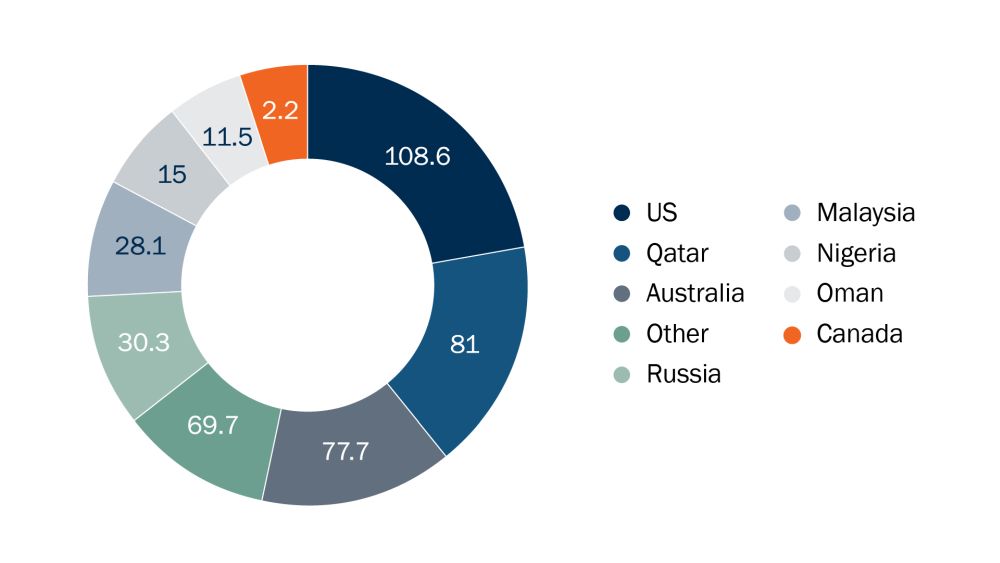
The Globe and Mail. Source: Institute for Energy Economics and Financial Analysis. Based on Kpler data.
Recent developments are bolstering demand
Geopolitical developments have removed 20% of the world’s supply of oil and LNG from global markets, creating new opportunities for Canada to expand its LNG presence on the global stage. Prices have surged, and in Europe, natural gas prices are predicted to be 40% higher than previously projected for 2026 and should stay elevated through 20273. The physical flow of LNG supply is shifting, with many shipments being rerouted from Europe to Asia. Accordingly, LNG Canada has ramped up exports to Asia as global supplies have tightened4.
Government support for LNG keeps building
The broad shift in tone among governments across Canada in support for oil, gas, and infrastructure projects continues to build in 2026. At a meeting of the Standing Committee on Natural Resources in February, Minister of Energy and Natural Resources Tim Hodgson outlined how Canada can become a top global exporter of LNG. “If we deliver as we hope to, proponents will ultimately increase our production to as much as 100 million tonnes per annum. That would make us one of the largest suppliers of LNG in the world”5. Minister Hodgson pointed out that Japan, Korea, China, and India all want Canadian LNG, making 2026 a potential turning point for the country’s LNG market.
Pipeline development
Since last year, pipeline development has been back in the national conversation, and there will continue to be an ongoing need for increased pipeline capacity as Canada’s LNG sector grows. As Canada rolls out federal and provincial initiatives to speed up regulatory and approval timelines, project proponents could see more investment into major projects, such as gas pipelines, to help secure domestic energy supplies and compete as a major exporter. Further, Budget 2025 outlined additional incentives for LNG projects in the form of (1) tax incentives for the expensing for gas manufacturing or processing buildings and (2) accelerated capital cost allowances for low-carbon LNG facilities6. Taken together, the momentum for gas pipeline development is building, creating new incentives and opportunities to accelerate Canada’s production and export of this natural resource.
Footnotes
1. The Globe and Mail, “Canada’s second chance in the global LNG race”, March 13, 2026.
2. Bloomberg, “Global 2025 LNG Exports Saw Biggest Jump in Three Years, Kpler Says”, December 29, 2025.
3. Bloomberg, “Europe Faces High Gas Prices Through 2027, HSBC Says”, March 16, 2026.
4. The Globe and Mail, “LNG Canada sharply boosts exports to Asia as global supplies tighten”, March 17, 2026.
5. House of Commons Standing Committee on Natural Resources, Evidence (45-1) – No. 24, February 12, 2026.
6. Government of Canada, Canada Strong: Budget 2025, November 2025.
The content of this article is intended to provide a general guide to the subject matter. Specialist advice should be sought about your specific circumstances.