- with Senior Company Executives, HR and Finance and Tax Executives
- in Canada
- with readers working within the Accounting & Consultancy industries
FCA: BEFORE CONSTITUTIONAL RIGHTS ASSERTED, NORMAL PROCESS TO BE FOLLOWED
Our Indirect Tax Practice often involves the intersection of Indigenous Peoples’ rights, especially under sections 87-89 of the Indian Act, and tax legislation.
Below, we review Zachary v. Canada, 2026 FCA 55 (“Zachary”), a recent Federal Court of Appeal (“FCA”) decision ruling that despite the substantive rights afforded by the Indian Act and constitutionally to Canada’s Indigenous Peoples, Status Indians are still required to comply with all “procedural” requirements (e.g. time requirements, Notices of Constitutional Questions, etc.) in the applicable taxing legislation before asserting those substantive rights!
The Original Tax Court Decision
The FCA decision affirmed the lower decision of the Tax Court of Canada (“TCC”), Zachary v. The King, 2024 TCC 8 .
The taxpayer, a Registered Indian, applied for an extension of time to object to his tax assessments years after the limitation period had expired. He argued that his constitutional and treaty protections exempted him from the procedural rules of the Income Tax Act.
The TCC dismissed the application entirely on jurisdictional grounds. It ruled that the taxpayer failed to serve the mandatory Notice of Constitutional Question required to even raise such a challenge. More importantly, the TCC reinforced that even when asserting fundamental constitutional or treaty rights, ALL taxpayers, including Status Indians, must comply with the strict statutory limitation periods and prerequisites for filing objections.
At the FCA
The FCA unequivocally affirmed the TCC’s decision, highlighting that strict adherence to procedural compliance is required – no matter the taxpayer, and no matter the importance of the case.
The FCA agreed that, because he failed to serve the essential Notice of Constitutional Question, the taxpayer was now entirely barred from raising his constitutional question regarding the legislative applicability of the tax rules on Status Indians.
While Zachary deals with an income tax case, the FCA’s decision relied heavily on a past GST case, Horseman v. Canada, 2018 FCA 119 , which essentially stands for the same proposition: statutory time limits in tax legislation must be strictly obeyed, even in cases where a party is asserting fundamental Indigenous constitutional and treaty rights. NO exceptions can be granted to the procedural rules laid out by statute; if not complied with, a Court simply has no jurisdiction.
Navigating Strict Procedural Rules
Procedural rules and strict statutory deadlines are among the most common, yet unforgiving, hurdles taxpayers face when litigating in Tax Court. As the Zachary case illustrates, even taxpayers with profound constitutional arguments will have their matter dismissed if a statutory deadline is missed.
Experienced Tax Counsel can help navigate these complex rules to avoid these common pitfalls – as well as put together the best possible substantive case. Important applications like the one in Zachary should be heard in Court – not tossed in the dustbin.
Takeaways
Canada has a long history of protecting its Indigenous Peoples from taxation – both under sections 87-89 of the Indian Act and under Canada’s Constitution.
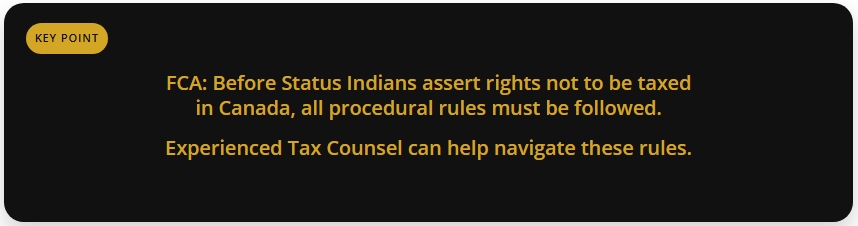
In a recent decision by the FCA, the Court has confirmed that before these substantive rights can be asserted, ALL procedural rules must first be followed! Experienced Tax Counsel can help navigate those rules and make sure important cases get a proper hearing in Court.
Download a PDF copy of this Blog here.
The content of this article is intended to provide a general guide to the subject matter. Specialist advice should be sought about your specific circumstances.
[View Source]