

Duane Morris Takeaway: This week’s episode features Duane Morris partners Jerry Maatman, Jennifer Riley, and Greg Tsonis with their discussion of Duane Morris’ Hospitality Class Action Review, highlighting several trends and developments shaping class action litigation in this sector – from the increase in filings to the sophistication of claims brought on behalf of workers and consumers – and best practices for hospitality companies.
Check out today’s episode and subscribe to our show from your preferred podcast platform: Spotify, Amazon Music, Apple Podcasts, Podcast Index, Tune In, Listen Notes, iHeartRadio, Deezer, and YouTube.
Episode Transcript
Jerry Maatman: Welcome, listeners. Thank you for being here for our weekly podcast series, The Class Action Weekly Wire. I’m Jerry Maatman, a partner at Duane Morris, and I’m pleased to be joined today by my colleagues and partners, Jennifer Riley and Greg Tsonis, who are both members of the Duane Morris Fashion, Retail, and Consumer Branded Products Industry Group. Welcome, Jen and Greg.
Jennifer Riley: Thanks, Jerry, happy to be here.
Greg Tsonis: Thanks for having me, Jerry.
Jerry: Today on the podcast, we’re discussing publication of a brand-new desk reference, the Duane Morris Hospitality Class Action Review. Listeners can find the e-book publication on our blog, the Duane Morris Class Action Defense Blog. Greg, can you tell our listeners a little bit about this new publication?
Greg: Absolutely, Jerry. So, Duane Morris released the second in a series of industry-focused class action publications, the Hospitality Class Action Review for 2026. This publication analyzes the key related rulings and developments in 2025, and the significant legal decisions and trends impacting class action litigation in this industry for 2026. We hope that the companies and employers out there will benefit from this resource in compliance with these evolving laws and standards.
Jerry: Well, certainly class action litigation seems to be on the rise across many industries, but especially for the hospitality industry. Jen, what’s driving that trend?
Jennifer: You’re absolutely right, Jerry. The hospitality industry has grown rapidly over the past decade, but with that growth comes some complexity. Hotels, restaurants, resorts – they all operate in a highly complex space, dealing with overlapping laws: employment laws, consumer protection, data privacy, accessibility – you name it. Those overlapping obligations can create some fertile ground for systemic issues, which is exactly what the plaintiff’s class actions lawyers are hoping to leverage.
Jerry: So, it’s just not more lawsuits, it’s the type of industry sometimes that lends itself to susceptibility to class action litigation.
Jennifer: Exactly. When you have large groups of employees or customers potentially affected by the same practice, class action litigation becomes a very efficient tool for the plaintiffs.
Jerry: Greg, let’s talk about the numbers. What are we seeing in terms of filings these days?
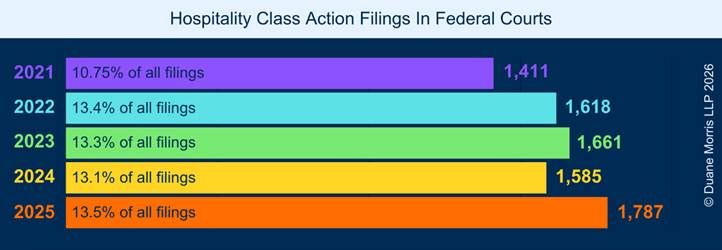
Greg: Well, the growth is pretty striking, Jerry. In 2025 alone, there were 1,787 class action filings in federal courts involving hospitality companies. That’s up from about 1,585 in 2024. And these cases span across traveler accommodations, food service, and drinking establishments.
Jerry: That’s quite a significant jump in year-after-year analytics. What sorts of claims are we talking about here when we’re focusing on the hospitality industry?
Greg: Well, on the employment side, wage and hour claims really dominate. We’re seeing allegations of unpaid overtime, improper tip pooling, and employee misclassification. These are classic issues in hospitality, especially given the reliance on hourly workers and tipped employees.
Jerry: Well, I know, Jen, you argued and won the signal tip credit case involving the hospitality industry before the Seventh Circuit a few years ago. Are these issues new, or are they just getting more attention these days?
Jennifer: Well, Jerry, I think it’s a bit of both. These issues have been around for a long time, but enforcement and awareness have really increased. Plus, plaintiffs’ attorneys are being more aggressive in bringing representative claims, especially when they see patterns across locations or franchises.
Jerry: But it’s just not employees, right? Customers are getting involved, too, in class action litigation?
Greg: Absolutely. So, consumer-facing class actions are growing very quickly. We’re seeing cases involving hidden fees, like resort fees, misleading advertising, and even data breaches. With so much business happening online now, these risks have expanded quite a bit.
Jerry: Let’s focus on that for a minute. How has technology changed this class action landscape?
Jennifer: Technology has introduced a whole new category of exposure. Digital booking platforms, mobile apps, and loyalty programs all collect and store customer data. If that data isn’t properly protected, it can lead to large-scale privacy claims. And because the effective group can be huge, those cases are often brought as class actions.
Jerry: So, what we’re seeing is more digital the business, the bigger the potential risk in this space?
Jennifer: That’s right, convenience for customers often means increased responsibility and potential liability for businesses.
Jerry: Greg, what about accessibility? That seems to be another growing area of risk.
Greg: It is, Jerry. We’re seeing more class claims alleging noncompliance with disability access requirements, particularly related to websites and online booking systems. If a platform isn’t accessible to individuals with disabilities, it can trigger significant legal exposure.
Jerry: Let’s shift our focus to the structure of the industry. Hospitality businesses often operate differently than other industries, with franchising, high turnover, multiple locations. How does that impact litigation risk in this space?
Jennifer: I think it really amplifies it. Franchising models can create complicated questions about liability. Who’s responsible, the franchisor or the franchisee? High employee turnover makes consistent compliance harder, and multi-jurisdictional operations mean businesses have to navigate different laws in different states, which really increases the risk of missteps.
Greg: And from a litigation standpoint, those factors Jen talked about really make it easier to argue that an issue’s widespread enough to justify class treatment.
Jerry: Well, class actions against any business can be devastating, but when it comes to the hospitality industry, I would imagine reputational brand stakes are pretty high on the radar screen.
Jennifer: Very high. Hospitality is a customer-centric industry. A class action, especially one involving consumer issues, can quickly damage a brand reputation. Even before a case is resolved, that publicity alone can have real business consequences.
Jerry: So, given all these risks, what should companies be doing in this day and age to protect themselves?
Greg: Well, first, I would say proactive compliance is key. Doing regular audits of wage and hour practices, having clear policies around tips and classification, and really staying up to date with evolving laws can go a long way.
Jennifer: I would add that companies need to invest in data security and privacy protections. That includes not just technology, but also training employees on proper data handling. And don’t overlook accessibility, both physical and digital.
Jerry: What about legal strategy? If a company does get hit with a class action, what should they keep in mind?
Greg: Early assessment of the case, I think, is critical. Understanding the scope of the claim, the potential class size, and the legal vulnerabilities can really help shape the defense strategy. In some cases, early resolution might make sense. In others, it’s worth fighting class certification.
Jennifer: And documentation matters. Having clear records, whether it’s payroll data, customer disclosures, or compliance efforts, those can make a huge difference in defending these cases.
Jerry: As we wrap up this edition of the Class Action Weekly Wire, any final thoughts, Jen and Greg, where this trend is heading?
Jennifer: I think we’ll continue to see growth in class actions, particularly as regulations and laws evolve and technology becomes even more integrated into hospitality operations.
Greg: Absolutely agreed. I think the key takeaway is that this isn’t a passing trend. It’s a fundamental part of the legal landscape now, and businesses really need to adapt accordingly.
Jerry: Well, thank you, Jen and Greg, for being here today, and for your thought leadership in this space, and thank you to our loyal listeners for tuning in. Please stop by our blog for a free copy of the Hospitality Class Action Review e-book.
Greg: Thank you for having me, Jerry, and thank you, listeners.
Jennifer: Thanks so much, everyone.
Disclaimer: This Alert has been prepared and published for informational purposes only and is not offered, nor should be construed, as legal advice. For more information, please see the firm's full disclaimer.
[View Source]

