

This detailed guide to ILR explains what it is, the benefits, ILR eligibility, how to apply, fees and processing times
Are you looking to settle in the UK permanently? Indefinite leave to remain (ILR) is the immigration status that allows you to live in the UK without a time limit.
If you currently hold a temporary visa and want to remain in the UK on a long-term basis, you may be able to apply for ILR.
In this guide, we explain what indefinite leave to remain is, who can apply, how long you need to live in the UK before applying and what you need to do to make an ILR application.
What is indefinite leave to remain?
Indefinite leave to remain is an immigration status which allows you to live, work and study in the UK without a time limit. If eligible, you can access free NHS healthcare and state benefits. It can also be an important step towards British citizenship.
If you’re currently on a temporary visa, such as a work or family visa, and want to stay in the UK on a long-term basis, ILR is an attractive option. Once granted, you will no longer need to renew your visa or meet the immigration requirements attached to your previous visa route. However, ILR is not the same as British citizenship and there are circumstances in which ILR can lapse, for example, being absent from the UK for an extended period.
What is the difference between limited leave, further leave and indefinite leave to remain?
There are several types of immigration permission you may have before you qualify for ILR:
|
Immigration status |
What does it mean? |
|---|---|
|
Limited leave to remain |
Permission to remain in the UK until your visa expires, usually subject to conditions attached to your visa route. |
|
Further leave to remain |
An extension allowing you to stay in the UK beyond your current visa expiry if you are not yet eligible for ILR. |
|
Indefinite leave to remain |
Permission to remain in the UK without a time limit, unless you lose your status through extended absence or other circumstances. |
Who can apply for indefinite leave to remain?
There are several routes to obtaining ILR. The qualifying period and requirements depend on the immigration route you have followed.
You may be able to apply for ILR if you:
-
have worked in the UK on an eligible work visa;
-
have a family or partner visa;
-
qualify under the private life route;
-
have lived lawfully in the UK for 10 years;
-
have spent the required period in the UK as a refugee or under humanitarian protection;
-
qualify under one of the routes available to members of the UK armed forces; or
-
qualify under another settlement route in the Immigration Rules.
ILR is not granted automatically. You must make an application and demonstrate that you meet the requirements.
Which visa routes lead to ILR?
The length of time you need to live in the UK before applying for ILR depends on your visa route. While five years is currently the qualifying period for many routes, the Government’s proposed earned settlement reforms are expected to change the qualifying periods for some applicants. The table below sets out the main routes to ILR and the current qualifying periods.
|
Visa route |
Minimum qualifying period |
|---|---|
|
Long residence |
10 years |
|
Spouse, civil partner or unmarried partner of a British citizen or person settled in the UK |
5 years |
|
Skilled Worker visa |
5 years |
|
Health and Care Worker visa |
5 years |
|
EU nationals and dependants under the EU Settlement Scheme |
5 years |
|
British National (Overseas) visa |
5 years |
|
UK Ancestry visa |
5 years |
|
Minister of Religion |
5 years |
|
International Sportsperson |
5 years |
|
Scale-up Worker visa |
5 years |
|
Representative of an Overseas Business visa |
5 years |
|
Global Talent visa |
3 or 5 years |
|
Innovator Founder visa |
3 years |
|
Tier 1 Investor visa |
2, 3 or 5 years, depending on the circumstances |
The exact requirements can vary between routes, so it is important to check which qualifying period applies to your circumstances.
Work and business visa routes
If you have a work or business visa in the UK, you may be eligible to apply for ILR once you have completed the relevant qualifying period, provided you continue to meet the requirements.
For many work routes, the qualifying period is five years. However, some business and talent routes have shorter qualifying periods, for example, individuals on an Innovator Founder visa or Global Talent visa may be able to apply for ILR after three years.
Marriage or civil partnership route
Spouses and partners of British citizens or people who are settled in the UK can apply for ILR after completing five years in the UK on the spouse visa or other relevant partner routes. You can generally apply up to 28 days before completing the required qualifying period and your application must be submitted before your current visa expires.
Time spent in the UK on a fiancé visa does not count towards the five-year qualifying period.
Private life route
This route can lead to settlement for people who have established strong personal ties in the UK. For example:
-
children born in the UK who qualify under the seven-year residence rule.
-
young adults aged 18 to 24 who have spent five years in the UK on a private life visa
-
adults who have spent ten years on a private life visa or who qualify on human rights grounds.
The requirements depend on your individual circumstances and the basis on which you have been granted permission to remain in the UK.
Adult dependent relative route
The Adult Dependent Relative route is for certain adult relatives of British citizens or people who are settled in the UK who wish to join them on a permanent basis.
The application must generally be made from outside the UK and there are strict requirements that must be met including:
-
you are 18 or over and are the parent, grandparent, brother, sister, son or daughter of an eligible person in the UK;
-
you require long-term personal care and help with everyday tasks because of age, illness or disability;
-
you cannot access the required level of care in the country where you are living, even with financial support from your family in the UK;
-
the required care is not affordable or cannot reasonably be provided in your home country; and
-
you will be adequately maintained, accommodated and cared for in the UK without recourse to public funds.
You may also need to provide a TB test certificate, depending on the country you are applying from.
It can be difficult to evidence the requirements for an Adult Dependent Relative visa. If you are considering this route, we would recommend seeking specialist immigration advice before submitting an application.
Parent route
You may be able to apply for ILR as the parent of a British or settled child in the UK once you have completed five continuous years on a parent visa.
You will need to satisfy the requirements of the route, which can include:
-
meeting the relevant suitability requirements;
-
not being in a relationship with the child's other parent;
-
having sole or shared responsibility for the child's upbringing and continuing to intend to play an active role in their life;
-
meeting the relevant financial requirements;
-
meeting the English language requirement at the required level; and
-
passing the Life in the UK test, unless exempt.
If you are not yet at the ILR stage, we can also help you make an application to remain in the UK as a parent.
Humanitarian route
Those who have spent the required period in the UK as a refugee or under humanitarian protection may be eligible to apply for ILR.
Armed forces scheme
Current and former members of the UK armed forces may be eligible to apply for ILR after the relevant period of service.
Long residence route
The long residence route can provide a route to ILR for people who have lived continuously and lawfully in the UK for 10 years but have not qualified for settlement under another route. One of the advantages of this route is that time spent under different immigration categories can potentially be combined, for example, qualifying residence may include time spent on Student visa, Graduate and Skilled Worker visas.
Time spent in the UK on a visitor visa and certain other short-term visas does not count towards the qualifying period.
What are the eligibility requirements for ILR?
The requirements for ILR vary depending on the immigration route you are applying under. However, there are several requirements that commonly need to be considered, including:
-
completing the required qualifying period;
-
meeting the continuous residence requirements;
-
complying with the relevant absence requirements;
-
meeting the English language requirement, where applicable;
-
passing the Life in the UK test, unless exempt; and
-
meeting the suitability requirements.
You must provide evidence to demonstrate that you meet the relevant requirements. Simply having lived in the UK for the required number of years does not mean that you will automatically qualify for ILR.
The 180-day continuous residence rule
For many routes, you must not have been absent from the UK for more than 180 days in any 12-month period during the qualifying period. It is therefore important to keep accurate records of your travel dates so that you can demonstrate that you have complied with the continuous residence requirements.
The rules around absences can be complicated, and there are differences between immigration routes, for example, the family routes do not generally have the same 180-day requirement at the ILR stage, although absences can become relevant when applying for British citizenship.
In some circumstances, the Home Office may exercise discretion where there are serious or compelling reasons for an absence. These may include circumstances such as serious illness, conflict or a natural disaster.
If you have spent significant periods outside the UK, it is important to take advice before submitting your application.
English language requirement
You may need to demonstrate sufficient knowledge of the English language. Depending on your circumstances, this can be demonstrated by:
-
passing an approved English language test at the required level;
-
having obtained a relevant qualification in the UK; or
-
having obtained a relevant qualification overseas which was taught in English.
There are exemptions from the English language requirement in certain circumstances, including for some applicants aged 65 or over and those with certain long-term physical or mental conditions. Applicants from certain majority English-speaking countries may also be exempt.
For some visa routes, your English language ability will already have been assessed when you applied for your visa and may not need to be assessed again.
Life in the UK test
You will generally need to pass the Life in the UK test before applying for ILR, unless you are exempt.
The test is a 24-question multiple-choice test covering areas such as British history, culture and values. You need to achieve a score of at least 75%. The test costs £50 and there are official resources available to help you prepare. You must book your test three days in advance of taking it through the official government service.
How do you apply for indefinite leave to remain?
The ILR application process can be complex, particularly if you have a lengthy immigration history or have spent significant periods outside the UK.
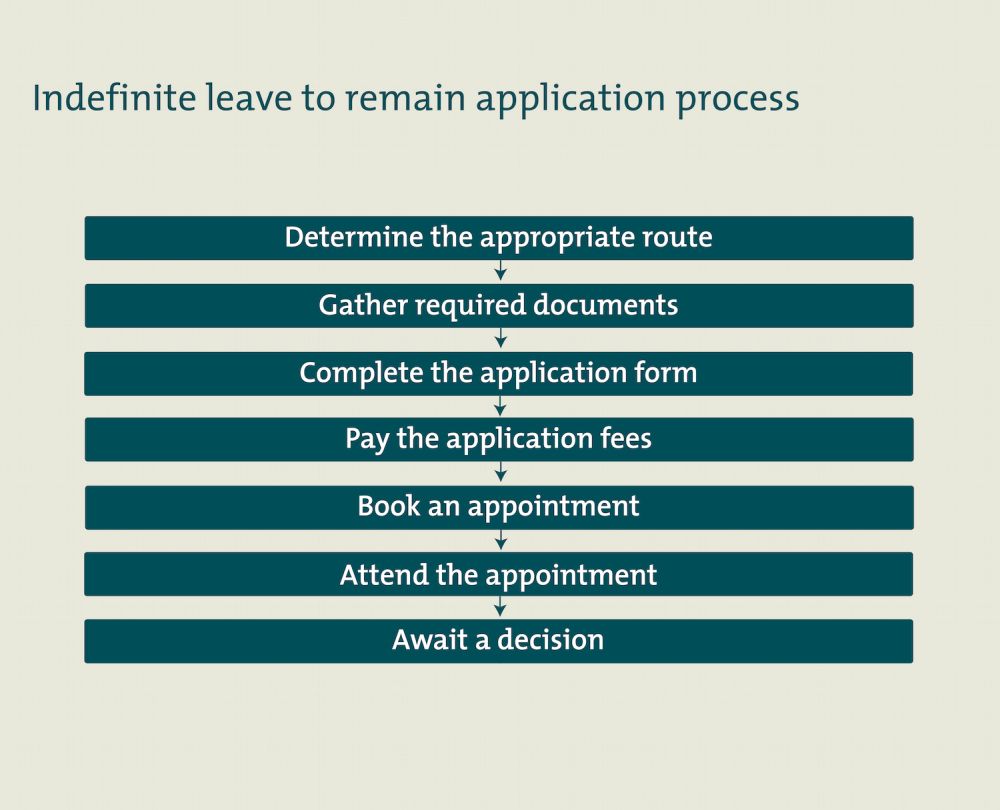
The general process involves:
-
Check the relevant route: establish which settlement route applies to you and confirm that you have completed the required qualifying period.
-
Check the requirements: make sure you meet the continuous residence, English language, Life in the UK and other relevant requirements.
-
Gather your documents: collect the evidence needed to support your application.
-
Complete the application form: use the correct ILR application form for your circumstances.
-
Pay the application fee: pay the relevant application fee when submitting your application.
-
Book a biometric appointment: arrange an appointment to provide your fingerprints and photograph.
-
Submit your supporting evidence: provide the documents required for your application.
-
Wait for a decision: UK Visas and Immigration will consider your application and notify you of the outcome.
If you are unsure about any part of the process, our immigration solicitors can advise you on your eligibility and help you prepare your application.
What documents do you need for an ILR application?
The documents you need will depend on your immigration route and personal circumstances.
Items you may need are listed in the table below:
|
Document |
When it may be required |
|---|---|
|
Valid passport and travel documents |
To confirm your identity and travel history |
|
Visa and immigration history |
To demonstrate your immigration status and qualifying residence |
|
Evidence of residence in the UK |
To demonstrate that you meet the continuous residence requirements |
|
English language test certificate |
Where required |
|
Evidence of financial requirements |
Where required by your immigration route |
|
Life in the UK pass certificate |
Unless you are exempt |
|
Employment documents |
Where relevant to your immigration route |
|
Marriage or civil partnership certificate |
Where relevant |
Providing the correct evidence is an important part of the application. Missing documents or insufficient evidence can result in delays or refusal.
How long does an ILR application take?
The time it takes to receive a decision can vary depending on the circumstances of the application and the current processing times. You can check the UK government's current processing times before submitting your application.
Priority and super priority services may also be available for eligible applications, although these services are subject to availability and additional fees.
Take care when making travel plans while your application is being considered. If you leave the UK before a decision has been made, your application may be treated as withdrawn in certain circumstances.
What are the benefits of indefinite leave to remain?
ILR provides a greater level of stability than temporary immigration permission.
Once you have ILR, you can generally:
-
live in the UK without a time limit;
-
work and study without the restrictions attached to your previous visa;
-
access public funds if you are eligible;
-
continue to access NHS healthcare; and
-
potentially apply for British citizenship.
ILR can therefore be an important milestone for people who intend to make the UK their permanent home.
Can you apply for British citizenship after ILR?
ILR can provide a route to British citizenship. In many cases, you can apply for naturalisation once you have lived in the UK for at least five years and held ILR or another form of settled status for at least 12 months.
There is an important exception for people who are married to or in a civil partnership with a British citizen. In those circumstances, you do not generally need to wait 12 months after obtaining ILR before applying for citizenship.
British citizenship has additional rights and benefits, including the ability to apply for a British passport.
What happens if an ILR application is refused?
Although a well-prepared ILR application has a better chance of success, there is no guarantee that an application will be granted. If your application is refused, it is important to understand the reasons for the decision before deciding what to do next.
Common reasons for an ILR application being refused can include:
-
errors or omissions in the application form;
-
failing to meet the eligibility requirements;
-
insufficient evidence of residence in the UK;
-
failing to provide required supporting documents; or
-
providing information which the Home Office considers to be false or misleading.
Depending on the circumstances, you may have options following a refusal, which could include challenging the decision or making a fresh application. Always take specialist advice.
Frequently asked questions about ILR
How much does an ILR application cost?
The current ILR application fee is £3,226 per applicant plus mandatory extras. You may also need to pay additional fees if you use a priority or super priority service.
Can I bring my family to the UK after obtaining ILR?
Your family members may be able to apply for permission to join you in the UK, depending on their relationship to you and their individual circumstances. Holding ILR does not mean that your family members will automatically receive the same status.
Can you lose indefinite leave to remain?
Yes. Despite the name, ILR is not necessarily permanent in all circumstances. ILR can lapse if you remain outside the UK for a significant period. Always take advice if you are considering living outside the UK after obtaining ILR.
Will my child automatically become British if I have ILR?
No. A child born in the UK does not automatically become a British citizen simply because one of their parents has ILR. However, your child may be eligible to register as a British citizen, depending on the circumstances.
Will criminal convictions affect an ILR application?
Criminal convictions can affect an ILR application and, depending on the circumstances, can result in an application being refused. If you have a criminal conviction or have previously been arrested or involved in criminal proceedings, it is important to obtain specialist advice before submitting an ILR application.
Need advice about indefinite leave to remain?
Applying for indefinite leave to remain is an important step if you want to make the UK your permanent home. The requirements vary depending on your immigration history and the route you are applying under, and getting the application wrong can have serious consequences.
Our experienced immigration solicitors can advise you on your eligibility, the qualifying period, continuous residence requirements and the evidence you need to provide.
Whether you are applying through a work, family, private life or long residence route, we can help you understand your options and prepare your application.
The content of this article is intended to provide a general guide to the subject matter. Specialist advice should be sought about your specific circumstances.
[View Source]