

In this Winter issue of Individual Matters we have taken as our focus not the issues that are screaming at you from the media headlines, but more enduring points. If any of these points matter to you, they may well matter very much indeed.
One of the greatest anxieties a parent can face is knowing that their child, whether still small or now adult, is never likely to be able to cope in the world unaided. Ian McCulloch and Judith Morris look at just a couple of the various options available to parents, and to grandparents, to ease at least some of those worries. That article is complemented by one offering a solution to a problem that can afflict the other end of life: Liz Neale and Rachel Rodrigo consider the position of the elderly person whose Will has become badly out of date but who sadly is now so mentally frail that they can no longer make decisions and change it.
The next two of our articles consider a possible crisis that can grip an individual at any stage in their life. Helen Pidgeon identifies a new hurdle for the divorcing spouse who believes that his or her former partner is not being honest about their assets. Elaine Dobson gives advice on how to avoid being one of the many who make the horrifying discovery that, though the bricks and mortar may remain, ownership of their property has been 'stolen' from them.
Foreign holiday homes – indeed all foreign assets – need good advance planning, both in the UK and abroad, to be sure that the right person inherits it, and does so without too great a tax liability. Judith Millar gives some pointers.
The media were full of how the Coalition Government has increased the rate of capital gains tax, from 18% to 28%. They were, however, less expansive about the practical difficulties produced by the fact that the rate was changed in the middle of the tax year instead of the usual 6 April date. The implications for settlors, beneficiaries and trustees of offshore trusts require a particularly cool head, and Helen Ratcliffe puts her mind to this in her article.
Lastly, Alastair Collett shows how to plan ahead for just one of the myriad problems caused by the UK's current immigration rules: the spouse who suddenly finds he or she has no right to remain in the UK.
Disabled and vulnerable beneficiaries – a helping hand
By Ian McCulloch, and Judith Morris
All parents worry about their children. But parents and family members worry especially about children – whether still young or now adult – who need more protection than most, and who may never become fully independent.
Sometimes the child or young adult may be physically disabled or have cognitive problems to an extent that they are recognised, for the purposes of state benefits, as being 'disabled'. Sometimes the worry may be a young adult who, although very talented in some directions, just seems completely unable to grasp even the basics of financial management or prudence, so that they need protection both from themselves and from others.
Gifting by Will to disabled and vulnerable beneficiaries
For vulnerable beneficiaries there are alternatives that are much better than simply leaving them an outright gift of capital by Will. Suppose a grandparent has died and has left a sizeable sum outright to each of their four young adult grandchildren. Three of the grandchildren will handle it wisely. One will not only waste it, but may also harm themselves in the process. Too often it is only after the grandparent's death that the parent comes to us for help. There may be 'first aid' options in the period following a death, but the best time to achieve protection is when the Will is being planned.
Similarly there are planning opportunities and traps where a beneficiary under a Will is, or may become, entitled to disability living allowance or a similar benefit. An incautiously planned gift may deprive that beneficiary of state benefits to which they would otherwise have been entitled.
Lifetime gifts to disabled or vulnerable individuals
Many disabled young adults are capable of living independently and a parent or grandparent may want to make a lifetime gift to them, maybe to help purchase a house or flat. Simply to provide cash may affect their state benefits, or make them a prey to fraudsters or unscrupulous 'friends'. A lifetime gift of this sort needs to be structured to achieve a careful balance between the practicalities, tax planning, and maintaining the young person's access to any benefits to which they would otherwise be entitled.
Alterations to the Will of someone who no longer has mental capacity
By Liz Neale and Rachel Rodrigo
Too often, when an elderly person suffers from dementia or no longer has mental capacity over an extended period of time, their Will gradually becomes seriously out of date. Families often assume that there is no option but to leave the Will unaltered, accepting this as one of the many sad aspects of failing mental faculties.
In fact, where a person has lost 'testamentary capacity', it is possible for those who care about them to ask the Court of Protection to make what is known as a 'statutory Will' on their behalf. In the past, the Court would have tried to make the Will that the person would themselves have made if they had still been able to do so. Following the recent case of Re P, the Court will now make the Will that it considers to be in the person's 'best interests'. This may not sound very different but it means that one important factor that the Court may take into account, in making its decision, is the way the person would have liked to be remembered.
Obviously, making a Will that involves the Court of Protection will cost more than making a straightforward Will, and obtaining a Court-approved Will is not likely to be cost-effective where the figures are small. But where the fact that a Will has been left unchanged may cause great family unhappiness, or major tax or practical headaches, the possibility can definitely be worth exploring.
The end of 'self-help' in uncovering a spouse's true wealth in divorce proceedings
By Helen Pidgeon
The mistrust that can arise in a divorce situation sometimes extends – maybe rightly – to an instinct that one party is not revealing the true extent of their assets. In the past, if that spouse (it was usually, but not always, the wife) had a good 'root around' her husband's study and copied his personal and business documents, this was acceptable as long as she did not break open any doors or cupboards to do so, and provided she quickly passed them to her solicitors who in turn immediately gave them to the husband's lawyers. The information could then be used in the divorce proceedings and the husband had to respond in his financial disclosure.
Whilst not actively encouraged, it used to be considered that this 'self-help' was an important aid to ensure that husbands gave full disclosure of their financial circumstances. Following the recent Court of Appeal Judgment in the case of Imerman this is now not so simple
The Court of Appeal stamped firmly on this sort of behaviour, describing it as a breach of the age old law of 'confidence'. It possibly involves criminal offences such as theft or burglary. Where information is downloaded from a personal, passwordprotected, computer, criminal offences under the Computer Misuse Act and Data Protection Act may have been committed. However much help to their case the information may be, these are serious matters with potentially grave consequences.
The Court did not feel that it could condone such 'self-help' – even though, without it, the Court might not have the benefit of a true picture of the family's wealth before deciding how to divide it.
A wife (or, of course, a husband if the tables are turned) is now left in the position that, if she believes the husband is not properly declaring his assets, she must have enough of a suspicion, and proof to go with it, to enable her to obtain an order for the seizure of documents.
If the wife does engage in 'self-help', the husband can obtain an order for the return to him of the documents taken by the wife and destruction of any copies taken, thereby severely curtailing their use within divorce proceedings.
This Court decision will leave some spouses in a precarious financial position whilst allowing other spouses intent on hiding their true wealth a greater opportunity to do so. So good advice at the earliest stage possible is particularly important in cases where one spouse suspects that the other is not being completely open about their financial position.
Who's been stealing my house? Electronic property theft
By Elaine Dobson
In 2007 the Land Registry recognised the need to strengthen their procedures to prevent fraudulent property transfers. In 2007/2008 £15m had been paid out in compensation by the Land Registry as a result of fraud and forgery, whereas in 2008/2009 the figure was £5m. The overall figure may have fallen, but for anyone who falls victim to this scam the moment when they discover that, though the bricks and mortar remain, their house has been 'stolen', remains horrifying. All property owners, whether individuals, trustees or executors, should consider whether action is required to minimise the possibility of property fraud.
The most significant action should be to check the address for correspondence that is noted on the Land Registry title. The Land Registry now accepts up to three addresses, and an email address and an overseas address can be accepted. The importance of the correct addresses is particularly significant where a property may be left empty for periods of time. Examples are holiday homes, buy-tolet property, inherited property and trust property.
Generally the cases that are vulnerable to this type of fraud are those where the legal owners are not aware of the day-to-day activities and correspondence received at the property. In a recent example brought to us to resolve, a £1m house had been used by a fraudster as collateral to secure a £½m mortgage. The property had been inherited and then let. The transfer of the house into the fraudster's name was achieved by accessing the property, forging the owner's details and by posing as in occupation at the time of the mortgage valuation.
How do you protect yourself?
The Land Registry will contact the registered proprietor if an application is received in relation to any change in the registered details. For this to be an effective protection it is vital that the address for correspondence that is recorded at the Land Registry is correct.
The Land Registry does operate a compensation scheme, but this can take several months to administer and if, for example, the owner of the house is fending off a debt action this can be very distressing. It will also be unacceptable to an owner if they are trying to sell the property.
The Land Registry has a guidance note on how to protect the information relating to a property and detailing the documentation required before the Land Registry will amend the register. This and the change of details forms, can be accessed on the Land Registry website.
Offshore trusts: how will the split year capital gains tax rate apply?
'Will you, won't you, will you, won't you, will you join the dance?' (Alice's Adventures in Wonderland)
By Helen Ratcliffe
The 'will they ... won't they ...' change the capital gains tax (CGT) rate speculation, which had been simmering ever since the differential between income tax and CGT rates became so out of kilter, finally and not unsurprisingly, ended with the Emergency Budget on 22 June 2010. Latterly speculation had not just been about what the new rate would be, but also when it would take effect. The financial predicament of the Government suggested an immediate rate change would be introduced, extraordinary though that would be, and the Emergency Budget did precisely that.
So how does this mid-year rate change apply to offshore trusts where, for example, the original legislation requires you to look at the position at the end of the tax year? With the publication of the Finance (No 2) Act 2010, we can now understand how the change will apply to offshore trusts.
For many years now the gains in offshore trusts have been taxed either:
- by reference to the settlor, if UK resident and domiciled (the settlor charge), or
- by reference to distributions, otherwise known as capital payments, to UK resident beneficiaries (the beneficiary charge).
The CGT rate prior to 23 June 2010 was 18% for the settlor charge. Where the beneficiary charge applied and the distribution of gains had been deferred, the CGT rate could be increased by an interest mechanism to 28.8% so that there was a sliding scale between 18% and 28.8%. Post–22 June 2010, the headline CGT rate for the settlor charge will be 28%, and for the beneficiary charge where the interest penalty is applied the CGT rate at its maximum will be 44.8%.
Against that background, the table below shows how the gains will be taxed in 2010/11.
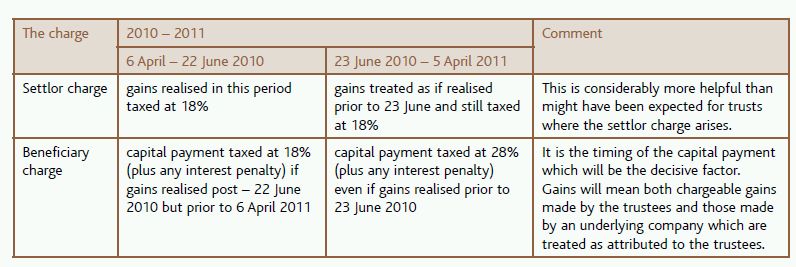
Given the complexity of the new legislation which we have seen in recent years, it is fair to say that there was widespread dread of some more difficult wording – it was a relief to see that the introduction of the split year rate seems clear and that it does not overly increase the burden of compliance.
Do you need a foreign Will?
In the last issue of Individual Matters, Judith Millar reflected on the divergence between the laws in continental Europe and in the UK relating to Wills and succession to property. In this article, she considers some of the practical implications for those who own a foreign holiday home.
By Judith Millar
'Forced heirs'
The principle of 'testamentary freedom' – being able to leave your estate to beneficiaries of your choosing – is embedded deep within the English common law. What is not always appreciated is that many other legal jurisdictions take a completely different approach.
One consequence of this can be that the provisions of a properly executed English Will, intended to cover your worldwide estate, may be overridden when it comes to the distribution of foreign assets.
This can happen because a number of civil law jurisdictions (for example, many European countries) operate a system whereby close family members, known as forced heirs, must receive a fixed portion of the foreign estate. For example, if you have children they may end up owning part of your foreign holiday home, even though you would have preferred your spouse to have full control and enjoyment of it. This can be especially problematic in the case of second marriages.
Immovable property
Broadly speaking, who will inherit land ('immovable' property) is decided according to the law where the asset is actually located. But, as with all laws, there are notable exceptions. Under the Spanish Civil Code, for example, inheritance to all property, immovable or not, is governed by the law of the deceased's nationality.
At first sight this might seem to suggest that the Spanish forced heirship rules should not apply to, say, the villa in Sotogrande that a British national owns. However, that is not the end of the matter. Spanish law says that English law applies, but English law 'bats' the question back to Spain again. This is because English law says that the law applying to foreign immovables is the law of the jurisdiction in which the property is situated. A game of legal ping-pong may be of academic interest but the uncertainty, delay and expense it would cause would be very unwelcome following a death.
Fortunately, the position under Spanish law has now been clarified in a succession of Court decisions with a result that, for a British national owning Spanish property, it is accepted that the principle of testamentary freedom holds good.
That certainty does not hold for other countries, however, and in order to ensure that your intended beneficiaries inherit your foreign assets, and that they do so in the most efficient way possible, it is important to plan ahead.
Forward planning for foreign assets – inheritance and taxation
Ideally, that planning should begin when you are acquiring the asset. At that stage, options may be available that cannot be adopted later - for example, a form of joint ownership that ousts any forced heirship provisions. Advice needs to be taken from an appropriate professional, in the relevant jurisdiction, and considered in conjunction with your UK advice. In some cases, there can be pressure to buy the property via a company. Occasionally this should be considered (though probably less often than it is offered to prospective buyers) and specialist UK and foreign advice is required.
Once you have bought the foreign property, do you need to have a separate foreign Will for it? In the case of the Sotogrande villa, it would be usual and advisable to have a Spanish Will, limited to your Spanish property, prepared by a Spanish notary which would be in a double English and Spanish format. By contrast, if the villa was not in Spain but, say, St Tropez, a better way to achieve the desired result might be to sign an English Codicil, dealing exclusively with the French property, rather than having a separate French Will.
Whichever approach is taken, one thing is certain: it is crucial that the documents governing the inheritance of the foreign assets and of the UK assets dovetail with each other, otherwise there is a risk that they may cancel each other out leading to a complicated and expensive estate to administer on death.
Tax worries?
So far this article has looked at who would inherit. The other key aspect is the taxation of your foreign property. In cross-border situations tax liabilities can sometimes interact in unexpected ways. Being prepared by taking UK and foreign advice at an early stage can reduce their impact.
The moral of the story? Get good advice, locally and in the UK, both on who will inherit your property and on how to minimise tax bills on it – and then enjoy your foreign home without worries!
UK immigration rules and the stranded spouse
By Alastair Collett
Many newspaper column-inches have been devoted recently to whether there has been, and still is, an exodus of talent from the UK and City of London because of the changes to UK taxation of non-doms and of banking executives. There have certainly been some individuals who have left, and not all of them have appreciated that immigration law can play havoc with family and domestic life in a wholly unexpected way: decisions taken for financial or tax reasons must also be looked at in the light of all circumstances, including their immigration law effect.
The general rule under UK immigration law is that the dependant spouse and children of a principal applicant for UK residence on a limited leave to remain can only stay for so long as the principal's permission to remain is in force.
Take the example of a US or Russian family where the 'principal applicant' has been working in London on, for example, a work permit or as a highly skilled migrant. He (or she) decides to relocate to, for example, Switzerland to work full time abroad for tax reasons. The relevant tax forms are filed to confirm exit from the UK. The intention is that the spouse and children will split their time between London and Switzerland. But once the 'principal applicant' has relocated to Switzerland the dependant spouse and children may find themselves stranded with no continuing permission to live in the UK. The dependants' leave to remain terminates when the principal relocates, so their plans are thrown into chaos, and their route to settled status in the UK from five years' continuous residence blocked.
With good advice, this may not be the end of the road for the spouse and children's residence in the UK. The spouse may be able to qualify for permission to work in a category leading to settlement, or it may be possible to obtain a more limited permission linked to the children's education. This will not lead to rights to settle however, and any previously qualifying time will be lost. If the position is not realised until after the primary applicant has already left the UK the remaining family members are likely to have to leave the UK and make their application from abroad.
Spouses and children who are European Community or Economic Area nationals will not be adversely affected as they will have access to the free movement rights available under European law. But for anyone who does not have full rights of residence in the UK it is vital that tax and other planning does not neglect the immigration implications.
The content of this article is intended to provide a general guide to the subject matter. Specialist advice should be sought about your specific circumstances.
