
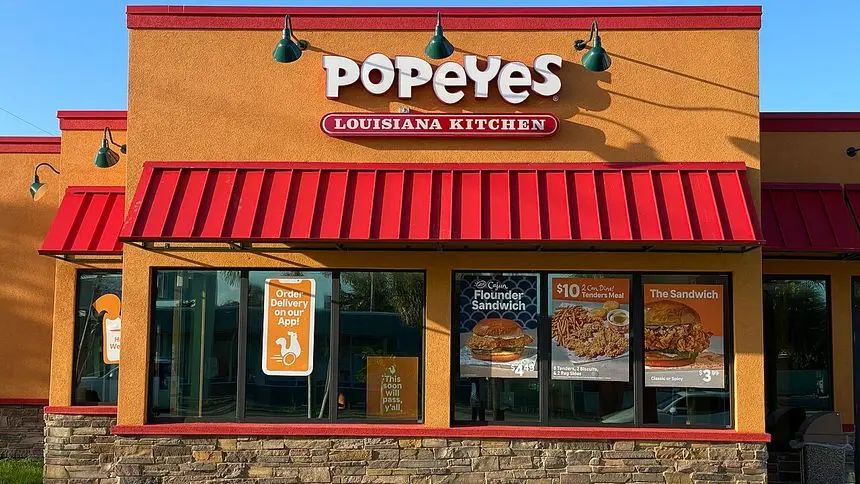
When I first heard of the restaurant chain 'Popeyes', I assumed that their core menu item would be tinned spinach, the culinary delicacy favoured by Popeye the Sailor Man. It transpires, however, that they specialise in Louisiana-style Southern fried chicken, not spinach. Of even greater significance is the fact that colour of the seasoning of the Cajun Hash Brown is red-brown, as we shall see.
On 2 September 2026, the Advertising Standards Authority published its ruling on two Instagram ads for Popeyes' breakfast menu. Both complaints were not upheld. That much you could summarise in a sentence. But the ASA's ruling itself runs to several thousand words of painstaking, granular analysis that, while genuinely useful, is about as easy to digest as a Big Cajun Wrap eaten in a hurry on the Tube. Not that I have done that!
The ads were straightforward enough. The first was a paid influencer post by Jono Yates (known as @onlyscrans, which is a name that rather undersells his credentials as a food critic). His video showed him outside a Popeyes restaurant, enthusiastically assembling a Big Cajun Wrap with Chicken Breakfast Patty, shaking seasoning over Cajun Hash Browns, and preparing an Egg and Cheese Muffin. The second ad was a simple image of a wrap with the caption "Rise & Shine with our New Orleans inspired Breakfast Menu."
Both were investigated under CAP Code rule 15.19, the new restriction on paid online advertising for identifiable "less healthy" food and drink products, which came into force on 5 January 2026. The question, as with the German Doner Kebab and Iceland rulings we covered back in April, was whether the ads were for identifiable less healthy products.
Here is where you may want to put the kettle on. Or perhaps order a coffee. (Not a specific coffee, mind you, just coffee generically. That distinction matters, as you are about to discover.)
The ASA set out a three-scenario framework. First: did the ad depict a specific less healthy product? No, because Popeyes demonstrated, with nutrient profiling calculations, that none of the featured items (the Big Cajun Wrap with Chicken Breakfast Patty, the Cajun Hash Brown and the Egg and Cheese Muffin) were classified as HFSS. None of them were less healthy. So far, so good.
Second: were the products clearly identified as specific non-less-healthy items? For the Big Cajun Wrap, yes, because the voice-over and on-screen text named it. For the Cajun Hash Brown, yes, because it was named in the voice-over and, crucially, because you could see Mr Yates shaking the distinctive red seasoning onto them. For the Egg and Cheese Muffin, no, because it was never named. And the coffee? That was just "coffee", a generic reference, which fell neatly under the brand advertising exemption.
Third, and this is where it gets properly spicy: because the muffin was not identified by name, was its realistic image visually indistinguishable from any specific less healthy muffin on Popeyes' menu? The ASA compared it carefully against Popeyes' four other muffins, all of which also contain either bacon or a Chicken Breakfast Patty. Since those extra ingredients are visible, the muffin in the ad was visually distinguishable from every less healthy alternative. No egg on Popeyes' face there.
For the second ad, which just showed a wrap without naming it, the ASA went through the same exercise (at some length). The wrap was compared against every other wrap on the menu. Some contained salad and breaded chicken (clearly different). The Big Cajun Wrap with Streaky Bacon had visible bacon (different). But what about the Big Breakfast Wraps with their standard (not Cajun) Hash Browns? Here, the ASA concluded that the light brown colour of the regular Hash Brown was sufficiently different from the red-brown colour of the Cajun Hash Brown to make the wraps visually distinguishable. Yes, really. The case turned, in part, on the colour of a hash brown.
If you are an in-house lawyer advising a food brand, there are real and useful takeaways from this ruling (pun intended). The ASA is clearly prepared to engage in granular visual analysis of food imagery. Nutrient profiling calculations are essential. Product naming in ads can be your friend. And if your menu includes items that look similar but have different nutritional profiles, make sure your advertising makes the distinction clear, whether through on-screen text, voice-over, or apparently, the colour of a condiment.
The ruling is a hefty serving. But for anyone advising on food advertising under the new rules, it is worth reading in full, even if you need a strong coffee (specific or generic) to get through it.
The content of this article is intended to provide a general guide to the subject matter. Specialist advice should be sought about your specific circumstances.
[View Source]