
- with Inhouse Counsel
- with readers working within the Banking & Credit, Retail & Leisure and Transport industries
With the backdrop of the West Asia crisis and the severe stress on the foreign exchange reserves of India owing to the sharp increase in the oil prices and gold imports, the Reserve Bank of India (RBI) has in an attempt to increase foreign exchange inflow introduced a US Dollar-Rupee Forex Swap Facility for fresh Foreign Currency Non-Resident Bank Deposit (FCNR(B) Deposits) effective on 8 June 2026 (Scheme).
Pursuant to this Scheme, AD Category I Banks are provided with the option to enter into USD-INR swap transactions directly with the RBI for FCNR(B) Deposits placed with it by non-resident Indians (NRIs) and persons of Indian origin (PIO) for deposits received between 8 June 2026 to 30 September 2026 subject to the criteria set out below:
- Tenor: FCNR(B) Deposits maintained for a tenor of three to five years are the only ones eligible for such swap; the underlying deposits will have a lock-in period of one year. The banks may at their discretion allow premature withdrawal of such deposits after one year, as per their internal policy;
- Deposit Currency: The FCNR(B) Deposits (including deposits that are renewed upon maturity) can be placed in any freely convertible currency. The banks may arrive at the equivalent USD amount eligible to be swapped with the RBI by converting the same at the prevailing market rates on the day of the swap deal;
- Swap Currency: While the FCNR(B) Deposits can be placed in any freely convertible currency, the swap between the bank and the RBI will be done in USD only;
- Swap tenor: The tenor of the swap will be co-terminus with the tenor of the underlying FCNR(B) Deposit. However, swaps undertaken with the RBI cannot be cancelled;
- Deposit pricing: Banks are free to price these deposits as per their internal policy, but within the overall ceiling as per the extant guidelines issued by the RBI;
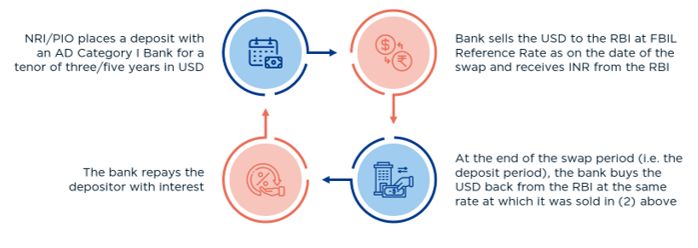
- Banks may sell USD to the RBI in multiples of USD 1 million and simultaneously agree to repurchase the same amount at the end of the swap period. Such swap can however be undertaken only once a week with the RBI.
- Swap rates: At the time of sale of the USD by the bank to the RBI, such sale shall be carried out at the FBIL reference rate. Subsequently, at the time of maturity, the swap back of the USD from the RBI to the bank shall be done at the same rate at which the first swap was undertaken, therefore ensuring a par-swap.
Transaction flow (illustration)
Comments
The implementation of this Scheme has been seen as a win-win situation for the RBI, the banks and the depositors as:
For banks – Prior to this Scheme being implemented, given banks in India are required to deploy funds in the domestic market in INR only, banks while converting the foreign exchange received under such deposits incurred hedging costs to protect against any exchange rate fluctuations between the date of conversion and the maturity date. However, given that the RBI will be re-swapping the foreign exchange at the same rate at which the RBI purchased it from the banks, this potential hedging cost is absorbed by the RBI, thereby reducing the cost of deployment for the banks.
For the depositors – Given the banks will not be incurring any hedging costs, the cost saved will be passed on to the depositors in the form of higher interest rates on the FCNR(B) Deposits.
For the RBI – By encouraging FCNR(B) Deposits in India, the RBI is looking to tap in on a large influx of foreign exchange from Indians outside India thereby helping the RBI recover and replenish its foreign exchange reserves for three to five years in the current volatile economy.
The content of this document does not necessarily reflect the views / position of Khaitan & Co but remain solely those of the author(s). For any further queries or follow up, please contact Khaitan & Co at editors@khaitanco.com.
[View Source]