Download a PDF copy of this Blog here.
Canada maintains a broad and expanding sanctions regime, including measures targeting individuals connected to designated countries and restricted transactions which we have previously written about here. Once listed under Canadian sanctions, available remedies are limited. The primary resource is typically an application for judicial review before the Federal Court of Canada.
In this International Trade Report, we review a recent Federal Court of Appeal ("FCA") decision in Fridman v. Canada (Foreign Affairs), 2026 FCA 80, which illustrates the significant challenges faced by sanctioned persons seeking relief.
Overview of Canadian Sanctions Regime
Canadian sanctions are imposed under the Special Economic Measures Act (“SEMA”) and other legislation, including the Justice for Victims of Corrupt Foreign Officials Act (the “Magnitsky Law”).
These regimes grant the federal government broad discretion to list individuals and entities where geopolitical or human rights concerns are engaged. Once listed, the consequences can be immediate and severe, including asset freezes, prohibitions on dealings – and not to mention significant reputational harm.
Fridman Decision
In Fridman v. Canada (Foreign Affairs), the Appellants were two daughters of a Russian oligarch who sought judicial review of their addition to the Russian Sanctions List. The Appellants applied to the Minister of Foreign Affairs for delisting under section 8 of the Special Economic Measures (Russia) Regulations (the “Regulations”), arguing that, as adult children, they lacked any meaningful connection to Russia’s conduct and that their listing was inconsistent with the objectives of Canada’s sanctions regime. The Minister refused to delist the Appellants, and the Federal Court upheld that refusal.
On appeal to the FCA, the Court dismissed their appeal, emphasizing both the text of the Regulations and the Minister’s “very wide” discretion in sanctions administration. More specifically, the FCA rejected the Appellants’ submission that “family members” should be read as implicitly limited to persons with a “sufficient link” to the foreign state’s actions, noting that paragraph 2(d) contains no such qualifying criteria and Parliament’s use of broad connecting language in SEMA (“in relation to”) supports a wide ambit for listings once the statutory preconditions are met.
The FCA also found that Minister’s decision was not unreasonable and was responsive to the Appellants’ submissions, and that the Minister’s rationale for listing family members – preventing sanctions circumvention, applying pressure, and denouncing Russia’s breach of international peace and security – was sufficient to justify maintaining the Appellants’ listings.
Takeaways
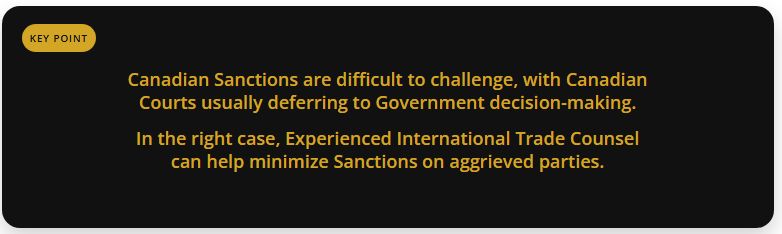
Canada’s sanctions regimes provide the government with broad discretion to list individuals and entities. For any “Listed Party”, the prospects of overturning such a decision are limited, and judicial review becomes the primary legal remedy. Given that judicial review is inherently constrained and highly deferential, early involvement of Experienced International Trade Counsel is often critical where any realistic prospect of success is to be achieved.
For help with Canada’s sanctions regime, please click here.
The content of this article is intended to provide a general guide to the subject matter. Specialist advice should be sought about your specific circumstances.
[View Source]