
Overview: Brief Overview of Corporate Residence and Incorporation
A corporation’s residence for tax purposes and the jurisdiction under which it is incorporated are legally distinct concepts. The corporate statute that governs a corporation, whether the Canada Business Corporations Act (“CBCA”) or a provincial equivalent, dictates its internal governance rules, but it does not, on its own, determine where the corporation is resident in Canada for the purposes of the Income Tax Act. In most cases, the jurisdiction of incorporation and the jurisdiction of tax residence coincide. However, where a corporation continues into a foreign jurisdiction, or where its real decision-making occurs somewhere other than its place of incorporation, the two can diverge. A corporation that emigrates from Canada does not necessarily cease to be a Canadian resident for tax purposes, and a corporation incorporated entirely outside Canada may nonetheless be found resident in Canada.
This article reviews the statutory deeming provisions in the Income Tax Act, the process of corporate continuance, the tax treaty rules that can override a corporation’s domestic residence, and the common law test of central management and control that the Canada Revenue Agency (CRA) and the courts apply when a corporation’s residence is in dispute.
Background: Incorporation, Continuance, and the Meaning of Corporate Residence
To be incorporated, a corporation must be formed under legislation that permits its existence. In Canada, each province, territory, and the federal government maintains its own corporate statute. The selected corporate statute determines the governance rules that apply to the corporation. For example, while the CBCA and Ontario’s Business Corporations Act (“OBCA”) are similar in many respects, they diverge in others. The CBCA requires that at least 25% of a corporation’s directors be Canadian residents, while the OBCA does not impose a residence requirement for directors. The incorporating legislation, therefore, operates as a rulebook for the corporation’s internal affairs. In most cases, the country where the corporation is incorporated is where its tax residence lies, but this aspect itself is not determinative of the corporation’s tax residence.
Continuance is the process by which a corporation ceases to be governed by the corporate statute of one jurisdiction and becomes governed by the corporate statute of another. The jurisdiction the corporation moves to is the importing jurisdiction, and the jurisdiction that the corporation leaves is the exporting jurisdiction. Corporations continue between jurisdictions for a variety of business reasons, including access to more favourable corporate governance rules or facilitating an amalgamation. Continuance avoids the need to dissolve the existing corporation and incorporate a new one in the destination jurisdiction.
Not every corporation is free to continue in every jurisdiction, and the applicable corporate statutes govern whether continuance is available. Under section 187 of the CBCA, a corporation incorporated under legislation other than the CBCA, including a provincial corporate statute, may be continued under the CBCA, provided the originating legislation permits it. The OBCA contains an equivalent provision at section 180, permitting a corporation that was not incorporated under the OBCA to continue under the corporate laws of Ontario. Emigration is equally available. Under section 188 of the CBCA, a CBCA corporation may apply to another jurisdiction to be continued there, and the OBCA permits the exporting of an OBCA corporation under section 181. Other provincial corporate statutes contain their own rules on whether, and under what conditions, continuance is permitted.
In relation to the applicability of Canadian federal tax law, if a corporation continues between different provinces or between provincial and federal legislation, the same tax law rules will apply. In other words, the Income Tax Act will apply to most corporations formed in Canada, with the exception of those that completely sever their ties with Canada. Continuing outside of Canada in a foreign country will require careful planning, as there are rules for when corporations and individuals cease to be resident in Canada.
Key Issues: Deeming Provisions, Tax Treaties, and Central Management and Control Test
Subsection 250(4) of the Income Tax Act deems a corporation to be resident in Canada under specified circumstances. Paragraph 250(4)(a) has broad application. Any corporation incorporated in Canada after April 26, 1965, is deemed resident in Canada, regardless of whether it was incorporated under the CBCA or under provincial legislation. Corporations incorporated before that date may still be deemed resident under paragraphs 250(4)(b) and (c).
Subsection 250(5) addresses the interaction between this deeming rule and Canada’s tax treaties. The Organization for Economic Co-operation and Development (OECD) Model Tax Convention is a useful reference point as Article 4 provides that a resident of a contracting state is a person liable to tax there because of a sufficient connection to that state. Where a corporation is resident in both contracting states under their respective domestic law, the Model Convention generally directs the states to endeavour to determine, by mutual agreement, which state the corporation is resident in, so as to avoid double taxation. Some of Canada’s treaty partners use a different tie-breaker altogether: the “place of effective management” (POEM) test found in Article 4 of the pre-2017 OECD Model Convention and still used in a number of Canada’s bilateral treaties.
POEM is related to, but not identical with, the common law central management and control test applied under Canadian domestic law. Central management and control asks where the corporation’s paramount decision-making authority actually resides as a question of fact; POEM asks, for treaty purposes, where key management and commercial decisions necessary for the conduct of the corporation’s business as a whole are in substance made, which can turn more heavily on senior executive activity than board-level authority alone. The two tests will usually point to the same jurisdiction, but a corporation with a board in one country and a senior executive team habitually making commercial decisions in another should not assume the two analyses are interchangeable, and each applicable treaty’s specific tie-breaker language should be checked rather than assumed.
The Canada-United States tax treaty illustrates how a tie-breaker rule can operate in practice. Under Article IV(3), where a corporation is resident in both Canada and the United States, its residence is generally determined by the jurisdiction under which it was incorporated, so a corporation incorporated in Canada that is also resident in the United States under domestic law will be treated as a Canadian resident for treaty purposes. The same provision deems a corporation that is incorporated in one country and continued into the other to be a resident of the importing country, meaning that a Canadian corporation that continues into the United States will be treated as a United States resident under the treaty, even though it was originally Canadian. Subsection 250(5) of the Income Tax Act gives domestic effect to this result. A corporation that would otherwise be deemed resident in Canada under subsection 250(4) is deemed to be a non-resident of Canada where a tax treaty determines that it is a resident of the other contracting state.
It is important to note that the Canada-United States treaty mechanics described above are not universal. In other words, every tax treaty must be reviewed on its own terms, since tie-breaker provisions vary considerably between Canada’s treaty partners.
Subsection 250(5.1) of the Income Tax Act operates alongside this framework and is directly relevant to any corporation considering continuance. It deems a corporation that is continued into a foreign jurisdiction to have been incorporated in that jurisdiction from the time of continuation, and not to have been incorporated in any other jurisdiction. Practically, this removes the continued corporation from the scope of the paragraph 250(4)(a) deeming rule from the moment its articles of continuance are granted. Subsection 250(5.1) also applies to foreign corporations that continue in Canada. Paragraph 250(5.1)(b) states that from the time of continuation into Canada, subsection 250(4) will apply to the foreign corporation to deem it resident in Canada.
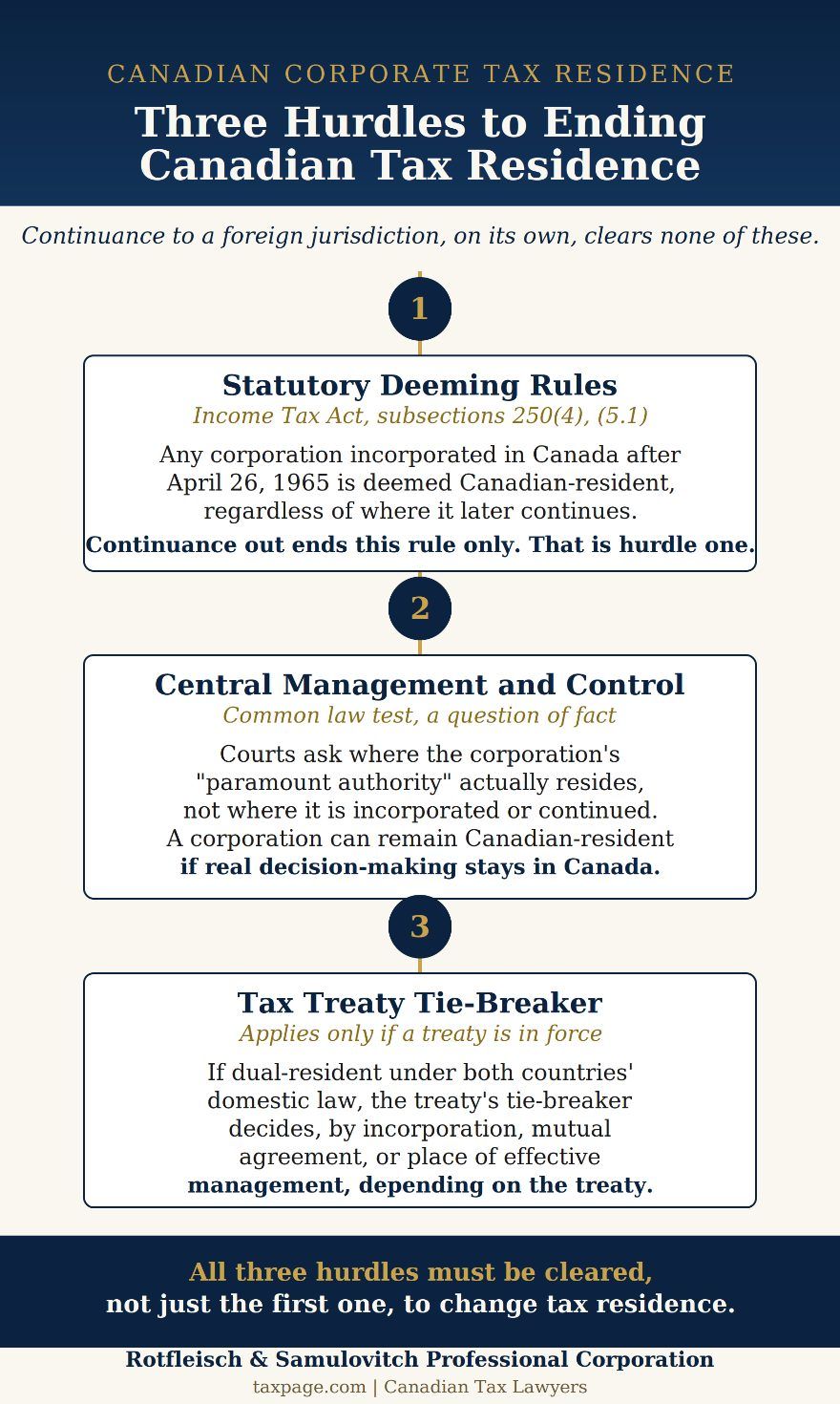
Critically, removing a corporation from the scope of the statutory deeming provisions does not end the residence inquiry. Canadian common law independently asks where the corporation’s central management and control is exercised, and a corporation can be found resident in Canada under this test regardless of where it is incorporated or continued. This is subject to the provisions of an applicable tax treaty that exists between Canada and the other country in question. If a tax treaty exists between Canada and the other country, subsection 250(5) may deem a corporation that is otherwise resident in Canada to be non-resident if the tax treaty operates to treat the corporation as a resident of the other country. Thus, for a corporation to end its residency in Canada, there are three hurdles: first, the statutory deeming rules in the Income Tax Act; second, the central management and control test; and third, the application of tax treaties and related deeming provisions in the Income Tax Act.
Central Management and Control: The Common Law Test
The central management and control test asks where the corporation’s real decision-making is exercised, which the courts have described in terms of where the “paramount authority” over the corporation resides. Courts assess a non-exhaustive list of factors, including where the business is primarily carried on, where the corporation’s books and records are located, where its bank accounts are maintained, and where its directors reside. Director residence, while significant, is not conclusive. The central management and control of a corporation is a question of fact, and it can be found to reside with a shareholder rather than the board if the shareholder is the one who actually exercises control.
The central management and control test is derived from British common law. Specifically, the first case to deal with this concept was De Beers Consolidated Mines Ltd v Howe, [1906] AC 455 (HL). The test was adopted in Canada, and Minister of National Revenue v Crossley Carpets (Canada) Limited, [1969] 1 ExCR 405, remains instructive on this point. The taxpayer in this case was found to be resident in Canada because its Canadian vice-president effectively ran the business, overseeing purchases, sales, credit, and collections. The Court characterized the inquiry as a pure question of fact directed at locating paramount authority over the corporation, and because that authority rested with the Canadian resident, central management and control, and the corporation’s residence, were found to be in Canada.
“Courts do not care what the organizational chart says. I have seen corporations lose a residence argument because the person with the title of director was, in practice, just carrying out someone else’s instructions,” says David J. Rotfleisch, founding tax lawyer and CPA at Rotfleisch & Samulovitch, and a Law Society of Ontario Certified Specialist in Taxation.
Shareholder Control and Director Independence
Shareholder residence is ordinarily immaterial to the central management and control analysis, but it may become determinative where shareholders effectively displace the board’s decision-making authority. In Landbouwbedrijf Backx BV v Canada, 2019 FCA 310, the Federal Court of Appeal upheld the Tax Court’s finding that central management and control was located in Canada because the director paid the corporation’s bills on shareholder instruction, executed documents to implement shareholder decisions, and was excluded from material communications concerning restructuring and tax planning. A comparable result was reached in Unit Construction Co Ltd v Bullock, [1960] AC 351, where a United Kingdom parent assumed the decision-making functions of its African subsidiaries; the Court held that central management and control does not reside with directors who fail to exercise their powers or who merely implement decisions made elsewhere.
Conversely, evidence of director independence supports a finding that central management and control resides with the directors. In Victoria Insurance Company Ltd v The Minister of National Revenue, 77 DTC 320, a Bahamian subsidiary of an Ontario corporation was found to have its central management and control in the Bahamas, since the subsidiary’s operations were independent of its parent and its business was carried on wholly in that jurisdiction. Directors may take instructions from shareholders without losing their own authority, provided they remain free to exercise independent judgment; the degree of that independence is therefore a relevant consideration in every case.
Dual Residence and the Quality of Decision-Making
Corporate residence is not confined to a single jurisdiction. In Crossley Carpets, the corporation was found resident in both England and Canada because “the exercise of paramount authority [was] divided between the two countries.” Accordingly, a corporation can be found resident in more than one jurisdiction, depending on how decision-making authority is distributed. It is also worth noting that not every decision counts equally: the courts have been clear that central management and control refers to high-level, strategic decision-making material to the corporation’s affairs, not routine day-to-day management. A director confined to operational matters may not be, without more, exercising the kind of authority that determines corporate residence.
For a deeper review of how these principles have been applied by Canadian courts, see our companion article, a Canadian Tax Lawyer’s Analysis on Corporate Tax Residence.
Taxes Upon Departure: Corporate Emigration Tax and Deemed Disposition
When a corporation ceases to be resident in Canada, there are two tax consequences. First, there is a deemed disposition of the corporation’s assets and a subsequent reacquisition. Second, there is a corporate emigration tax that is applied on the fair market value of all of the corporation’s assets.
Once a corporation ceases to be a Canadian resident, paragraph 128.1(4)(b) of the Income Tax Act deems it to have disposed of all of its property immediately before emigration, at fair market value, and to have immediately reacquired that same property at a cost equal to that fair market value. A handful of exceptions to this deemed disposition exist, but they are available only to individual taxpayers, not to a corporate taxpayer. Depending on the nature of the assets involved, the resulting gain may be taxed as either capital or income.
Separately, section 219.1 imposes a corporate emigration tax on any corporation that ceases to be resident in Canada. The tax is calculated as 25% of the fair market value of all property owned by the emigrating corporation, reduced by the corporation’s paid-up capital, its outstanding debts, and any tax already payable under subsection 219(1) (a tax that applies only to non-resident corporations).
Section 219.3 can reduce the 25% rate where Canada has a tax treaty with the importing country that limits the Canadian withholding tax on dividends paid by a wholly owned Canadian subsidiary to its non-resident parent. In that case, the treaty-specified rate replaces the default 25% rate. If no such tax treaty exists between Canada and the importing jurisdiction, then section 219.3 offers no relief, and the full 25% rate will apply.
Continuing into a treaty jurisdiction instead would not necessarily solve this problem. Section 219.3 denies the benefit of the reduced treaty rate where it is reasonable to conclude that avoiding Part XIV tax or Part XIII tax (on Canadian-source income paid to non-residents) was one of the main reasons for the corporation’s emigration. In other words, a corporation cannot emigrate purely to access a favourable treaty rate. If tax avoidance is the main purpose of emigration, the CRA will apply the full 25% rate regardless of the treaty.
For foreign corporations continuing into Canada, there are also tax consequences. Under paragraph 128.1(1)(b), a taxpayer that becomes resident in Canada is deemed to have disposed of each property owned by the taxpayer at fair market value. Subsequently, under paragraph 128.1(1)(c), the taxpayer is deemed to have reacquired the property at its fair market value. The cost base of the property upon immigration becomes the fair market value of the property. This can result in either a bump or a decrease in tax cost, as the provision is clear that the proceeds of disposition, whatever amount that may be, become the cost of the property.
Corporations that continue within the same country are not subject to the rules on deemed disposition. For example, a corporation that is incorporated under provincial legislation and continues into another province will not be deemed to have disposed of its property.
Practical Implications: Continuance Alone Does Not Change Tax Residence
The interaction between continuance, the statutory deeming provisions, and the common law central management and control test creates a genuine risk for corporations that emigrate from Canada while their real decision-making remains in Canada. A corporation that obtains articles of continuance into a foreign jurisdiction is, from that moment, deemed under subsection 250(5.1) to have been incorporated there rather than in Canada, which precludes the application of paragraph 250(4)(a).
That step alone, however, does not achieve non-resident status for the corporation if the corporation’s central management and control remains substantially in Canada. In that scenario, the CRA may take the position that central management and control continues to reside in Canada under the common law test, notwithstanding the change in governing legislation, and reassess or assess the corporation on the basis that it never actually ceased to be a Canadian resident.
Thus, corporate tax residence requires a comprehensive analysis of the corporation’s inception and activities. A corporation that is created in Canada will generally be resident in Canada under subsection 250(4) of the Income Tax Act if it was created after April 26, 1965. If a corporation chooses to continue in a foreign country, its residence is determined through its central management and control and the applicable provisions of an existing tax treaty between Canada and the importing country. Where a Canadian corporation succeeds in relocating its central management and control outside Canada, the corporation may be treated as having emigrated from Canada, triggering a deemed year-end, a deemed disposition of its property at fair market value, and a separate 25% corporate emigration tax under section 219.1 of the Income Tax Act, which may be reduced under an applicable tax treaty.
However, if a tax treaty exists between Canada and the importing country, there may be a provision that deems the corporation to be resident in only one of the countries. There may be a scenario where the tax treaty continues to treat the continued corporation as a corporation resident in Canada, in which case the corporation’s central management and control will be highly relevant in determining whether any emigration taxes will be due.
In other cases, the tax treaty may consider the continued corporation as a corporation resident in the importing country, as is the case with the tax treaty between Canada and the United States. In these cases, the tax treaty and subsections 250(5) and 250(5.1) of the Income Tax Act apply to deem the corporation to be a non-resident of Canada and emigration taxes will be due. Our companion article on the tax implications of a Canadian corporation’s emigration discusses these consequences, including planning strategies available to mitigate them, in greater detail.
From a tax audit and litigation perspective, central management and control disputes tend to be document-intensive. The CRA and the Tax Court will look to board minutes, the location of board meetings, email correspondence concerning material corporate decisions, banking records, and the residence of the individuals who actually signed off on the corporation’s significant decisions. Where the evidence shows that the board simply ratified decisions made by a shareholder or parent corporation resident in Canada, as in Backx and Unit Construction, the corporation’s claimed non-resident status is unlikely to withstand a CRA reassessment or survive scrutiny before the Tax Court.
Conversely, a well-documented record of independent board decision-making outside Canada, consistent with Victoria Insurance, is the strongest evidence available to support non-resident status. Given the fact-intensive nature of the inquiry and the significant tax consequences of getting it wrong, corporations contemplating continuance should engage an experienced Canadian tax lawyer before, rather than after, filing the articles of continuance.
Takeaways: Significant Tax Liability from Deemed Disposition Can Be Deferred
Continuance changes the corporation’s governing statute, but it does not, by itself, change the corporation’s residence under the common law central management and control test. Strategically, it is not enough to simply move a corporation to another jurisdiction; a proper plan must be made to address the corporate and tax consequences of leaving Canada.
However, the taxes that may become owing upon emigrating from Canada can be deferred. An election can be made under subsection 220(4.5) using Form T1244 to defer the amount of tax that must be paid for the deemed disposition. This deferral only applies to the deemed disposition under subsection 128.1(4) and not the corporate emigration tax under section 219.1. Once this election is made, the taxes can be paid later and without interest when the property is disposed of. If the amount of federal tax owing from the deemed disposition of property exceeds $16,500, security will have to be posted to cover the amount. If the property disposed of is an employment benefit plan, then this deferral is not available.
“From a practical standpoint, an issue with deferring the taxes on the deemed disposition of property is that the property is not actually sold at the time of emigration. At the time of the deemed disposition, the property’s fair market value may be at an all-time high, and when it becomes time to dispose of the property, there may be a substantial difference in the fair market value. Taxpayers should be careful to time corporate emigration, the election for deferral, and the subsequent sale of the property to avoid a situation where the proceeds of disposition are not adequate to cover the taxes that must be paid,” says David J. Rotfleisch.
Pro Tax Tips: Recent Cases and GAAR
Corporations considering continuance into a foreign jurisdiction should treat the central management and control analysis as a planning exercise, not an afterthought. While planning for changing or maintaining the central management and control should be done prior to applying for a certificate of continuance, the execution of the plan should be done afterwards, as there is a chance that the continuance process might be delayed or unsuccessful. By doing this, you can avoid an otherwise premature tax bill. However, caution should be taken as alteration of the central management and control can lead to dual residence issues, application of foreign tax laws, and GAAR consequences.
Specifically, Canada v DAC Investment Holdings Inc, 2026 FCA 35, suggests that the GAAR may apply in situations where continuance to a foreign jurisdiction is used as a means to avoid the application of Canadian tax provisions if the transaction falls outside the rationale of subsection 250(5.1) of the Income Tax Act. In DAC Investment Holdings, the Federal Court of Appeal found that continuance was used to circumvent anti-deferral measures in sections 123.3 and 123.4 of the Income Tax Act. While ensuring that a corporation does not incur premature tax liability is important, it is equally important to avoid the application of anti-avoidance rules. As such, there is no universal rule that can be implemented, and the recommended tax planning strategy will depend on the facts.
A similar case was decided by the Tax Court of Canada in Somerset Limited v The King, 2026 TCC 123. In this case, a corporation incorporated in British Columbia continued to the British Virgin Islands shortly before the closing of the sale of two Vancouver real estate properties that it owned. The main question in this case was the interpretation of subsection 89(1) of the Income Tax Act and the definition of a “Canadian corporation”. The taxpayer was found to meet the definition of a Canadian corporation under paragraph 89(1)(a) prior to the continuation, but after the continuation it remained a Canadian corporation under paragraph 89(1)(b).
This is because the operation of subsection 250(5.1) deemed the corporation to be incorporated in the British Virgin Islands the day that it was incorporated in British Columbia (May 26, 1943). Alternatively, the Tax Court stated that the continuance would have offended the GAAR, as in DAC Investment Holdings, because the continuance was utilized to avoid the same anti-deferral provisions. These cases exemplify how continuance may trigger a myriad of different issues that are not only related to the residence of the corporation. Specifically, the corporation’s status as a Canadian-controlled private corporation and GAAR should be considered.
Conversely, there may be a scenario where the central management and control leaves Canada without any plans to do so. For example, in the context of a family business, if the parents make their children directors and the parents exercise the requisite amount of decision-making authority abroad, then the central management and control may have unintentionally left Canada. In this case, there will be separate and different taxes and obligations on the corporation as a non-resident. In these cases, it is prudent to have an experienced Canadian tax lawyer evaluate your plans and determine the best course of action.
Care should be taken to determine where the central management and control is because of the operation of tax treaties and foreign laws that may conflict with Canadian laws. It is important that you reach out to an experienced Canadian tax lawyer to plan for your corporation’s emigration from Canada to position yourself to be tax compliant and also to successfully sever ties with Canada or to ensure that the central management and control stays within Canada.
FAQs – Permanent Establishments, Trusts and Partnerships, and the Absence of a Tax Treaty
Can central management and control shift gradually over time without any formal corporate continuance taking place at all?
Yes. Because central management and control is a question of fact rather than a formal legal event, it can migrate gradually as a corporation’s real decision-makers relocate, as new directors are appointed abroad, or as a parent company or shareholder abroad becomes more involved in directing the business, all without the corporation ever filing articles of continuance. This means a corporation can find itself dual resident, or exposed to a CRA tax reassessment on residence grounds, purely as a result of how its management has evolved in practice, even where no one turned their mind to the corporate law consequences of continuance at all.
Does central management and control affect whether my corporation has a permanent establishment in another country?
These are distinct concepts that are often confused. Central management and control determines where a corporation is resident, which generally establishes which country has the right to tax the corporation’s worldwide income. Permanent establishment is a treaty concept that determines whether a non-resident corporation’s business profits earned in a particular country are taxable there, even where the corporation is not resident in that country. A corporation can have a permanent establishment in a country without being resident there, and it can be resident in a country without carrying on business through a permanent establishment elsewhere. Both concepts should be considered separately whenever a corporation operates across borders.
If a foreign-incorporated corporation is found resident in Canada under the central management and control test, does it also become subject to Canadian corporate law, such as CBCA reporting requirements?
No. A finding that a corporation is resident in Canada under the common law central management and control test is a tax law consequence only; it does not convert the corporation into a CBCA or provincially incorporated entity, and it does not subject the corporation to Canadian corporate governance, filing, or reporting requirements under corporate law. The corporation remains governed by the corporate statute of its actual jurisdiction of incorporation for all corporate law purposes, while separately being treated as a Canadian tax resident, subject to Canadian tax on its worldwide income, and required to file Canadian corporate tax returns.
Does the central management and control test apply to trusts and partnerships the same way it applies to corporations?
Trusts, but not partnerships, are subject to an analogous test. In Fundy Settlement v Canada, 2012 SCC 14, the Supreme Court of Canada held that a trust’s residence, like a corporation’s, is determined by the location of its central management and control, generally the location of the individuals who actually make the key decisions affecting the trust, rather than automatically the residence of its trustees. Partnerships, by contrast, are not themselves taxed as separate entities under the Income Tax Act and do not have a residence in the same sense; partnership income is instead allocated to, and taxed in the hands of, each partner according to that partner’s own residence, though the location of a partnership’s business activities remains relevant for other purposes, such as determining the source of income.
How long does the CRA have to reassess a corporation on the basis that it was never actually a non-resident?
The CRA’s normal reassessment period is generally three years from the date of the original notice of assessment for a Canadian-controlled private corporation, and four years for other corporations. However, where the CRA alleges misrepresentation attributable to neglect, carelessness, wilful default, or fraud in a corporation’s tax filings, including a misrepresentation as to residence, there is no time limit on how far back a CRA reassessment can go, provided the CRA can meet its onus of proving the misrepresentation.
A corporation that has taken an aggressive or poorly documented residence position should be aware that this exposure does not necessarily disappear once the normal reassessment period expires. These types of cases tend to be more complicated, as it is not just a question of whether your tax filing was incorrect, but there is an additional question of whether there was a misrepresentation. If the CRA seeks to reopen a statute-barred tax year, an experienced Canadian tax lawyer should be consulted to guide you through the litigation process.
Does holding a single board meeting outside Canada each year change my corporation’s central management and control?
Not on its own. Central management and control is not established by a single formal event; it is established by where the corporation’s real decision-making genuinely and substantively occurs over time. A token annual meeting held offshore will not outweigh a pattern of evidence, such as ongoing correspondence, banking activity, and day-to-day direction, showing that the corporation’s actual decisions are made in Canada throughout the rest of the year. The CRA and the courts look at substance over form, and an isolated meeting designed to create the appearance of foreign decision-making is unlikely to withstand scrutiny.
Do virtual or electronic board meetings affect where central management and control is located?
They can complicate the analysis. Where directors attend meetings remotely from different jurisdictions, it becomes less clear where the corporation’s paramount authority actually resides, and the inquiry shifts toward who is genuinely directing the discussion, whose input drives the outcome, and where the supporting documentation and decision-making record are maintained, rather than simply where the meeting was nominally convened. Corporations that rely on virtual meetings should take particular care to document who is participating, from where, and how material decisions are actually reached, since this record will be central to any future residence dispute.
What other factors would the CRA or the courts look at when determining the central management and control?
A succinct list of all factors would not be available as the central management and control test does not have exhaustive factors. Rather, the circumstances and the facts are analyzed. In the past, the CRA and the courts have looked at the location of board meetings, offices, investments, bank accounts, and the corporation’s lawyers and accountants. Having these items in one location will not guarantee that the central management and control is located there, but it can be helpful to point to certain things to show that business decisions are made in a particular jurisdiction.
Do shareholders need to consent before a corporation can continue into another jurisdiction?
Yes, in practice. Continuance is generally treated as a fundamental change requiring approval by special resolution of the shareholders, and dissenting shareholders may in some circumstances be entitled to exercise dissent and appraisal rights. In addition, corporate statutes such as the CBCA require Corporations Canada to be satisfied that the continuance will not adversely affect creditors before the corporation may be authorized to continue out of the jurisdiction. A corporation planning a continuance for tax residence purposes should therefore also budget time for the corporate law approval process, since a continuance that is delayed or blocked on shareholder or creditor grounds will also delay any change in tax residence the corporation is hoping to achieve.
Does Canada have a tax treaty with every country, and what happens if there is no treaty at all?
No. Canada has tax treaties with many, but not all, of its trading partners. Where no treaty exists, there is no tie-breaker rule available to resolve dual residence, and a corporation found resident in Canada under domestic law is simply treated as a Canadian resident, potentially alongside residence in the other country under that country’s own domestic law. In that situation, any relief from double taxation depends on unilateral measures, such as the foreign tax credit available under Canadian domestic law, rather than on a treaty mechanism, which generally makes the residence analysis more consequential, not less, when no treaty is in place.
The content of this article is intended to provide a general guide to the subject matter. Specialist advice should be sought about your specific circumstances.
[View Source]