
Overview: Can the CRA Limit an Interest Deduction Even If the Interest Was Actually Paid?
If the CRA has cut your interest deduction because it says the rate you paid was too high, the Tax Court’s 2026 decision in Honey v. The King shows how a reasonable interest rate is tested and how to push back.
Paying interest under a legally binding loan agreement does not necessarily mean that the entire amount is deductible for Canadian income-tax purposes. Under subparagraph 20(1)(c)(i) of the Income Tax Act, an otherwise qualifying interest deduction is limited to the lesser of the amount actually paid or payable and a “reasonable amount.” The reasonableness requirement therefore operates as a separate statutory limitation on the deduction.
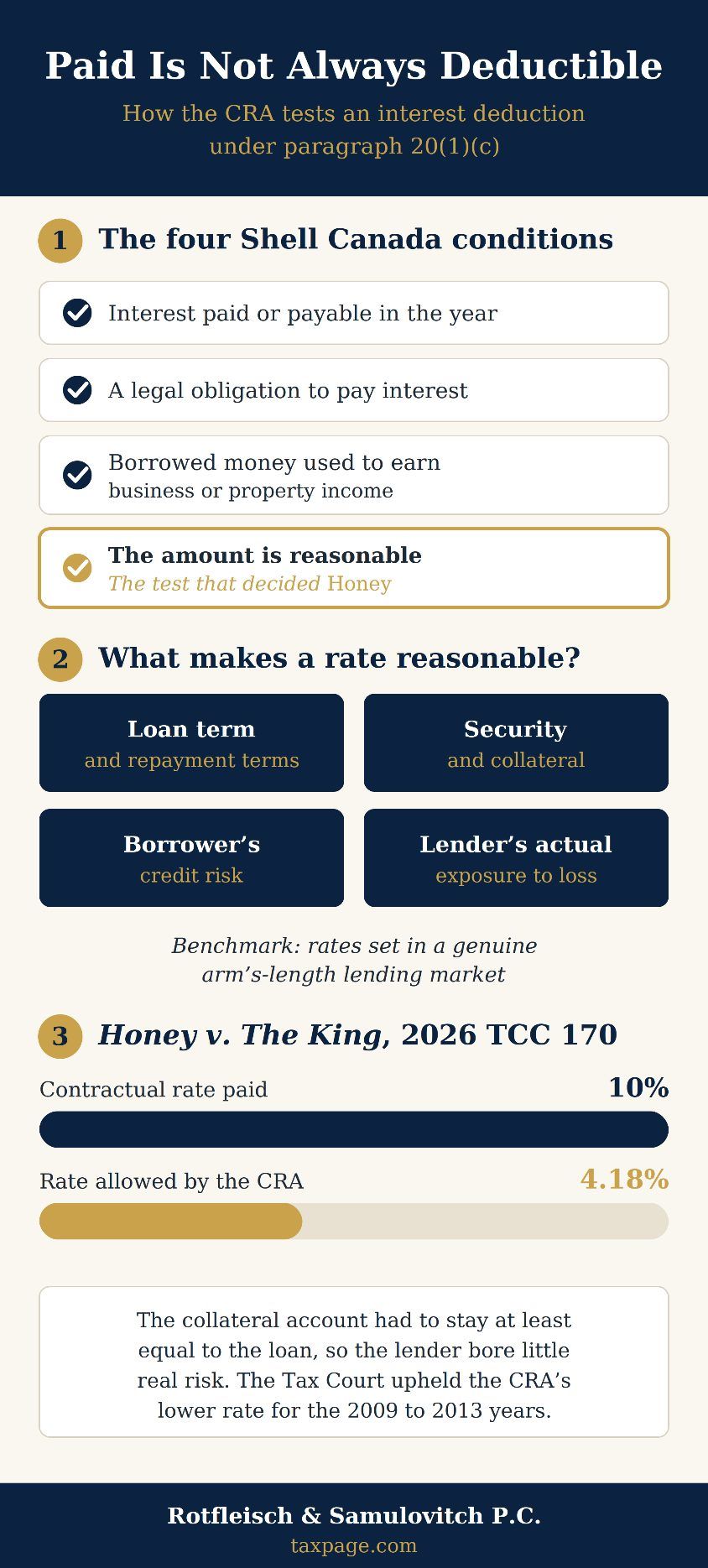
That limitation was central in Honey v. The King, 2026 TCC 170. Glenn and Greg Honey participated in leveraged “10/8” life insurance arrangements under which amounts deposited into collateral investment accounts earned an 8% return while corresponding borrowings carried a 10% interest rate. The borrowed funds were ultimately loaned to their operating company for income-earning purposes, and the brothers claimed deductions based on the full 10% interest they paid.
Following a CRA tax audit, the CRA reassessed the brothers and concluded that 10% was not a reasonable amount of deductible interest. Instead, the CRA allowed deductions using a 4.18% rate. The Tax Court upheld the CRA tax reassessments, finding that the 10% contractual rate was not adequately supported by comparable market evidence given the structure of the loans and the limited economic risk borne by the lender.
The decision is important because it distinguishes between the interest rate that parties contractually agree to pay and the amount that the Income Tax Act permits the taxpayer to deduct. In determining reasonableness, the Court considered economically comparable lending rates, the term of the borrowing, security and collateral, and the lender’s actual exposure to credit and repayment risk. A contractual interest rate is therefore not necessarily conclusive for tax purposes.
“Taxpayers should not assume that an interest expense is fully deductible simply because the rate appears in a valid loan agreement and the interest was actually paid. The reasonable-amount requirement requires a separate examination of the economic terms of the borrowing, including whether the claimed rate can be supported by genuinely comparable market evidence,” says David J. Rotfleisch, founding tax lawyer and CPA at Rotfleisch & Samulovitch, and a Law Society of Ontario Certified Specialist in Taxation.
Honey concerned the 2009 to 2013 taxation years, before subsection 20(2.01) was introduced to prevent deductions under paragraphs 20(1)(c) and (d) for 10/8 amounts in respect of periods after 2013, so it should be read for its reasonable-amount analysis rather than as confirming that an equivalent 10/8 arrangement would work today. If the CRA challenges an interest deduction following a CRA tax audit, an experienced Canadian tax lawyer can assess whether the CRA relied on appropriate market comparators and whether the relevant documentation supports the interest rate claimed.
Background: How the Honey Brothers’ 10/8 Life Insurance Arrangement Worked
Glenn and Greg Honey were brothers involved in an agricultural machinery manufacturing business and were directors and officers of Honey Bee Manufacturing Ltd. In 2006, each entered into a “10/8” universal life insurance arrangement with RBC Life Insurance Company. The policies included a $19 million base death benefit and allowed additional deposits into a collateral investment account that generated a guaranteed annual return of 8%.
Each brother also obtained an investment credit facility from RBC. Under the structure, amounts deposited into the collateral investment account were required to correspond substantially with the amounts borrowed under the credit facility. The borrowed amounts carried interest at 10%, while the collateral investment account earned 8%. The life insurance policies were assigned to RBC as security for the borrowing.
During the taxation years at issue, the brothers drew funds from Honey Bee Manufacturing Ltd., deposited those amounts into their collateral investment accounts, and then borrowed approximately corresponding amounts from RBC at the 10% interest rate. The borrowed funds were subsequently loaned back to Honey Bee Manufacturing Ltd. for use in earning business income.
For their 2009 through 2013 taxation years, Glenn and Greg claimed interest deductions based on the full 10% interest they paid under the credit facilities. Following CRA tax audits, the CRA reassessed them on the basis that 10% was not a “reasonable amount” of deductible interest under subparagraph 20(1)(c)(i) of the Income Tax Act. The CRA instead allowed interest deductions using a rate of 4.18%.
The brothers appealed the CRA tax reassessments to the Tax Court of Canada. They argued that the 10% rate was reasonable because similar 10/8 life insurance products were available in the market. The CRA took the position that the appropriate comparison was with lending of similar risk and duration, rather than with other 10/8 arrangements.
The Tax Court dismissed both appeals. The central issue was not whether the brothers had actually paid 10% interest, but whether that amount satisfied the separate statutory requirement that the deductible interest be a “reasonable amount.”
Key Issues and Findings: What Does “Reasonable Amount” Mean for an Interest Deduction?
Subparagraph 20(1)(c)(i) of the Income Tax Act does not permit a taxpayer to deduct an unlimited amount of interest simply because the interest was legally payable and actually paid. The provision contains a separate reasonableness requirement. In effect, the deductible amount is limited to the lesser of the interest actually paid or payable and a reasonable amount in respect of the borrowing.
The Supreme Court of Canada addressed this requirement in Shell Canada Limited v. Canada, [1999] 3 S.C.R. 622. The Court identified four elements that must be satisfied for an interest deduction under subparagraph 20(1)(c)(i): the interest must be paid or payable in the relevant year, there must be a legal obligation to pay it, the borrowed money must be used for the purpose of earning income from a business or property, and the amount claimed must be reasonable.
The fourth requirement is distinct from the other requirements, although reasonableness is assessed in the context of the borrowing and the other elements of paragraph 20(1)(c). A taxpayer may establish that money was genuinely borrowed, that interest was actually paid, and that the borrowed funds were used to earn income, yet still be denied part of the deduction if the interest claimed exceeds a reasonable amount. The use requirement is itself governed by a direct-tracing test that the Supreme Court of Canada confirmed in Singleton v. Canada, 2001 SCC 61, as explained in our analysis of when an interest expense is deductible.
In Shell Canada, the Supreme Court explained that an interest rate established in a genuine market of lenders and borrowers dealing at arm’s length will generally be reasonable. The analysis therefore looks beyond the wording of the loan agreement and asks whether the claimed rate is supported by economically meaningful market evidence.
The CRA’s current administrative position is consistent with this approach. Income Tax Folio S3-F6-C1, Interest Deductibility, states that the deductible amount is limited to the lesser of the interest actually paid or payable and a reasonable amount, and that prevailing market rates for debts with similar terms and credit risks should be considered when assessing reasonableness. Although the CRA’s administrative guidance is not law and is not binding on the courts, it provides useful guidance on how the CRA currently applies the reasonable-amount requirement in paragraph 20(1)(c).
Relevant factors can include the term of the loan, the security provided, the borrower’s creditworthiness, repayment terms, guarantees, currency, and the actual credit or liquidity risk borne by the lender. A comparison with another loan is useful only if the loans are sufficiently similar in those respects.
That principle became central in Honey. The issue was not whether the brothers had a contractual obligation to pay interest at 10%. The question was whether 10% represented a reasonable amount for tax-deduction purposes given the actual economic characteristics of the borrowing.
How Do Courts Determine a Reasonable Interest Rate?
Determining whether an interest rate is reasonable under subparagraph 20(1)(c)(i) requires more than identifying the rate stated in the loan agreement. The analysis focuses on whether the claimed rate is supported by economically comparable borrowing arrangements, taking into account the actual characteristics of the loan.
As noted above, Shell Canada ties reasonableness to rates set in a genuine arm’s-length lending market. The comparison must be tied to a real lending market rather than simply to another transaction with a similar label or structure.
The more fully secured and lower-risk the borrowing, the less persuasive a comparison with higher-risk or unsecured debt may be.
The broader lesson is that a useful comparator must be economically similar, not merely structurally familiar. A taxpayer seeking to support a higher interest deduction should therefore be prepared to show why the proposed comparator reflects similar duration, security, credit risk, repayment conditions, and lender exposure.
Why Did the Tax Court Reject the 10% Interest Rate in Honey?
The Tax Court rejected the 10% rate because the taxpayers did not establish that it reflected a reasonable market rate for borrowing with the same economic characteristics as the RBC investment credit facilities. The Court focused particularly on the level of risk actually borne by the lender and the degree to which the borrowing was secured by the structure itself.
Under the 10/8 arrangements, the collateral investment accounts were required to remain at least equal to the outstanding investment credit facility balances. The life insurance policies were also assigned to RBC as security. As a result, the Court found that RBC faced little or no meaningful funding, liquidity, or repayment risk in relation to the loans.
That feature was important because the taxpayers sought to justify the 10% rate by pointing to other 10/8 products carrying similar rates. The Court was not persuaded that those products represented the type of genuine lending market contemplated in Shell Canada. The 8% and 10% rates were components of a bundled insurance and financing arrangement rather than rates shown to have been produced by independent market forces.
The CRA instead relied on lower-risk market evidence, including 10-year Government of Canada and high-grade corporate bond yields. The CRA’s 4.18% rate fell between the 4.00% and 4.68% 10-year benchmark rates identified in the evidence and was also within the 3.5% to 4.5% range identified by the CRA’s expert.
The taxpayers’ evidence, including their expert evidence, supported the 10% rate mainly by reference to the rates charged under other insurers’ 10/8 products. That approach failed for two reasons that run through the Court’s analysis. First, in a 10/8 product the loan rate is typically set at a fixed spread above the return credited to the investment account, so a 10% rate found elsewhere in the market reflected the same product design rather than an independent assessment of the borrower’s credit risk. Second, those comparators did not account for the feature the Court considered most important: the collateral account and the assigned policies substantially protected RBC from loss, so the relevant benchmark was secured, low-risk debt of a similar term, which is what the CRA’s bond-yield evidence addressed. On that record, the taxpayers did not establish that 10%, or any rate above 4.18%, was reasonable.
The result illustrates that the tax treatment of interest depends on the economics of the borrowing, not merely the contractual rate. Where collateral or other structural protections substantially reduce the lender’s risk, a higher contractual interest rate may be difficult to support as a reasonable amount for purposes of subparagraph 20(1)(c)(i).
Does Circular Financing Automatically Defeat an Interest Deduction?
A circular movement of funds does not automatically prevent an interest deduction under paragraph 20(1)(c) of the Income Tax Act. The legal analysis depends on which statutory requirement is being tested. A financing structure may satisfy the income-earning-purpose requirement while still failing, in whole or in part, because the amount of interest claimed is not reasonable.
That distinction is illustrated by The TDL Group Co. v. Canada, 2016 FCA 67. In that case, funds moved through a series of related entities and were lent interest-free to the group’s ultimate parent for about seven months before an interest-bearing note replaced that loan. The Federal Court of Appeal nevertheless allowed the interest deduction because the relevant inquiry was whether the borrowed money was used for an income-earning purpose when the taxpayer deployed it. The Court did not treat the circular movement of funds, by itself, as fatal to the income-earning-purpose test; it also ultimately accepted the reasonableness of the interest in the circumstances.
Honey addressed a different issue. The question was not primarily whether the borrowed funds had an income-earning purpose, but whether the 10% interest claimed was a reasonable amount. The Tax Court considered the circular nature of the 10/8 arrangement relevant because the borrowers effectively supplied funds into the collateral investment accounts before drawing substantially corresponding amounts under the credit facilities.
That structure also reduced the lender’s economic exposure, which, as discussed above, weakened the taxpayers’ argument that a 10% rate reflected an arm’s-length market rate for economically comparable debt.
The practical distinction is therefore important. Circular financing does not automatically eliminate an interest deduction, but the way funds move through the structure, the collateral protecting the lender, and the lender’s actual economic risk can all affect whether the claimed interest rate is reasonable under subparagraph 20(1)(c)(i).
Practical Implications: Do the Current 10/8 Rules Still Allow the Same Result Today?
Honey v. The King must be understood in its historical context. The 10/8 arrangements at issue were established in 2006, and the disputed interest deductions related to the 2009 through 2013 taxation years. The case therefore concerned the tax treatment of these arrangements before Parliament introduced specific restrictions targeting 10/8 life insurance structures.
Following the 2013 Federal Budget, the Income Tax Act was amended to restrict the tax benefits associated with certain 10/8 policies. In particular, subsection 20(2.01) prevents a deduction under the interest-deduction rules in paragraphs 20(1)(c) and 20(1)(d) for specified amounts paid or payable in connection with a 10/8 policy. The restrictions generally apply to relevant amounts paid after March 20, 2013 for periods after 2013.
The statutory restrictions apply only where the life insurance policy meets the definition of a “10/8 policy” in subsection 248(1). In general terms, that definition links the policy to borrowing or a policy loan and requires a specified relationship between the borrowing and the policy’s investment account. Accordingly, not every leveraged life-insurance arrangement is automatically a 10/8 policy for purposes of subsection 20(2.01).
The amendments also affect other tax consequences associated with policy-linked borrowing, including the deduction involving collateral life insurance under paragraph 20(1)(e.2) (see our overview of the deductibility of life insurance premiums). As a result, the legislative framework applicable to a modern 10/8 arrangement is materially different from the rules governing the historical transactions considered in Honey.
This distinction is important when interpreting the Tax Court’s decision. Honey confirms that, under the rules applicable to the years before the Court, the “reasonable amount” limitation could independently reduce an otherwise qualifying interest deduction. It does not establish that a taxpayer entering into an equivalent 10/8 arrangement today would be entitled to an interest deduction subject merely to determining a reasonable rate.
Accordingly, Honey remains relevant for the broader interpretation of the reasonable-amount requirement under paragraph 20(1)(c), particularly where the CRA challenges the interest rate claimed on leveraged financing. However, taxpayers considering policy-linked borrowing today must first determine whether the specific statutory restrictions applicable to 10/8 policies prevent or limit the deduction before reaching the separate question of whether the interest rate is reasonable.
How Honey Applies to Shareholder, Family and Related-Party Loans
Few taxpayers will ever hold a 10/8 policy, but many borrow from a shareholder, a family member or a related corporation. The reasonable-amount requirement in subparagraph 20(1)(c)(i) applies to those loans in exactly the same way. The CRA often reviews them closely during a CRA tax audit because the parties do not deal at arm’s length, and the rate may reflect family or corporate-group objectives rather than market forces. An above-market rate also moves income from the borrower to the lender, which is one more reason the CRA scrutinizes these arrangements.
Honey strengthens the CRA’s position in these cases. The lender in Honey was an arm’s-length financial institution, yet the Tax Court still upheld the CRA’s use of a rate well below the contractual 10% because collateral substantially protected the lender from loss. Where the lender is related to the borrower, the taxpayer cannot point to independent parties having negotiated the rate, so the evidentiary burden of showing a market rate is, if anything, heavier.
Because there is usually no independent lender to rely on, the taxpayer should assemble market evidence before the loan is advanced. Useful evidence can include written quotes or term sheets from a bank for a loan with the same term, security and repayment schedule, published rates for similar commercial or personal lending, evidence of the borrower’s actual credit profile, and a written loan agreement that records the rate, the security, the repayment terms and the consequences of default. An unsecured demand loan may justify a higher rate than a fully secured term loan, but only if the documents show that the lender genuinely bears that risk.
The CRA’s prescribed rate is not a substitute for this analysis. The prescribed rate is used for other purposes, such as calculating taxable benefits on certain shareholder and employee loans and applying the attribution rules, and it does not set either a ceiling or a floor for deductible interest under paragraph 20(1)(c). A related-party loan at or above the prescribed rate can still be challenged if the rate exceeds what an arm’s-length lender would charge for comparable borrowing, while a rate below the prescribed rate may raise separate issues under those other rules.
Taxpayers should also review the lender’s side of the transaction. Interest received by a related individual or corporation is generally taxable to the recipient, and where family members are involved, the tax on split income rules and the attribution rules may need to be considered. An experienced Canadian tax lawyer can review the loan terms and the supporting market evidence before the rate is set, which is far less costly than defending the rate after a CRA tax reassessment.
What Evidence Should Support a Claimed Interest Rate?
A taxpayer claiming an interest deduction under paragraph 20(1)(c) should be prepared to support more than the existence of a loan agreement and proof that interest was paid. Where the CRA challenges the amount deducted, the evidence should address the legal obligation, the use of the borrowed funds, and the economic characteristics that make the claimed interest rate reasonable.
Relevant documentation may include the loan agreement, principal balances, payment and accrual records, tracing schedules showing how the borrowed funds were used, and evidence establishing the income-earning purpose of the borrowing. The taxpayer should also preserve the complete security and collateral arrangements because those terms may materially affect the lender’s actual economic exposure.
Evidence supporting the interest rate itself is equally important. Market comparators should involve debt with sufficiently similar terms, duration, security, credit risk, guarantees, and repayment characteristics. A higher rate charged in a different transaction may provide little support if that borrowing exposed the lender to materially greater risk.
Independent expert evidence may also be useful where the appropriate market rate is disputed, but the expert analysis should be based on genuinely comparable lending conditions. As Honey shows, evidence built on comparators that share a product’s label but not its risk profile will carry little weight.
In practice, a taxpayer challenging a CRA tax reassessment should build the evidentiary record around the actual economics of the borrowing. A contractual rate may establish what was paid, but comparable market evidence is what helps establish whether that amount is reasonable for purposes of paragraph 20(1)(c). If the CRA disputes the amount of an interest deduction, a top Canadian tax lawyer can assess the financing structure, the relevant market comparators, and the evidentiary record needed to support the claimed rate.
Takeaway: What Honey Means for Interest Deductions and Reasonable Rates
Honey v. The King confirms that actually paying interest does not, by itself, establish that the full amount is deductible under paragraph 20(1)(c) of the Income Tax Act. The reasonable-amount requirement operates as a separate statutory limitation, so the deductible amount may be lower than the contractual interest rate.
The reasonableness analysis depends on the economic characteristics of the borrowing, so a useful market comparator must be economically comparable, not merely part of a financing arrangement with a similar name or structure.
In Honey, the taxpayers were unable to establish that the 10% interest rate reflected a reasonable market rate for the borrowing at issue. The Tax Court emphasized that the collateral investment accounts substantially protected RBC and that the 10/8 rates were components of a bundled arrangement rather than rates shown to have resulted from independent market forces.
The case also shows that circular financing does not automatically eliminate an interest deduction. The purpose test and the reasonable-amount test are distinct. Circularity, collateral, and the movement of funds may nevertheless be relevant when assessing the lender’s actual risk and whether the claimed rate is commercially reasonable.
Taxpayers should also be cautious about applying Honey directly to modern 10/8 life insurance arrangements. The case concerned historical taxation years, and subsequent amendments, including subsection 20(2.01), now specifically restrict certain interest amounts associated with 10/8 policies. Honey is therefore most important as an authority on the reasonable-amount limitation rather than as approval of equivalent arrangements under current law.
“Honey shows that the amount a taxpayer actually pays under a loan agreement is not necessarily the amount the Income Tax Act permits the taxpayer to deduct. When the CRA challenges the interest rate, the strength of the taxpayer’s evidence on comparable market rates, collateral, and the lender’s actual economic risk can become decisive,” says David J. Rotfleisch.
Pro Tax Tips: Supporting an Interest Deduction Before a CRA Tax Audit
Taxpayers claiming significant interest deductions should document the borrowing before a CRA tax audit begins. A loan agreement and proof that interest was paid are important, but they may not be enough where the CRA disputes whether the amount claimed is reasonable under paragraph 20(1)(c) of the Income Tax Act. The supporting record should also explain how the borrowed funds were used, the security provided, the term of the borrowing, and the lender’s actual economic exposure.
Where the interest rate is materially higher than prevailing market rates, taxpayers should be prepared to explain why. A comparison with another loan charging the same nominal rate may carry little weight if the underlying risks are materially different.
Honey also demonstrates the importance of examining the entire financing structure rather than focusing only on the contractual interest rate. Where collateral or linked investments substantially protect the lender from loss, those protections may affect what constitutes a reasonable interest rate for tax purposes.
If the CRA reassesses an interest deduction, the taxpayer should review the CRA’s own market comparators critically. The relevant question is not simply whether the CRA selected a lower rate, but whether the comparison reflects borrowing with sufficiently similar terms and economic risk. Independent financial or expert evidence may become important where the appropriate market rate is genuinely disputed.
“Where the CRA challenges an interest deduction, the analysis should not stop at whether the taxpayer paid the interest. The financing documents, market evidence, collateral and lender risk should all be reviewed to determine whether the amount claimed can be defended as reasonable under the Income Tax Act,” says David J. Rotfleisch.
Where a taxpayer discovers that prior interest deductions may have been overstated or otherwise incorrectly reported, the CRA’s Voluntary Disclosures Program (VDP) may be worth considering before a CRA tax audit or investigation begins. Under Information Circular IC00-1R7, an unprompted disclosure is normally eligible for 100% penalty relief and 75% interest relief, while a prompted disclosure, made after the CRA has contacted the taxpayer about the specific issue, is normally eligible for up to 100% penalty relief and 25% interest relief. The underlying tax remains payable in either case.
Eligibility depends on several conditions, including making the application before a CRA tax audit or investigation has been initiated in relation to the disclosed issue, providing complete information, and satisfying the applicable filing and payment requirements. The CRA has also indicated that voluntariness is assessed issue by issue, so a CRA tax audit of an unrelated matter does not necessarily bar a disclosure of overstated interest deductions, although a routine CRA notice touching the same issue will likely result in prompted treatment. Our guide to the overhauled VDP explains these tiers in more detail.
Frequently Asked Questions (FAQs): Interest Deductions and Reasonable Interest Rates
Can I deduct all the interest I actually paid on a loan?
Not necessarily. Paragraph 20(1)(c) of the Income Tax Act limits an otherwise qualifying interest deduction to the lesser of the amount actually paid or payable and a reasonable amount. Paying the contractual rate does not automatically establish that the full amount is deductible.
What does “reasonable amount” mean for an interest deduction?
The reasonable-amount requirement looks at whether the claimed interest rate is supported by economically comparable borrowing. Relevant factors can include the loan term, security, collateral, credit risk, repayment terms, guarantees, currency, and the lender’s actual exposure to loss.
Can the CRA reduce my interest deduction even if the loan agreement requires a higher rate?
Yes. A contractual interest rate establishes what the taxpayer agreed to pay, but it does not necessarily determine what is deductible for tax purposes. In Honey v. The King, 2026 TCC 170, the taxpayers paid interest at 10%, but the CRA allowed a deduction based on 4.18%, and the Tax Court upheld the CRA tax reassessments.
Why did the Tax Court reject the 10% interest rate in Honey?
The Court was not satisfied that the 10% rate was supported by comparable market evidence. It emphasized that the collateral investment accounts substantially protected the lender and that the lender faced little meaningful repayment risk. The Court also rejected the argument that other 10/8 products charging 10% necessarily established an appropriate market rate.
What kinds of loans should be used as market comparators?
Useful comparators should have sufficiently similar economic characteristics, including duration, security, collateral, credit quality, repayment conditions, and lender risk. A loan with a similar nominal interest rate may provide little assistance if its underlying risk is materially different.
Does circular financing automatically prevent an interest deduction?
No. Circular financing does not automatically defeat the income-earning-purpose requirement. However, the structure and movement of funds may still be relevant to other aspects of paragraph 20(1)(c), including whether the lender bears sufficient economic risk to justify the interest rate claimed.
Does collateral affect whether an interest rate is reasonable?
It can. Strong collateral may reduce the lender’s credit and repayment risk. In Honey, the collateral investment accounts were required to correspond substantially with the outstanding borrowing, which was an important factor in the Court’s assessment of the lender’s limited risk.
Are 10/8 life insurance arrangements treated the same way today?
No. Honey concerned arrangements established before Parliament introduced specific restrictions targeting 10/8 policies. Subsection 20(2.01) now restricts certain policy-linked interest amounts, so Honey should not be read as confirming that an equivalent modern arrangement would qualify for an interest deduction.
What evidence should I keep to support an interest deduction?
Relevant evidence may include the loan agreement, payment records, principal balances, tracing schedules showing how borrowed funds were used, security and collateral documents, evidence of the lender’s actual risk, and market comparators involving economically similar borrowing.
What is a 10/8 life insurance arrangement?
A 10/8 arrangement is a leveraged life insurance structure in which amounts are invested in a policy’s investment account, and a corresponding amount is borrowed, with the interest rate on the borrowing tied to the return credited to the account. In the classic version, the borrowing carried 10% interest, and the account earned 8%, and the policyholder deducted the interest. In Honey v. The King, 2026 TCC 170, the borrowed funds were then lent to the brothers’ operating company.
Is the CRA’s prescribed interest rate a safe harbour for a reasonable interest deduction?
No. The CRA’s prescribed rate is used for other purposes, such as calculating taxable benefits on certain shareholder and employee loans and applying the attribution rules. It does not set a ceiling or a floor for a reasonable interest deduction under paragraph 20(1)(c). Reasonableness depends on market rates for borrowing with comparable terms, security and risk.
Can the CRA challenge interest paid on a loan from a family member or related company?
Yes. The CRA closely examines interest paid to non-arm’s-length lenders because the rate may not reflect what an independent lender would charge. The taxpayer should be able to show that the rate matches what arm’s-length lenders charge for similar term, security and credit risk. Honey shows that the CRA can substitute a lower market rate even where the lender is an arm’s-length financial institution, if the loan’s actual risk does not justify the contractual rate.
Are there other rules that can limit an interest deduction?
Yes. Apart from the reasonable-amount limit, interest deductions can be restricted by the thin capitalization rules for certain corporations and trusts with non-resident specified shareholders or beneficiaries, the excessive interest and financing expenses limitation (EIFEL) rules in section 18.2 of the Income Tax Act, the exclusion in subparagraph 20(1)(c)(i) for money borrowed to acquire a life insurance policy, and subsection 20(2.01) for 10/8 policies. A seasoned Canadian tax lawyer can identify which of these rules applies before a deduction is claimed.
How far back can the CRA reassess an interest deduction?
The CRA can generally reassess within the normal reassessment period, which is three years from the date of the original notice of assessment for individuals and Canadian-controlled private corporations and four years for most other corporations. The CRA can go further back where the taxpayer signed a waiver or where a misrepresentation was attributable to neglect, carelessness, wilful default or fraud. Longer periods can also apply to certain transactions with non-arm’s-length non-residents.
What should I do if the CRA challenges my interest deduction after a tax audit?
The taxpayer should review both the legal requirements for deductibility and the CRA’s reasonable-rate analysis. Particular attention should be given to whether the CRA’s market comparators genuinely reflect similar term, security, credit risk, and lender exposure. An experienced Canadian tax lawyer can also assess the CRA tax reassessment and the available objection and appeal rights. A notice of objection generally must be filed within 90 days of the date of the notice of reassessment.
The content of this article is intended to provide a general guide to the subject matter. Specialist advice should be sought about your specific circumstances.
[View Source]