
Published: November 17, 2020
Last Updated: October 16, 2026
An Overview of Tax Remission Order, Taxpayers’ Last Resort for Tax Relief: Canadian Tax Lawyer Tax Guide
Introduction: Tax Remission Order
The Income Tax Act contains provisions that are carefully crafted and precisely designed to provide taxpayers with various avenues to resolve their tax issues. However, in certain circumstances, the Income Tax Act does not provide taxpayers with adequate relief, or the strict application of its provisions can lead to unfair results.
A tax remission order is a taxpayer’s last resort for relief from tax debt and enforced penalties, including interest, where all other avenues for taxpayer relief have been exhausted. Under subsection 23(2) of the Financial Administration Act, the Governor in Council may remit any tax or penalty, including any interest paid or payable on it, where the Governor in Council considers that the collection of the tax or the enforcement of the penalty is unreasonable or unjust, or that it is otherwise in the public interest to remit the tax or penalty.
Because tax remission orders are discretionary, they are granted only in extraordinary circumstances.
A note on terminology, because it causes confusion. The CRA calls the process a remission review, and what a taxpayer submits is a request for a remission review. The remission order itself is the instrument that issues at the end if the request succeeds. The two terms describe different stages of the same process, and a taxpayer searching for help will encounter both. All remission orders that are granted are published in Part II of the Canada Gazette, naming the taxpayer, the amount remitted, the periods involved and the basis for remission. If you have exhausted all taxpayer relief avenues, it is highly recommended that you contact one of our certified specialists in taxation law for appropriate tax guidance with respect to a possible tax remission order application.
How the Courts Describe Remission
The single most important thing to understand before making an application is how seriously the courts treat the word “extraordinary.”
In Canada (Attorney General) v. Collins Family Trust, 2022 SCC 26, the Supreme Court of Canada described a remission order under section 23 of the Financial Administration Act as an extraordinary remedy, to be granted by the Governor in Council in rare circumstances on a ministerial recommendation, citing Fink v. Canada (Attorney General), 2019 FCA 276. In the same passage the Court adopted the observation that the ability to apply for remission through an Order in Council is restrictive, uncertain, complex and slow.
That is the Supreme Court of Canada characterizing the process, not a critic of it. A taxpayer considering remission should plan around a long timeline and a low base rate of success, and should not treat remission as a substitute for pursuing an objection or an appeal on time.
The Federal Court of Appeal has also addressed how the CRA’s guidelines operate. In Escape Trailer Industries Inc. v. Canada (Attorney General), 2020 FCA 54, the Court dismissed an appeal from a refusal to recommend remission of GST/HST and interest, and in doing so rejected an argument that Waycobah First Nation v. Canada (Attorney General), 2011 FCA 191, requires the CRA to consider factors the taxpayer did not actually raise in the remission request. The practical lesson from Escape Trailer is that the application defines the scope of the review. A ground that is not asserted in the request is unlikely to rescue the application later.
“A tax remission order serves as a final recourse for taxpayers seeking relief from tax debt and enforced penalties, including interest, when all other means of taxpayer relief have been exhausted. Because tax remission orders are discretionary, they are only granted in exceptional circumstances.”
David J. Rotfleisch, Certified Specialist in Taxation Law (Law Society of Ontario)
Application for Tax Remission Order: The Process
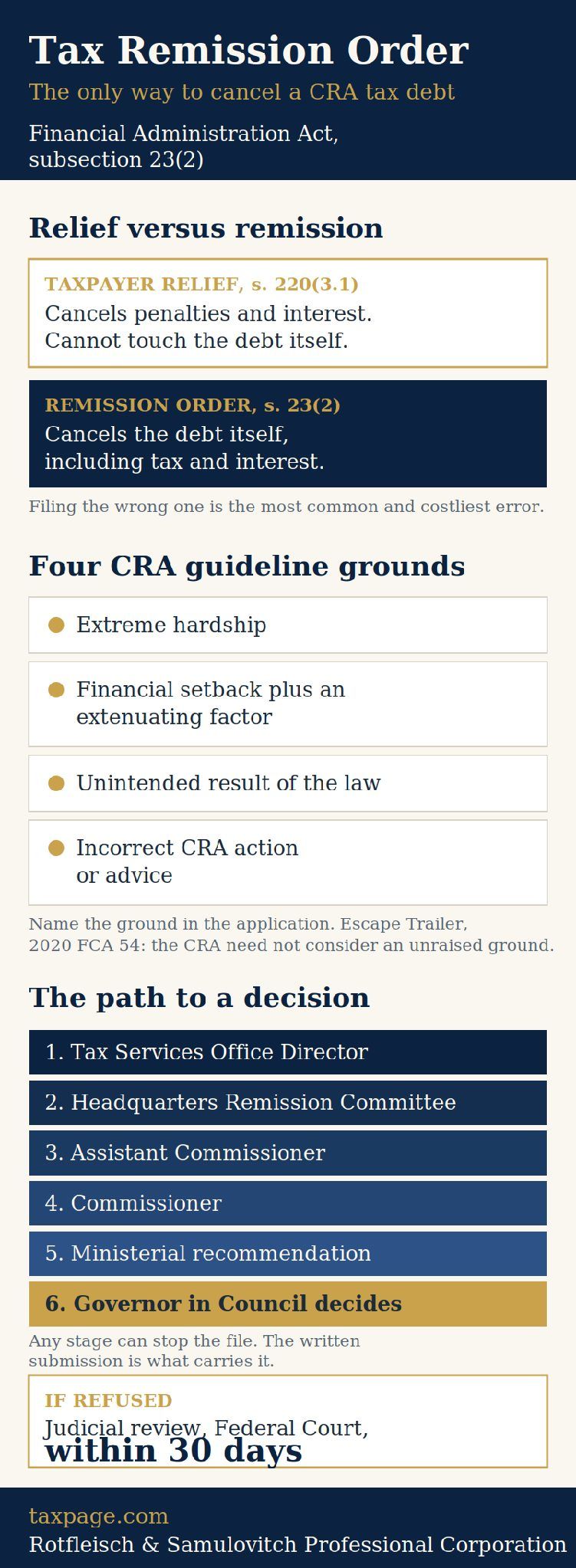
A taxpayer seeking a tax remission order must begin by submitting an application to the Director of his or her Tax Services Office requesting a tax remission order. The Director will either recommend for or against the remission order. If the Director recommends in favour of the tax remission order, the application will be forwarded to the Headquarters Remission Committee in Ottawa, which will make further recommendations.
A formal decision on recommending the application is then made by the Assistant Commissioner for the Legislative Policy and Regulatory Affairs Branch of the Canada Revenue Agency. If that decision is positive, it is forwarded to the Commissioner for the Legislative Policy and Regulatory Affairs Branch of the CRA. If the Commissioner’s decision is positive, the application proceeds up to the ministerial level for a recommendation, and is then recommended to the Governor in Council, which is responsible for making the final decision.
Every one of those stages is a place where the application can stop. This is why the initial submission matters so much: no one further along the chain will build the taxpayer’s case for him or her.
A Remission Order Is Not a Reassessment
A point that is regularly misunderstood, and that matters to expectations. If remission is granted, the CRA applies the authorized credit to the taxpayer’s account. The underlying assessment is not changed and no reassessment is issued.
This follows from what remission is. A remission review does not ask whether the CRA assessed correctly. It asks whether collecting a validly assessed amount is unreasonable or unjust, or whether relieving it is in the public interest. A taxpayer who believes the assessment itself is wrong is in the wrong process and should be filing a notice of objection within the applicable deadline. Incorrect action or advice by CRA officials can still be relevant to a remission request, but as part of the narrative supporting relief rather than as a challenge to the assessment.
What the CRA Remission Guide Covers, and What Counts as “Other Debt”
The CRA’s internal framework for these requests is the CRA Remission Guide. It exists to give CRA employees the information needed to review and process a remission request, to promote consistent treatment, and to help them assess whether collection of a tax or enforcement of a penalty is unreasonable or unjust, or whether remission is otherwise in the public interest. It is not binding on the CRA and it is not the law, but it is what the decision maker is actually working from, which is why an application should be written to speak to it directly.
Remission is also not confined to income tax. Subsection 23(1) of the Financial Administration Act defines “other debt” as any amount owing to the Crown other than a tax or penalty, and other debts can include Canada Pension Plan contributions, Employment Insurance premiums, and repayments of income-tested benefits such as the Canada Child Benefit. That last category matters a great deal in practice, because benefit overpayment debts are often the ones a taxpayer has no realistic prospect of paying and no other way to eliminate.
Our companion article on the CRA Remission Guide goes through the Guide’s framework in more detail, including the circumstances in which a remission request is refused.
How to Make the Request, and What It Must Contain
The CRA sets out what a remission request must include, and an incomplete request is one of the published reasons a request is not recommended. Every request must identify the tax years or periods to which the amounts relate and the types of amount at issue, whether tax, interest, penalty or other debt, and must be accompanied by documents adequate to let the CRA verify the circumstances relied on.
Where the request is based on extreme financial hardship, the documentation must show that the taxpayer was not able, is not able, and will not be able to pay the amounts owing while still affording the basic necessities of life. That is a three-part burden covering past, present and future, and it is more demanding than a snapshot of current finances. Form RC921, Remission Financial Disclosure Form for Individuals, may be used, or an equivalent statement of income and expenses, assets and liabilities.
Two further points from the CRA’s published process matter in practice.
A taxpayer relying on extreme financial hardship is expected to have made appropriate attempts to pay the debt before requesting a review. A request that shows no attempt to pay is weaker for that reason alone.
Requesting a remission review generally does not stop collection action. This is the point most taxpayers get wrong. Recovery by set-off against refunds and benefit payments continues while the request is pending unless a separate collections hold is requested and granted, which is why the hold should be sought in writing at the same time as the request rather than afterwards.
Requests may be submitted through My Account, My Business Account or Represent a Client using the option to send a remission request and supporting documents, or on paper.
Application for Tax Remission Order: The Guidelines
An application for a tax remission order should include a holistic view of the taxpayer’s circumstances and outline why payment of taxes or enforcement of penalties, including interest, is unreasonable, unjust or contrary to the public interest, given the taxpayer’s situation. Accordingly, an application for a remission order will only be recommended to the Governor in Council where all other avenues for taxpayer relief have been exhausted, including, but not limited to, objections, appeals and taxpayer relief requests.
The CRA developed the following guidelines for decision makers to apply in determining whether to recommend a remission order request in any given case:
- Extreme hardship;
- Financial setback coupled with extenuating factors;
- Unintended result of the legislation; and
- Incorrect action or advice of CRA officials.
Extreme Hardship
Extreme hardship, in the context of a tax remission order, is relevant to the taxpayer’s income and resources and whether they are sufficient to resolve the tax liability or enforced penalties. An application for a tax remission order must demonstrate that payment of the taxes, penalties or interest owing would cause extreme financial hardship for the taxpayer.
The CRA applies a concrete test. A taxpayer is in extreme financial hardship where current and anticipated resources are not enough to pay the amounts owing and still afford the basic necessities of life, which the CRA treats as including healthy food, safe and suitable shelter, clothing, transportation, uninsured medical expenses, basic internet or cell phone service, utilities, childcare and education. The taxpayer must show that after taking account of existing funds and assets, rearranging finances, and the possibility of borrowing, he or she cannot meet the tax obligation and still afford those necessities.
Earlier firm commentary described this ground by reference to Statistics Canada’s low income cut-offs. The CRA’s current published guidance uses the low income measure instead, and the comparison is to annual family income for the relevant household size. The hardship should exist at the time of the request and will normally have existed when the debt first arose.
The CRA generally considers remission under this ground only where the hardship exists at the time the request is made, and it examines ability to pay across the whole period under review. In assessing severity the CRA looks at current ability to pay, disposable income and whether expenses are modest and reasonable, age, health and income levels, annual family income measured against Statistics Canada’s low income measure for the relevant household size, and future earning potential. Form RC921, Remission Financial Disclosure Form for Individuals, may be used to present this, or an equivalent statement of income, expenses, assets and liabilities.
This ground rarely assists corporations, which will not generally be considered on hardship unless the financial difficulty would force the corporation to cease operating and adversely affect a large group of people or a community. It does not assist trusts and estates at all, because the concept of affording the basic necessities of life does not apply to such an entity.
id="financial-setback-coupled-with-extenuating-factors") Financial Setback Coupled with Extenuating Factors
A tax remission order may be recommended in circumstances where an additional tax debt would strain the taxpayer’s limited access to financial resources. However, financial setback is viewed by the courts as less severe than extreme hardship. Financial setback involves determining the significance of the amount of the tax liability involved for the taxpayer. For this guideline to apply, a significant financial setback must be present as well as at least one extenuating factor. The two main extenuating factors are:
- Circumstances beyond a taxpayer’s control; and
- Taxpayer error.
Circumstances beyond a taxpayer’s control may include, but are not limited to, a series of illnesses, which may warrant consideration for a tax remission order. However, the fact that a taxpayer made an error that led to excess tax liability does not in itself constitute an extenuating factor. If there is sufficient evidence shedding light on a taxpayer error that should have been detected and corrected by CRA officials, this may constitute an extenuating factor and warrant consideration for a remission order.
In Mokrycke v. Canada (Attorney General), 2020 FC 1027, the taxpayer missed the 90-day deadline to file an objection with the CRA in response to reassessments issued against him for the 2005 and 2006 taxation years. As a result, the CRA issued a Notification of Confirmation confirming the reassessed amounts. The cover letter accompanying the notification indicated that if the taxpayer disagreed with the CRA’s decision, he could appeal to the Tax Court of Canada. However, the taxpayer also missed the 90-day deadline to file a notice of appeal with the Tax Court of Canada. The Federal Court set aside the CRA’s decision to deny the taxpayer’s remission order request and held that the application must be remitted back to the CRA for reconsideration.
The issue in Mokrycke was whether the CRA’s decision to deny the remission request was unreasonable. In his remission request, the taxpayer argued that the reassessments were inaccurate due to circumstances beyond his control, specifically that he had not been able to respond effectively to the concerns raised by the CRA tax auditor or to contest the reassessed amounts. The taxpayer had relied on tax professionals to deal with his tax affairs because he was unable to respond to the CRA tax audit for personal and professional reasons. His first accountant was unable to respond to the tax audit and his second accountant failed to pursue the matter. The taxpayer therefore requested relief on the basis that he did not actually owe the taxes and penalties imposed on him.
The Federal Court allowed the taxpayer’s application and explained that it was unreasonable for the CRA to reject the remission request on the basis that the information examined during the remission review did not reveal that the CRA had made any error at the tax audit stage, when this was the exact point in issue. The Federal Court further explained that the CRA failed to provide reasons why it rejected the taxpayer’s argument that the failure of his professional representatives to discharge their responsibilities was an extenuating circumstance.
Mokrycke is the decision most worth understanding in this area, because it identifies the reviewable error that recurs: a refusal that does not engage with the extenuating circumstance actually advanced. It also reminds taxpayers that tax remission orders are discretionary and are not easily granted.
It should be noted that the extenuating factors mentioned above are not exhaustive. Where an extenuating factor other than those mentioned is considered, it must be reasonable in the relevant circumstances and must unequivocally relate to the remission order requested.
Unintended Results of the Legislation
Where a taxpayer alleges that the amount owing is created by or results from unintended consequences of the legislation, including but not limited to the Income Tax Act, the tax result must be unjust and contrary to the scheme of the particular provision in the relevant legislation.
Incorrect Action or Advice of CRA Officials
Where the tax or penalties owing are created by or result from incorrect action or advice of CRA officials, a tax remission order may be warranted. To determine whether a taxpayer took reasonable steps to address an alleged incorrect action or advice of CRA officials, that taxpayer’s personal circumstances should be considered. Accordingly, a tax remission order will be considered where:
- There is no evidence of bad faith on the part of the taxpayer requesting the remission order;
- The taxpayer could not reasonably have been expected to initiate timely actions to avoid or minimize the tax, collect and remit the tax, or claim a GST/HST rebate;
- The taxpayer requested a remission within a reasonable time period to enable CRA officials to properly investigate the matter; and
- There is written evidence to substantiate the fact that CRA officials have taken incorrect action or provided incorrect advice to the taxpayer. In the absence of written evidence, the facts may be verified by other acceptable means.
As stated by the Federal Court in Mokrycke, if CRA officials make an error in assessing tax, the error must have been recognizable at the time of the assessment and not in light of subsequent circumstances, such as when a court reverses a previous decision on which the assessment was based. When it is established that an assessment is in error, it must also be established that the taxpayer could not reasonably have been expected to:
- File a waiver;
- File a notice of objection to the assessment;
- Provide new information within the required time limits; or
- Resolve the issue through any other avenue.
Further, actions or advice by CRA officials that may have misled or discouraged the taxpayer from taking timely and appropriate action should also be taken into consideration when deciding on a tax remission order recommendation.
When the CRA Will Not Recommend Remission
Knowing what disqualifies a request is as useful as knowing what supports one. The CRA has published the circumstances in which remission generally is not recommended, and they include requests unsupported by adequate documents, circumstances affecting the population as a whole such as an economic downturn, circumstances that are merely temporary, non-compliance such as a filing history of missed deadlines or participation in avoidance or evasion arrangements, attempts to revisit a CRA tax audit, objection, consent to judgment, minutes of settlement or court decision because the taxpayer was dissatisfied with the outcome, attempts to use remission to extend a missed statutory time limit, and retroactive tax planning after the taxpayer realizes a better alternative existed.
Two of these deserve comment.
The first is the time limit exclusion, which appears to sit awkwardly with Mokrycke. The CRA’s own position resolves it: a taxpayer is generally not expected to have appealed to court where he or she is not disputing the correctness of an assessment and is seeking remission for other reasons, such as a financial setback with an extenuating factor. The exclusion is aimed at using remission as a substitute for an appeal on the merits, not at every taxpayer who missed a deadline.
The second matters a great deal to the situation described in the next section. The CRA generally will not recommend remission where the appropriate recourse lies against a third party rather than the CRA, and it gives as examples a taxpayer who entered into an arrangement with a third party that turned out to be fraudulent, or who engaged a tax professional who made an error. A request grounded in third-party wrongdoing therefore has to be framed with care.
Remission Where the Debt Was Created by Someone Else: Identity Theft, Fraud and Coercion
One category of case has grown considerably since this article was first published, and it fits the guidelines unusually well.
Where a third party has used a taxpayer’s identity to claim benefits, file returns, or incur a liability in the taxpayer’s name, the resulting debt is legally the taxpayer’s but was created by an offence committed against him or her. Benefit overpayments are recovered administratively by set-off against refunds, the Canada Child Benefit and the GST/HST credit, so the taxpayer may find money being taken every month without any step at which anyone weighs the circumstances.
The third-party exclusion noted above has to be addressed head on, and it is distinguishable. The CRA’s examples describe a taxpayer who chose to enter an arrangement that went wrong, whether a fraudulent scheme or a negligent adviser. A victim of identity theft entered into nothing. There was no arrangement, no choice and no recourse against the offender that would produce payment, and in many cases the offender has been criminally charged. An application in this category should draw that distinction expressly rather than leave the reviewer to reach for the exclusion.
Two further points matter for these taxpayers. First, taxpayer relief under subsection 220(3.1) of the Income Tax Act cannot help with the principal, because that provision reaches only penalties and interest. Remission is the only route to cancelling the debt itself. Second, the “circumstances beyond a taxpayer’s control” extenuating factor is close to a paradigm fit where the circumstance is a documented criminal offence rather than an assertion, and police records, charges and bank records showing where the money actually went do work that a taxpayer’s own account cannot.
Our analysis of what a survivor of human trafficking faces when a trafficker claims benefits in her name sets out how such a file is built and sequenced. The CRA’s own published guidance on when to request a remission review sets out the grounds and the disqualifying circumstances. Our overview of the CRA Remission Guide covers how the CRA assesses these requests internally, including repayments of income-tested benefits.
“An application for a remission order will only be put forth to the Governor in Council after all other potential avenues for taxpayer relief have been thoroughly exhausted.”
David J. Rotfleisch, Certified Specialist in Taxation
What Happens After the Request Is Made
The CRA describes its review as thorough, impartial and applied consistently across requests, assessed against the broad terms of section 23 of the Financial Administration Act and against its own guidelines, which it treats as non-exhaustive.
Three things follow that are worth setting expectations on. The CRA has no legal authority to grant remission; only the Governor in Council can issue a remission order, and the CRA advises the taxpayer of that decision. A taxpayer is expected to provide full and complete disclosure of his or her circumstances, so a partial account is a risk rather than a tactic. And the broad public interest considerations the CRA weighs include maintaining the integrity of the legislative appeals process, the self-assessing nature of the Canadian tax system, the taxpayer’s own responsibility to understand and meet tax obligations, and fairness to other Canadians. Those considerations explain why so few requests succeed, and an application that ignores them is arguing past the decision maker.
Takeaway
A tax remission order is genuinely a last resort, and the Supreme Court of Canada has said as much. It is discretionary, it travels a long internal path before anyone with authority to grant it sees the file, and it is available only after objections, appeals and taxpayer relief have been exhausted.
What the case law shows is that the applications that succeed, or that survive judicial review when refused, are the ones that put a specific guideline ground squarely in front of the decision maker with supporting evidence attached. Escape Trailer shows that a ground not raised will not be considered. Mokrycke shows that a ground that is raised must be engaged with. Everything therefore turns on the quality of the written submission.
Pro Tax Tips: Tax Guidance and Tax Remission Orders
A tax remission order is an extraordinary measure and it is difficult to provide exact tax guidance as to whether one will be recommended. While the guidelines above provide a framework within which an application might be supported, they are not exhaustive. A taxpayer’s compliance history with the Income Tax Act and health issues might be taken into consideration in determining whether the collection of a tax debt or enforcement of a penalty is unreasonable, unjust or contrary to the public interest. It is highly recommended that an application include at least one of the guidelines above, and that it name the ground expressly rather than leaving the decision maker to infer it.
According to subsection 165(1) of the Income Tax Act and subsection 301(1.1) of the Excise Tax Act, the limitation period for filing a notice of objection to a notice of assessment or reassessment is on or before the day that is 90 days after the day of sending the notice of assessment. Taxpayers may appeal directly to the Tax Court of Canada to have the assessment vacated or varied, under subsection 169(1) of the Income Tax Act, after either the CRA has confirmed the assessment or reassessment, or after 90 days from filing an objection, without waiting for the objection to be considered by the CRA.
Mokrycke sheds light on some of the challenges taxpayers may experience if they miss the deadline for filing a notice of objection with the CRA or a notice of appeal with the Tax Court of Canada. Missing the deadline to file an objection could make subsequent filings invalid, in which case a Tax Court of Canada appeal cannot be filed. However, in certain cases, missing the limitation period to file a notice of objection to an assessment or reassessment issued by the CRA may be grounds for a tax remission order application to succeed.
Finally, a refusal is not necessarily the end. A refused remission request can be challenged by way of judicial review in the Federal Court, which must generally be commenced within 30 days of the decision being communicated under subsection 18.1(2) of the Federal Courts Act. As we explain in our analysis of judicial review of discretionary decisions by the CRA, judicial review is not a rehearing. The Court reviews the reasonableness of the decision on the record that was before the decision maker and will ordinarily send the matter back for redetermination rather than grant the remission itself.
Inadequate relief from tax debt and enforced penalties, including interest, can create immense financial consequences for taxpayers. If you owe taxes to the CRA and your personal circumstances support the principle that payment of such debt would be unjust, unreasonable or contrary to the public interest, or if you are out of time to file a notice of objection to an assessment or reassessment issued against you by the CRA, please contact our tax law office for tax guidance from one of our top tax lawyers in Toronto.
Frequently Asked Questions
What is a tax remission order?
A tax remission order is an order of the Governor in Council under subsection 23(2) of the Financial Administration Act forgiving all or part of a tax, penalty or interest where collection or enforcement would be unreasonable or unjust, or where remission is otherwise in the public interest. It is the only mechanism that can cancel the principal amount of a tax debt outright.
Who actually grants a remission order?
The Governor in Council, on a ministerial recommendation. The CRA reviews the request and makes recommendations at several levels, but the CRA itself has no authority to grant remission.
How likely is a remission order to be granted?
Rare. The Supreme Court of Canada in Collins Family Trust, 2022 SCC 26 described remission as an extraordinary remedy granted in rare circumstances, and adopted the description of the route as restrictive, uncertain, complex and slow.
How long does a remission request take?
Considerably longer than an objection or a taxpayer relief request. The application passes through the Tax Services Office Director, the Headquarters Remission Committee, the Assistant Commissioner, the Commissioner, the ministerial level, and finally the Governor in Council.
What is the difference between a remission order and taxpayer relief?
Taxpayer relief under subsection 220(3.1) of the Income Tax Act can waive or cancel penalties and interest only, and the ten year limitation period on it was settled in Bozzer v. Canada, 2011 FCA 186. It cannot touch the principal. A remission order can extinguish the underlying tax or benefit debt itself. Applicants routinely file the wrong one and conclude wrongly that they have run out of options.
Do I have to exhaust objections and appeals first?
Yes. A remission application will only be recommended to the Governor in Council where all other avenues have been exhausted, including objections, appeals and taxpayer relief requests.
Can I apply for remission if I missed the objection deadline?
Yes, and Mokrycke, 2020 FC 1027 confirms that missing the objection and appeal deadlines does not by itself bar a remission request. Remission is not a workaround for a missed deadline, but a missed deadline can itself form part of the circumstances relied on.
What are the CRA’s guidelines for remission?
Extreme hardship; financial setback coupled with extenuating factors; unintended results of the legislation; and incorrect action or advice of CRA officials. The list is not exhaustive, but an application should expressly invoke at least one.
Does it matter which ground I rely on?
Yes. Escape Trailer, 2020 FCA 54 confirms that the CRA is not required to consider a factor the taxpayer did not raise in the request. The ground has to be asserted in the application itself.
What happens if my remission request is refused?
You may apply for judicial review in the Federal Court, generally within 30 days of the decision being communicated. The Court reviews whether the refusal was reasonable and will normally send the matter back for redetermination rather than grant remission itself.
Can a remission order cover GST/HST?
Yes. Subsection 23(2) is not confined to income tax, and Escape Trailer, 2020 FCA 54 concerned a remission request for HST and interest.
My tax debt was created by identity theft or fraud committed against me. Is remission available?
It is one of the better fits for the “circumstances beyond a taxpayer’s control” extenuating factor, particularly where the offence is documented by police rather than merely asserted. Remember that taxpayer relief will not cancel the principal, so remission is the route if the debt itself needs to go.
Do I need a Canadian tax lawyer to apply?
You can apply yourself, but the outcome turns almost entirely on the written submission and on identifying the right ground with supporting evidence. Communications with a Canadian tax lawyer are also protected by solicitor-client privilege, which communications with an accountant are not.
The content of this article is intended to provide a general guide to the subject matter. Specialist advice should be sought about your specific circumstances.
[View Source]