
Agreement for summary entry of arbitral award in event of default enforced - Australian court supports the flexibility of international arbitration under the New York Convention
Introduction
"Do not bribe". These are some of the words a company will state in its policies if it adopts a zero tolerance attitude to bribery and corruption. But staying out of trouble with regulators that enforce the various pieces of international anti-corruption legislation goes far beyond words.
What is your company doing to ensure its anti-bribery and corruption policies are believed, enforced and effective?
Australian media has recently been awash with headlines of companies allegedly engaging in corrupt conduct both in Australia and overseas. These companies are facing regulatory investigations, fines and reputational damage. Also, imprisonment is a real prospect for any individuals who are found to be involved in corrupt conduct at any level.
Whether your company is exposed to the provisions for foreign bribery in the Australian Criminal Code or international anti-corruption laws including the US Foreign Corrupt Practices Act ('FCPA') or the UK Bribery Act, simply relying on words in a policy is not sufficient when it comes to anti-bribery and corruption compliance.
In this article, our corruption and fraud risk specialists provide an overview of their recent experiences advising ASX-listed and other companies on how to mitigate the regulatory risks associated with bribery and corruption.
What is your company's culture?If your company is subject to scrutiny by the Australian Federal Police for alleged corrupt conduct, you may be guilty of an offence if a corporate culture existed within your company that directed, encouraged, tolerated or led to non-compliance with the foreign bribery provisions in the Australian Criminal Code!1 |
Better practice compliance
Aside from the ethical and moral issues associated with engaging in corrupt conduct, the serious implications for non-compliance with international anto-corruption legislation means it si imperative for companies to take appripriate action to make sure they stay out of trouble.
We recommend companies implement a specific anti-bribery and corruption compliance program ('ABC Program').
There is limited guidance from Australian authorities on how an ABC Program should be structured. When advising companies, we recommend they follow guidelines provided for the FCPA and the UK Bribery Act, adapted to the specific bribery and corruption risks they face in the industries and countries they conduct business in.
In November 2012, the two US Government regulators responsible for enforcing the FCPA, the Securities and Exchange Commission ('SEC') and Department of Justice ('DOJ'), issued 'A resource Guide to the U.S. Foreign Corrupt Practices Act' ('the Guide').
Applying the Guide provides a useful global benchmark for compliance with other international anti-corruption laws.
The Guide specifies that there are no 'formulaic requirements' regarding an ABC Program and that one size does not fit all but, more broadly, DOJ and SEC will assess such a program on the following criteria:
- Is the compliance program well designed?
- Is it being applied in good faith?
- Does it work?
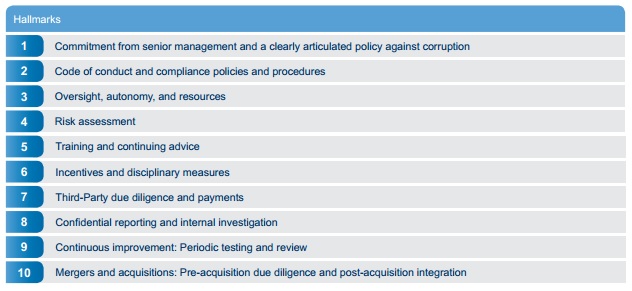
In considering the framework of an effective ABC Program, the Guide specifies 10 hallmarks.
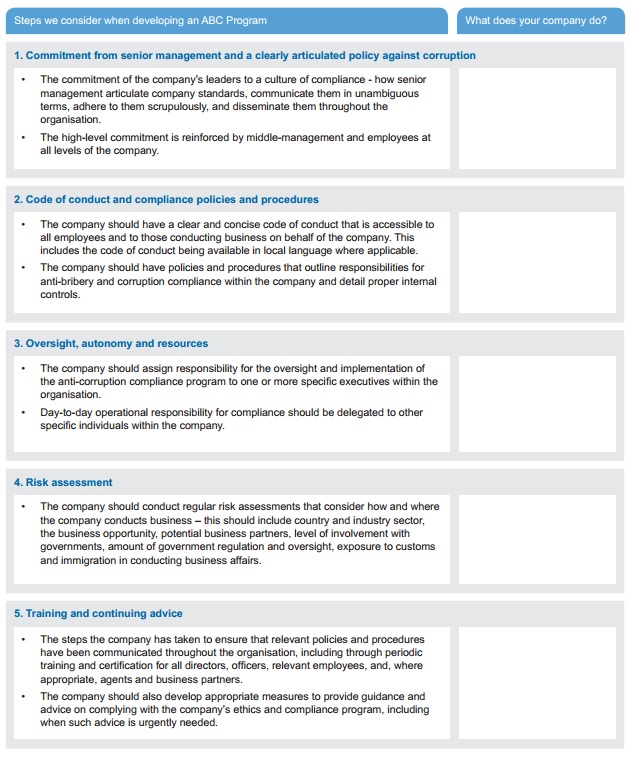
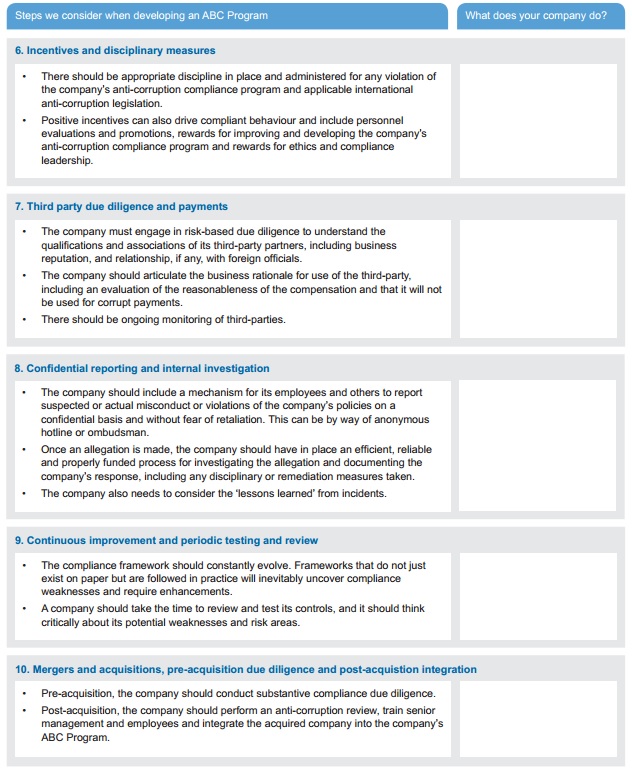
The principles of the 10 hallmarks are similar in nature to the 'Adequate Procedures' guidance issued by the UK Ministry of Justice in connection with the introduction of the UK Bribery Act, as well as the Organisation for Economic Co-operation and Development's 'Good Practice Guidance on Internal Controls, Ethics and Compliance.' We consider these 10 hallmarks when developing and implementing an ABC Program tailored to the needs of our clients.
Practical considerations
Have you considered how your current anti-bribery and corruption compliance activities compare with the 10 hallmarks?
Tailor to your circumstances
It is important that the design of your ABC Program considers the specifics of the anti-corruption laws of the various countries to which your executives and company are exposed.2
For instance, the FCPA focuses on bribery of public officials, but those exposed to the UK Bribery Act need to ensure their ABC Program also covers mitigation of the risks associated with business to business bribery.
Facilitation payments are another area that requires consideration. Such payments are legal under the FCPA and Australian Criminal Code but prohibited by the UK Bribery Act, which classifies them as a type of bribe. They are also illegal under local law in many countries where they are regularly made in practice.
In response to the risks associated with facilitation payments, many companies have implemented a policy to ban them in their ABC Program.
Your ABC Program needs to be tailored to mitigate the specific bribery and corruption risks your company faces and regulatory requirements to which it is exposed. Go beyond words to promote your company's culture of zero tolerance to bribery and corruption. Take action now and avoid being another headline in Australian or international media.
Reward for your effortsThe Guide highlights that both DOJ and SEC understand that 'no compliance program can ever prevent all criminal activity by a corporation's employees'. They further state 'DOJ and SEC may decline to pursue charges against a company based on the company's effective compliance program, or may otherwise seek to reward a company for its program, even when that program did not prevent the particular underlying FCPA violation that gave rise to the investigation'. As we discussed in our Forensic Matters publication 12-04 Stay out of trouble, DOJ and SEC practised what they preached when they declined to take enforcement action against Morgan Stanley following the corrupt actions in China of an employee, Garth Peterson. In this case, DOJ stated '[Peterson] used a web of deceit to thwart Morgan Stanley's efforts to maintain adequate controls designed to prevent corruption'. |
Footnotes
1Division 12 of the Australian Criminal Code
Act 1995
2A company should seek legal advice on the
international anti-corruption laws that may apply.
The content of this article is intended to provide a general guide to the subject matter. Specialist advice should be sought about your specific circumstances.
[View Source]