

Following urgent amendments to the Fair Work Act designed to fast-track the process, the Fair Work Commission has now made a road transport contractual chain order (RTCCO) requiring participants in the road transport industry, including businesses that contract with road transport operators, to provide for recovery of increased fuel costs within road transport contractual chains. In light of the RTCCO’s immediate operation and broad scope, businesses should be taking proactive steps now to assess their position and ensure compliance. What is the RTCCO? The RTCCO is an emergency order made by the Commission following an application by the Transport Workers’ Union and the Australian Road Transport Industrial Organization. The RTCCO is the first order under the Commission’s road transport contractual chain powers in Chapter 3B of the Fair Work Act, and has been made to address fuel cost increases since 6 March 2026 arising from the reduction in shipping through the Strait of Hormuz and conflict in the Middle East. The Commission found that these cost increases are disproportionately impacting vulnerable participants in road transport contractual chains such as owner-drivers and small fleet operators who often lack the bargaining power to renegotiate rates or pass on increased costs. The RTCCO is intended to allow the increased cost of fuel to be recovered by participants in road transport contractual chains and passed on up the chain, with the cost burden ultimately being borne by the end users of road transport services. When is the RTCCO effective? The RTCCO
Following urgent amendments to the Fair Work Act designed to fast-track the process, the Fair Work Commission has now made a road transport contractual chain order (RTCCO)requiring participants in the road transport industry, including businesses that contract with road transport operators, to provide for recovery of increased fuel costs within road transport contractual chains.
In light of the RTCCO’s immediate operation and broad scope, businesses should be taking proactive steps now to assess their position and ensure compliance.
What is the RTCCO?
The RTCCO is an emergency order made by the Commission following an application by the Transport Workers’ Union and the Australian Road Transport Industrial Organization.
The RTCCO is the first order under the Commission’s road transport contractual chain powers in Chapter 3B of the Fair Work Act, and has been made to address fuel cost increases since 6 March 2026 arising from the reduction in shipping through the Strait of Hormuz and conflict in the Middle East.
The Commission found that these cost increases are disproportionately impacting vulnerable participants in road transport contractual chains such as owner-drivers and small fleet operators who often lack the bargaining power to renegotiate rates or pass on increased costs.
The RTCCO is intended to allow the increased cost of fuel to be recovered by participants in road transport contractual chains and passed on up the chain, with the cost burden ultimately being borne by the end users of road transport services.
When is the RTCCO effective?
The RTCCO was issued on 20 April 2026 and became operative on 21 April 2026.
While the RTCCO is intended to be a temporary measure designed to respond to current market conditions, it has no fixed end date. The obligations under the order will only automatically cease to apply if the weekly average national terminal gate price for diesel, as measured in the weekly diesel price report of the Australian Institute of Petroleum, falls below $2.00 per litre.
In addition, the Commission has indicated that it will actively monitor the operation and impact of the RTCCO. The Commission intends to conduct an initial review after one month, followed by further reviews at three-month intervals.
What is a road transport contractual chain?
A road transport contractual chain is defined as a chain or series of contracts or arrangements:
- under which work is performed for a party to the first contract or arrangement in the chain or series by a regulated road transport contractor or a road transport employee-like worker under a services contract, or by an employee; and
- in which at least one party to the first contract or arrangement in the chain or series is a constitutional corporation.
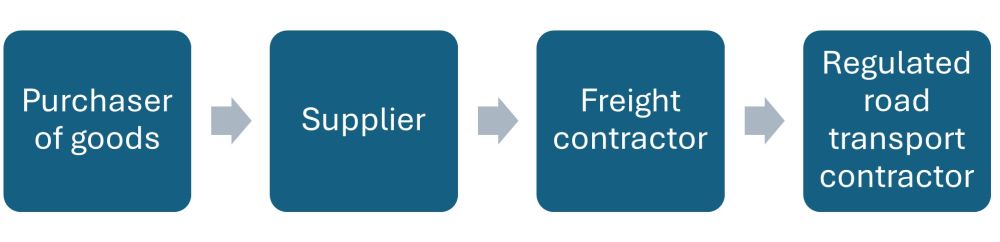
A road transport contractual chain can take different shapes depending on the specific contractual arrangements in place. A typical arrangement will often look like the following:
Who does the RTCCO apply to?
The RTCCO applies to particular parties (other than employees) in road transport contractual chains that involve the performance of work in the road transport industry by regulated road transport contractors, road transport employee-like workers or employees.
The RTCCO applies to:
- primary parties, who are the parties to the first contract or arrangement in the road transport contractual chain. One of the primary parties will be the person who work is performed for in the road transport contractual chain, e.g. the purchaser of particular goods that are being delivered. At least one other primary party will be the party engaging others to undertake road transport industry work, e.g. for delivery of the goods;
- secondary parties, who are the parties to subsequent contracts or arrangements in the road transport contractual chain. This will include the primary party who is engaging others to undertake road transport industry work;
- road transport businesses and digital labour platform operators in the road transport industry;
- road transport employee-like workers (for digital platform work) performing work in the road transport industry; and
- regulated road transport contractors (for non-digital platform work) performing work in the road transport industry.
The ‘road transport industry’ is broadly defined and goes beyond delivery of goods. It includes:
- the road transport and distribution industry within the meaning of the Road Transport and Distribution Award 2020;
- the long distance operations in the private road transport industry within the meaning of the Road Transport (Long Distance) Operations Award 2020;
- the waste management industry within the meaning of the Waste Management Award 2020; and
- the passenger vehicle transportation industry within the meaning of the Passenger Vehicle Transportation Award 2020 (other than transport of passengers by tramway, monorail or light rail).
What is required under the RTCCO?
The RTCCO imposes a series of obligations on parties within a road transport contractual chain.
Primary parties must:
- adjust the rate paid to the other primary party (or parties) for performance of work in the road transport industry by the amount necessary to ensure that the other primary party recovers the increased cost of fuel as compared with prices on or before 6 March 2026;
- take reasonable steps to ensure that secondary parties further down the contractual chain engaging regulated road transport contractors or road transport employee-like workers adjust the rate they pay to those contractors or employee-like workers for the performance of work in the road transport industry by the amount necessary to ensure recovery of the increased cost of fuel.
Secondary parties must adjust the rate they pay to any other secondary party, regulated road transport contractor or road transport employee-like worker by the amount necessary to ensure that the other party recovers the increased cost of fuel.
The rate adjustment obligations must be complied with either within each fortnight or twice per calendar month.
How can businesses comply with the rate adjustment obligations?
The RTCCO provides that parties may adopt a range of approaches, including:
- adjusting the overall rate or components of the rate payable;
- introducing a specific fuel increment or levy;
- providing a direct reimbursement for increased fuel costs; or
- implementing a combination of these measures.
In addition, the rate adjustment obligations can be satisfied by adjustment of rates that accounts for or addresses recovery of the increased cost of fuel under:
- a State or Territory industrial instrument which involves the application of a ‘rise and fall’ formula or cost model;
- a ‘rise and fall’ formula, cost model or cost benchmark in an applicable collective agreement or contract;
- an ongoing or special arrangement between persons in a road transport contractual chain which adjusts the rate in accordance with an agreed ‘rise and fall’ formula, cost model or other benchmarking methodology.
It is permissible to take into account any adjustments implemented prior to commencement of the RTCCO in satisfaction of the obligations imposed by the RTCCO, but whether such existing adjustment mechanisms or arrangements are sufficient to satisfy obligations under the RTCCO will depend on its terms and how it operates in practice. Some comfort may be taken from the Commission’s decision, whereby it was stated that the obligation “is not an exercise in perfection as to cost recovery but rather involves an approximation, albeit one that has a sound and reasonable mathematical basis, of what is necessary to provide for cost recovery.”
How can primary parties comply with their ‘reasonable steps’ obligation to secondary parties?
In its decision, the Commission emphasised that the obligation to take “reasonable steps” to ensure rates for regulated contractors and employee-like workers are increased will depend on the particular circumstances, but does not extend to all steps which might conceivably be taken. Instead, the Commission suggested that this would involve “inquiries to be made and assurance received about how rates have been adjusted to allow for cost recovery”, and likened it to the safety obligations borne by primary parties under the ‘chain of responsibility’ provisions of the Heavy Vehicle National Law.
What dispute mechanisms are available and what are the consequences of non-compliance?
The Commission has jurisdiction to deal with disputes about the implementation or operation of the RTCCO if the parties have already genuinely tried to resolve the dispute between themselves. While the Commission cannot arbitrate disputes without the consent of the parties, the Commission can use other methods to attempt to resolve the dispute, such as mediating, conciliating, making a recommendation or expressing an opinion.
In addition, contravening a term of the RTCCO is a contravention of the Fair Work Act, and claims can be brought in the Federal Court, Federal Circuit and Family Court, or an eligible State or Territory Court by:
- any person covered by the RTCCO who is affected by the contravention and is a party to a contract with the alleged contravener;
- an organisation entitled to represent the industrial interests of such a person; or
- the Fair Work Ombudsman.
The maximum penalty that can be imposed for each contravention is currently $19,800 for an individual and $99,000 for a corporation, and the Court also has power to order compensation and other usual remedies for contraventions of the Fair Work Act.
What steps should businesses be taking?
In light of the RTCCO’s immediate operation and broad scope, businesses should be taking proactive steps to assess their position and ensure compliance, such as:
- Assess whether the RTCCO applies: Businesses should consider which parts of their operations involve (whether directly or indirectly) work performed in the road transport industry within a contractual chain captured by the RTCCO, and whether they are a primary or secondary party (or both) in the chain.
- Review existing contractual arrangements: Businesses should identify whether current arrangements for work in the road transport industry already have price adjustment mechanisms that can can be relied upon to satisfy the RTCCO’s rate adjustment obligations. In some cases, particularly for contracts entered into since early March 2026, existing pricing may already reflect the relevant increased fuel costs. The timing and calculation methodology of any existing adjustment mechanisms will need to be carefully considered.
- Implement processes for price adjustment: Where existing mechanisms are insufficient, businesses should introduce processes to facilitate regular price reviews for the increased cost of fuel.
- Consider “reasonable steps” obligations: Primary parties need to take reasonable steps to ensure that secondary parties comply with the RTCCO. This may include communicating with other parties within the supply chain regarding the RTCCO and setting expectations of compliance.
- Assess broader commercial implications: Even where a business is not directly part of a road transport contractual chain, it may still be indirectly affected. Counterparties who are subject to the RTCCO may seek to pass on increased costs through other contractual mechanisms. Conversely, businesses affected by increased transport costs may consider whether they are able to pass those costs further up the supply chain. In this context, it will be important to review contractual provisions dealing with changes in law, cost increases and cost reimbursement. Contracts operating on a cost-reimbursable basis, in particular, may already provide a basis for recovering increased costs irrespective of whether the contract forms part of a road transport contractual chain.
- Monitor developments and application of the RTCCO: The obligations under the RTCCO will cease to apply if the weekly average national terminal gate price for diesel falls below $2.00 per litre. The Commission will also review the RTCCO after the first month of its operation (i.e. after 21 May 2026). We may also see disputes being agitated within the Commission or Courts that clarify the intended operation of the order. It will be important for businesses to keep pace with these developments to ensure that they comply with any updated guidance about the application of the RTCCO (or, indeed, if it ceases to apply).
The content of this article is intended to provide a general guide to the subject matter. Specialist advice should be sought about your specific circumstances.
[View Source]


