

- within Law Department Performance topic(s)
- in Canada
Why importers who diversified out of China to FTA partners are now squarely in CBP’s forced-labor crosshairs — and the five-step package you need before your first detention notice.
Short summary: CBP just issued two Withhold Release Orders against garment factories in Jordan, a U.S. free trade agreement partner. If you diversified out of China, thinking that solved your forced-labor exposure, this action is your wake-up call. Duty-free status is not a compliance shield. For apparel and textile importers, the window to build a defensible admissibility package is now, before a detention notice arrives.
On June 23, 2026, U.S. Customs and Border Protection (CBP) issued two Withhold Release Orders (WROs) against garments produced by Needle Craft Ltd. and Casual Wear Apparel LLC — two garment-manufacturing factories in Jordan. Effective immediately, CBP will detain all garments produced by these two factories at every U.S. port of entry. These are the fifth and sixth WROs of fiscal year 2026, and they push CBP’s active enforcement docket to 58 WROs and eight Findings under 19 U.S.C. § 1307.
If you read only one sentence of this post, read this one: the country you moved your sourcing to to escape China-related forced-labor risk is not safe by virtue of being a U.S. trade-preference partner. Jordan Apparel enters the United States duty-free under the U.S.–Jordan Free Trade Agreement and the Qualifying Industrial Zone (QIZ) framework. That preferential status did nothing to slow this enforcement action — and it will not slow the next one.
The Challenge: Enforcement Has Gone Global, and Diversification Created New Exposure
For years, the forced-labor conversation in U.S. trade has been dominated by China — Xinjiang cotton, the Uyghur Forced Labor Prevention Act (UFLPA), and the rebuttable presumption. Importers responded rationally: they diversified, shifting apparel and textile sourcing to lower-cost partners, many of them holding U.S. trade-preference status. The unstated assumption was that moving production out of China moved the forced-labor problem with it.
CBP has now spent seven months proving that assumption wrong. In November 2025, CBP issued a WRO against garments, apparel, and textiles produced in Mauritius by Firemount Group — an AGOA duty-free beneficiary — over migrant-worker abuse. Today’s action against two Jordanian factories follows the identical pattern in a U.S.-FTA partner. The throughline is unmistakable: CBP is systematically working the migrant-worker garment corridors outside China, and preferential trade status is not a defense to a Section 307 detention.
The Jordan action is also notable for its severity. Where the Firemount WRO cited four International Labour Organization (ILO) indicators of forced labor, CBP cited seven against Needle Craft and Casual Wear: retention of identity documents, excessive overtime, intimidation and threats, physical and sexual violence, withholding of wages, restriction of movement, and abusive living and working conditions. CBP assembled this record from media reports, official Jordanian government documents, company statements, videos, photographs, victim statements, and non-governmental organization statements.
Mauritius to Jordan: The Same Playbook, Escalating
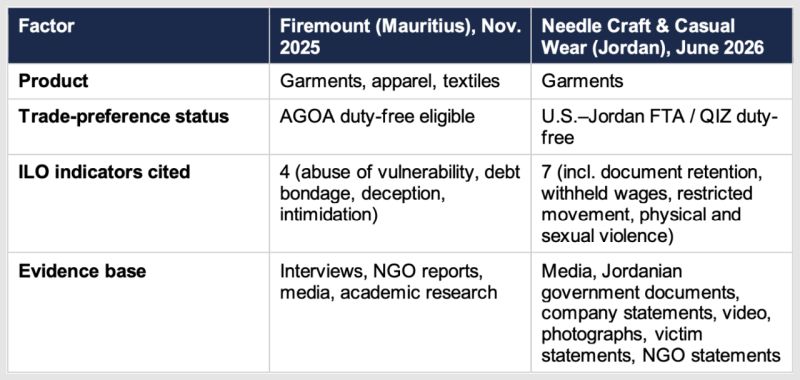
The lesson is not that Jordan or Mauritius is uniquely dangerous. The lesson is that by the time a WRO issues, CBP’s evidentiary record is already overwhelming — built from victim testimony and government records, not a single audit. The reasonable-suspicion threshold is low, the burden then shifts to you, and you will be assembling your supply-chain defense for the first time under a three-month clock. That is the worst possible moment to start.
The Strategy: Build Your Admissibility Package Before You Need It
If your garments are detained under a WRO, you have three options: export the shipment, destroy it, or demonstrate that the merchandise was not produced with forced labor. The third option is the only one that protects your margin — and it is the one that requires evidence you cannot manufacture after the fact. Here is the ranked sequence Diaz Trade Law recommends to importers right now, in priority order.
- Screen your apparel and textile suppliers against active enforcement today. Pull CBP’s active WRO and Finding list and the UFLPA Entity List and check every garment vendor, including indirect ones. If you source from Jordan, confirm immediately whether Needle Craft or Casual Wear sits anywhere in your chain — including as a subcontractor to your nominal supplier.
- Map your supply chain beyond the first tier. CBP’s reasonable-care standard requires you to know how your goods are made “from raw materials to finished goods, by whom, where, and under what labor conditions.” Knowing your direct vendor is not enough; you must know who supplies them. Document every stage of production and every supplier at each stage.
- Assemble the admissibility package now. A defensible package includes the certificate of origin required under 19 C.F.R. § 12.43, a detailed importer statement, and supply-chain tracing documentation that follows the product from raw material to entry. A standard commercial certificate of origin will not satisfy the regulation on its own.
- Put forced-labor compliance into your contracts. Build supplier obligations into your purchase orders and agreements: prohibition of forced labor, disclosure of upstream suppliers and production sites, traceability recordkeeping, audit and inspection rights, restrictions on unauthorized subcontracting, and corrective-action and termination rights. These provisions are your leverage when CBP comes asking.
- Re-screen on a schedule, not once. The active WRO list, the UFLPA Entity List, and the underlying NGO and government reporting all change over time. A one-time vetting at the start of a supplier relationship is not reasonable care. Build periodic re-screening and audit cycles into your compliance program.
Note the Process Change: The Forced Labor Portal Is Now Mandatory
As of January 21, 2026, WRO and Finding admissibility reviews, UFLPA applicability reviews, UFLPA exception requests, and CAATSA exception requests must be submitted through CBP’s Forced Labor Allegation and review portal. If you are caught flat-footed by a detention, you will now be learning the portal mechanics under a deadline as well. One more reason to prepare the substance in advance.
The Outcome: A Level Playing Field If You Move First
CBP’s own framing is that forced-labor enforcement “protects and promotes American economic prosperity” by removing competitors who cut costs through exploitation. For compliant importers, that is genuinely good news — but only if you are positioned to keep your goods moving while non-compliant rivals are stuck at the port.
The importers who will absorb a Jordan-style WRO without a margin-destroying disruption are the ones who treated the Firemount action as a warning rather than a one-off. They mapped their chains, built their packages, and contracted for traceability before the detention notice arrived. The importers who diversified out of China and assumed the problem was solved are the ones who will be exporting or destroying detained shipments at a loss — or scrambling to reconstruct a supply-chain history that no longer exists.
CBP has now told you, twice in seven months, exactly where it is looking. The only question is whether your compliance file is built before your shipment is detained, or after.
The content of this article is intended to provide a general guide to the subject matter. Specialist advice should be sought about your specific circumstances.
[View Source]