

- within Insurance topic(s)
- with readers working within the Insurance, Law Firm and Construction & Engineering industries
- within Wealth Management, Employment and HR and Transport topic(s)
- with Senior Company Executives, HR and Inhouse Counsel
Declining birth rates are reshaping pension systems globally, creating new opportunities and capital flows
Demographic change is becoming a structural driver of life insurance M&A. Declining birth rates and rising life expectancy are reshaping pension systems globally and accelerating private sector involvement in retirement provision.
The impact of declining birth rates
Birth rates in many countries are declining at the same time as life expectancy is increasing. Consequently, the ratio of pensioners to working-age people is increasing. Japan, South Korea and Germany are frequently given as examples, but many other countries are following the same trend.
One by-product of this is governments having increasing difficulties with unfunded pension commitments. This is partly because pension costs increase when there are more pensioners and those pensioners live longer. Government revenues (through certain taxes, like income tax) also reduce, all else being equal, when fewer working-age people bear the tax burden.
The issue is widely recognised, with governments responding in various ways. Some, such as Germany and Spain, are putting in place generational measures to build up reserves for future pensions. Across the European Economic Area (EEA), efforts are being made to modernise and, where possible, simplify the approach to personal pensions products to increase take-up. Many countries are trying to increase the state retirement age, though this often meets strong public resistance.
Employers in many countries are increasingly resistant to bearing the risks associated with providing pensions based on final salaries. The result is that the pensions burden over the coming decades looks likely to fall on the individuals themselves. Some governments have been explicit about this. Australia, for example, has imposed positive legal obligations on industry to develop private-sector longevity-solutions to support retirement incomes, while the UK and Ireland have introduced measures that automatically enrol workers into private pension schemes. Everything is, therefore, pointing towards global growth in private pensions in the coming decades.
How demographic trends are driving growth in life insurance
In many countries, life insurers already play an important role in helping people to save for retirement and then to secure a retirement income. Growth in private pensions represents an opportunity for life insurers.
The projected growth in the global life-insurance and pension de-risking sector has driven a good deal of activity in recent years, but the focus of this article is more specific. When life insurers provide pension products, assets supporting those products accumulate on the life insurers' balance sheets, often staying there for decades. Globally, those assets will be valued in the tens of trillions of dollars.
The relevant part of the life insurance market can be divided broadly into two categories:
- The "capital light" model: Where assets accumulate for the policyholders' benefit (eg, unit-linked pension products), the insurer tends to generate fee-based income. This approach does not usually require high levels of regulatory capital, mainly because the risks faced by the insurers are modest.
- The "capital intensive" model: Where the assets accumulate for the insurer's benefit, the insurer generally relies less on fees. Those assets are typically held by the insurer as capital against some form of guarantee the insurer has given to its policyholders (eg, to pay them income for as long as they live). The insurer's profits in those cases relies to a significant extent on the assets' values (derived from both income and capital appreciation) being more than the corresponding liabilities. This tends to be capital intensive under the applicable solvency regulations as the insurer is exposed to considerable risks.
One by‑product of this is governments having increasing difficulties with unfunded pension commitments.
Impact on capital flows
Whilst there is common ground on the demographic and macro-economic drivers of activity, the scale of the opportunity, the concentration of assets and a spectrum of investor views on which model is the better prospect are resulting in a wide variety of transaction types and investors in the life insurance sector.
Traditional transaction structures and industry incumbents still play a significant part in this. But new structures involving private equity, asset managers and private capital more generally are increasingly driving deal flow, with investment in the sector continuing to be viewed as a strategic investment opportunity.
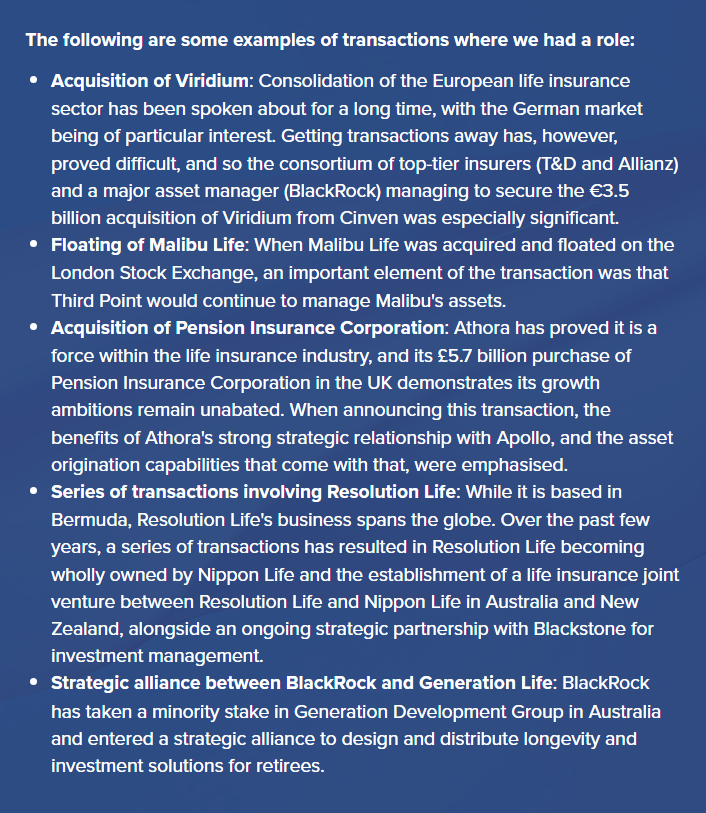
There are also other transaction types that, while focused on capital management, have a lot of similarities with the above transactions. Asset-intensive reinsurance (sometimes called funded reinsurance) can be used to share the risks of defined books of business, including large portfolios of supporting assets.
While these types of transactions have been more common in the US and, to a lesser extent, the UK, national and supra-national regulators have remarked on the increasing use of this type of reinsurance and are looking closely at the risks that might result from it. This has resulted in new regulatory rules and guidance for asset-intensive reinsurance in some jurisdictions, including the US and the UK.
These transactions will continue to be cross-border, highly complex and involve regulatory issues that require true sector expertise.
The content of this article is intended to provide a general guide to the subject matter. Specialist advice should be sought about your specific circumstances.
[View Source]


