
The Bottom Line
- The FTC will continue to use Section 5 to challenge non-transparent fee practices in any industry, not just those covered by the FTC’s Fees Rule. Businesses should ensure that their fee practices comply with the Fees Rule, even where the Rule does not technically apply.
- Fees preselected by default, hidden below the fold, or requiring affirmative action to decline rather than to accept are now squarely within the FTC’s enforcement focus. All optional charges should require affirmative opt-in.
- Descriptions of fees should match what the consumer is actually getting. Even when a consumer voluntarily chooses to pay a fee, it can still be deceptive if the fee was mischaracterized or the consumer does not receive the promised benefit.
On July 2, 2026, the Federal Trade Commission (FTC) announced a $35 million settlement with travel booking app Hopper Inc. over allegedly deceptive hidden fees. Although Hopper billed itself as “the travel app with no hidden fees,” the FTC alleged that the popular travel booking app unlawfully charged consumers tens of millions of dollars in hidden, frequently preselected fees.
The FTC alleged that Hopper’s fee practices generally violated Section 5 of the FTC Act and that certain practices also specifically violated the FTC’s Rule on Unfair or Deceptive Fees, which became effective in May 2025.
Key Allegations
Fees Were Both Hidden and Pre-selected
At the heart of the complaint are two charges, a “Tip” fee and a “VIP Support” fee, that Hopper added to bookings without clear disclosure. In both cases, the fee was technically optional but hidden and pre-selected.
After being shown a “total” price to be charged for the options chosen, users were directed to a final “Review Details” page and could complete their bookings through a slider labelled “Swipe to Book Flight.” The Tip and VIP Support fees were included on the Review Details page, but were located below the booking slider and were not visible unless users scrolled further down. Users received no other indication that these fees would be charged or that they needed to scroll to review them.
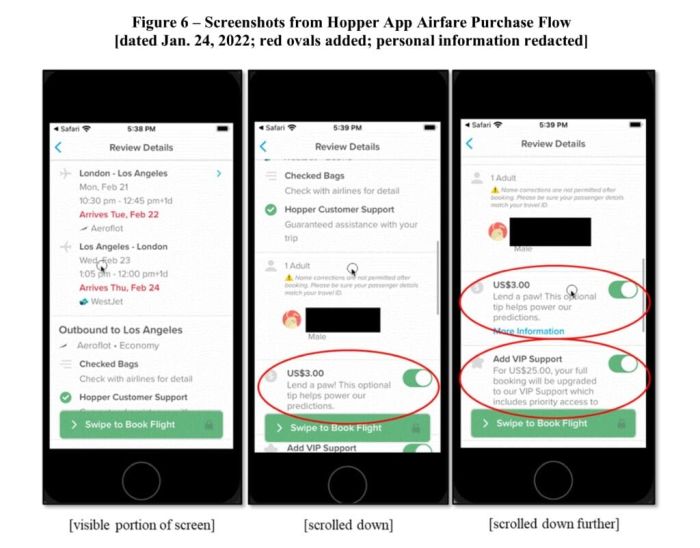
From: FTC complaint against Hopper
Internal Documents Allegedly Showed Awareness of the Issue
According to the complaint, dozens of internal documents showed that Hopper was actively aware of the deceptive nature of these fees. For example, internal testing showed that whereas 15% of users paid a disclosed and unselected Tip fee, 25% of users paid the fee if it was disclosed and pre-selected and 75% of users paid the fee if it was hidden and pre-selected. In internal emails, employees described the practices as “tricking users” and “deceptive UX.”
Hopper’s VIP Support Claims Were Allegedly Misleading
Additionally, the FTC alleged that Hopper misrepresented the level of support that users would receive in exchange for their VIP Support fees. Hopper’s marketing materials promised that users would be connected to an agent instantly or within minutes. In reality, many consumers were unable to receive a response at all, and those who did receive a response often waited only to receive an automated message that did not offer any actual assistance.
The FTC alleged that Hopper collected approximately $18 million in Tip fees and $67.6 million in VIP Support fees between 2021 and 2023.
“Price Freeze” Product Was Allegedly Misrepresented
The FTC also took aim at Hopper’s optional “Price Freeze” product. The Price Freeze product was initially advertised as a refundable deposit, but was later changed to a non-refundable fee. However, even after switching to a fee-based model, Hopper continued to describe the Price Freeze as a “deposit,” resulting in 45% of consumers incorrectly believing that the Price Freeze fee would be refunded. Additionally, the Prize Freeze product only protected against fare increases up to a cap (e.g., $300 per traveler), a limitation 62% of consumers did not understand due to poor or nonexistent disclosures.
Double-Pronged Section 5 and Fees Rule Violations
The FTC alleged that Hopper’s fee practices violated Section 5 of the FTC Act. In addition, the FTC alleged that fees charged for Hopper’s short-term lodging bookings violated the FTC’s Unfair and Deceptive Fees Rule (the “Fees Rule”) if they were charged after the Fees Rule took effect on May 12, 2025. The Rule applies only to short-term lodging and live-event bookings, so Hopper’s charges for airfare, rentals, and other travel services were not subject to the Fees Rule.
The content of this article is intended to provide a general guide to the subject matter. Specialist advice should be sought about your specific circumstances.
[View Source]