

The Spanish Artificial Intelligence Supervisory Agency (Agencia Española de Supervisión de la Inteligencia Artificial, or AESIA) has released 16 Guides to support compliance with the European Artificial Intelligence Act (AIA). The guides have been developed as part of Spain's pilot AI Regulatory Sandbox, an initiative designed to facilitate implementation of and compliance with the AIA by offering practical, non-binding recommendations aligned with the AIA's requirements, pending approval of the harmonised rules applicable across all Member States.
The 16 guides are structured into three groups:
- Introductory Guides (Guides 1 and 2): These documents provide a general and practical overview of the AIA to facilitate an initial understanding via supporting materials and hypothetical use cases to illustrate the application of the rules;
- Specialised Technical Guides (Guides 3 to 15): These guides address specific legal and technical requirements applicable to high-risk AI systems. They include critical aspects such as conformity assessment procedures, quality and risk management systems, data governance, transparency, human oversight, accuracy, system robustness and cybersecurity, as well as technical documentation; and
- Checklist User Manual (procedural support) (Guide 16): This guide provides a structured methodology in checklist form, enabling organisations to easily assess their degree of compliance, identify deficiencies and design a structured conformity plano.
AESIA has pointed out that these documents do not replace existing regulations and will be reviewed as European standards and guidelines are issued or developed further. It is expected that they will be updated as legislative amendments to the "Digital Omnibus Package" are adopted.
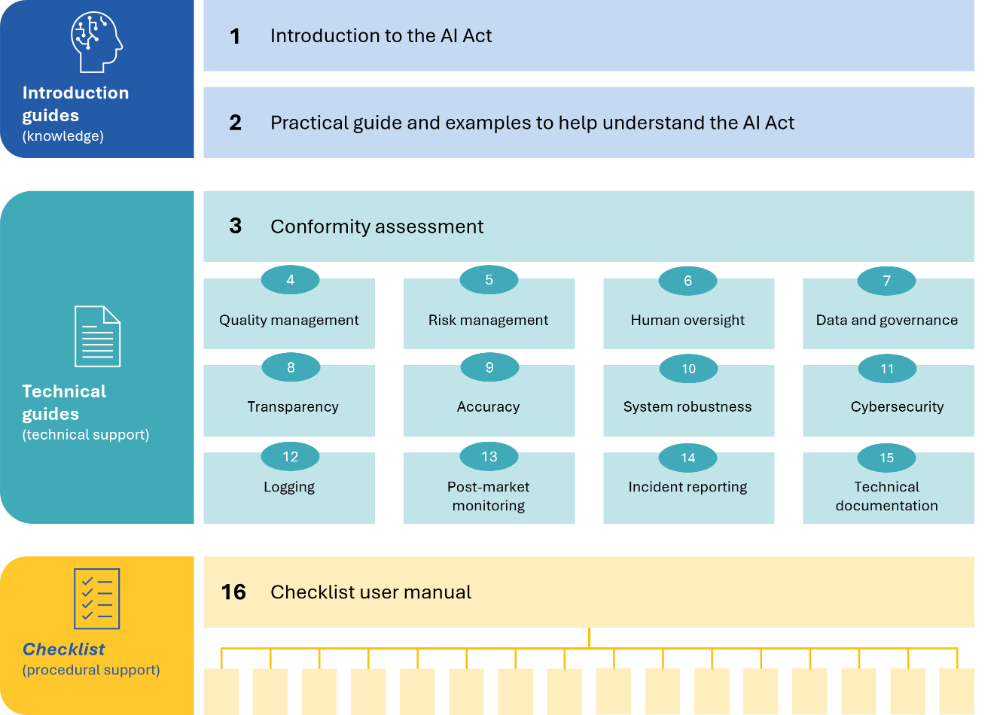
'Relation of the AIA's Guides'. Source: Guide no. 1, page 4
With this note, we begin a series of publications in which we will announce the content of the guides in the coming weeks.
The content of this article is intended to provide a general guide to the subject matter. Specialist advice should be sought about your specific circumstances.

