

English is increasingly becoming the dominant language at the UPC, making it a more accessible venue for the many European, US and Asian claimants now bringing cases in this forum. The charts below illustrate the increasing predominance of English at the UPC over time.
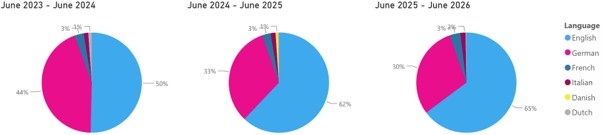
A recent decision of the Milan LD illustrates this trend towards conducting proceedings in English (UPC_CFI_1146/2026, 28 July 2026). ASTES4 filed an infringement action at the Milan LD against Bystronic and Isochronic. The defendants subsequently filed a procedural application to change the language of proceedings from Italian to English (the language of the patent in suit). The application was granted by the Milan LD, after considering the balance of interests between the parties and the circumstances of the case, pursuant to Art. 49 UPCA and R. 323 RoP.
The Milan LD also confirmed the UPC’s consistent position that an application for a change in language does not need to be included in the Statement of Defence. To ensure efficiency and flexibility, the application may be made before the Statement of Defence is filed.
In reaching its decision, the Milan LD was influenced by the landmark decision of the UPC Court of Appeal in Curio Bioscience v 10x Genomics (UPC_CoA_101/2024, 17 April 2024). In those proceedings, in which Carpmaels acted for the successful applicant, Curio, the Court of Appeal provided its first guidance on the relevant circumstances to be considered when deciding whether to change the language of proceedings. It found in favour of changing the language of the proceedings from German to English, overturning the first instance ruling.
The Court of Appeal set out that the circumstances to be taken into consideration include the language commonly used in the technology field; the position of the parties as regards their nationality, domicile, and internal working language; and the potential impact of the change of language on each party. Ultimately, by considering these factors, the aim is to reach a fair result based on balancing the parties’ interests. The Court of Appeal has also confirmed that, should the balance of interests be equal, the position of the defendant should prevail. This is because the claimant has the choice of where to file the action and can choose the timeframe for drafting its Statement of Claim, whereas the defendant is bound by tight deadlines. Additionally, in an infringement action, the claimant has chosen the language of the patent; therefore, conducting the proceedings in the language of the patent cannot be considered unfair.
In this recent case, the Milan LD considered the balance of interests to be fairly equal; all parties involved were in a similar situation in terms of their multilingual environment and their logistical and financial resources. However, the LD considered that it would involve “significant effort” for the defendants to communicate and coordinate in Italian on both legal and technical matters, especially given the tight deadlines. Therefore, the defendants’ request was granted.
This decision confirms that the UPC will seek to reach a fair decision for parties that aligns with the court’s emphasis on efficiency and flexibility. In many cases, this will result in the UPC conducting proceedings in English, as the language of international business, removing barriers to participation in UPC proceedings.
The content of this article is intended to provide a general guide to the subject matter. Specialist advice should be sought about your specific circumstances.
[View Source]

