

- within Intellectual Property topic(s)
- within Intellectual Property topic(s)
- within Consumer Protection, Coronavirus (COVID-19), Food, Drugs, Healthcare and Life Sciences topic(s)
Introduction
At first glance, a pair of hawaii slippers, the humble rubber flip-flop ubiquitous across Indian households, seems an unlikely protagonist in a high-stakes intellectual property dispute. Yet it is precisely in such ordinary, everyday objects that design law faces its most interesting test: can novelty truly reside in something as commonplace as a slipper? And if it can, how does the law protect it without strangling competition? The Delhi High Court’s Division Bench decision in Aqualite Industries Pvt. Ltd. v. Relaxo Footwears Ltd.1grapples with these questions head-on, delivering a judgment that is both doctrinally precise and practically significant. Touching upon the scope of design protection, the mechanics of the “instructed eye” test and the evidentiary threshold for a prior art defence, this decision is essential reading for anyone navigating design law in India.
Brief Facts
Relaxo Footwears Ltd. manufactures Hawaiian slippers, including models BHG 136 and BHG 137, whose designs were registered under the Designs Act, 20002. The registration certificates certified novelty as residing in the shape, configuration and surface pattern of the footwear, specifically, distinctive vertical ridges running along the side surfaces of the slippers, referred to throughout the judgment as “side ridges”. In Design Registration 325071, the ridges covered the entire side surface, while in Design Registration 325074, they appeared only along the front or upper portion of the side.
In early 2021, Relaxo discovered that Aqualite Industries Pvt. Ltd. was manufacturing and selling hawaii slippers that closely replicated these registered designs. Relaxo filed a civil suit before the Intellectual Property Division of the Delhi High Court, alleging design piracy under Section 22(1) of the Designs Act and simultaneously sought an interim injunction restraining Aqualite from manufacturing or dealing in such footwear.
The Single Judge granted the interim injunction, finding a clear visual similarity between the products and rejecting Aqualite’s prior art defence. Aqualite appealed to the Division Bench, constituting the present proceedings before Justices C. Hari Shankar and Om Prakash Shukla.
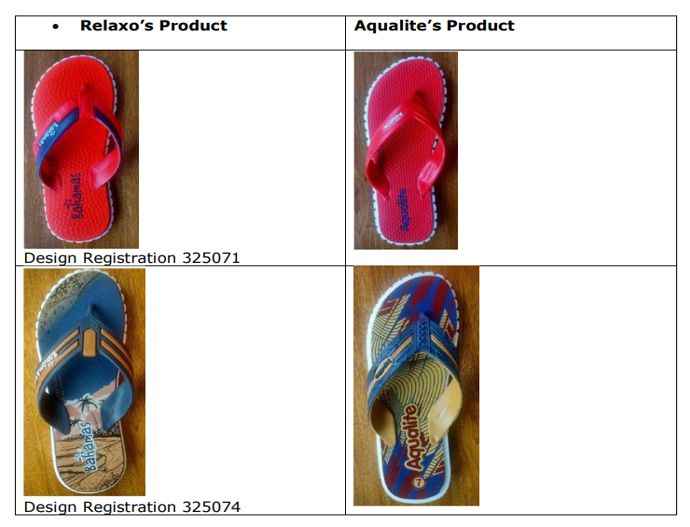
Comparison of Relaxo’s product (left) and Aqualite’s product (right) as reproduced in the judgment
Legal Issues
The Division Bench was called upon to examine the following principal questions:
- What constitutes the protectable “design” under the Designs Act and did Aqualite’s footwear amount to piracy under Section 22(1)?
- Could Aqualite successfully invoke the Section 22(3) defence i.e., that the suit designs were liable to cancellation due to prior publication or lack of novelty under Section 19(1)(b) and (c)?
- Was the interim injunction granted by the Single Judge legally sustainable?
The Court’s Analysis and Ratio
Scope of Design Protection
The Court began by carefully delineating what a “design” encompasses under the Designs Act. It emphasised that design protection attaches not to the article itself, but only to those specific features viz. shape, configuration, surface pattern, ornamentation or composition of lines or colours, in which novelty is certified. This is a crucial distinction: the registered design is not a monopoly over the hawaii slipper as a product, but only over the novel features identified in the registration certificate.
Accordingly, since the registration certificates in question certified novelty only in shape, configuration and surface pattern and not in colour, the Court held that Relaxo could not claim design piracy based on colour similarities alone. The relevant enquiry was limited exclusively to whether the side ridges had been replicated.
Design Piracy: Section 22(1)
On the question of infringement, the Court found the facts remarkably straightforward. Aqualite’s own senior counsel did not contest that the impugned footwear bore identical side ridges. Both parties had, in fact, conceded before the Single Judge that the dispute centred on the “teeth-like design” on the sides of the slippers. The Division Bench held that this admission, made at the trial stage, could not be resiled from on appeal.
Given that the side ridges fell squarely within the “shape, configuration and surface pattern” of the registered design and given Aqualite’s implicit admission of replication, the Court held that design piracy under Section 22(1)(a) was indisputably established.
The Prior Art Defence: Section 22(3)
The more contentious portion of the case concerned Aqualite’s defence that the suit designs had been published prior to registration and lacked novelty, grounds that, under Section 22(3), would justify cancellation under Section 19(1)(b) and (c) and negate the injunction. Aqualite relied on seven prior art designs, labelled Prior Arts 1 to 7.
The Court upheld the Single Judge’s finding that two of the prior arts were inadmissible, as there was no evidence of when those products entered the market. Other prior arts had been filed with Aqualite’s reply and were properly on record. The remaining prior arts, though filed without supportive pleadings, were nonetheless permitted to be considered given the procedural peculiarity that Aqualite had never been served with summons in the main suit and therefore could not have filed a formal written statement before the impugned order was passed.
The “Instructed Eye” Test
To assess novelty vis-à-vis prior art, the Court applied the “instructed eye” test, drawing from established precedent.3 Unlike trademark law, which uses the “average consumer of imperfect recollection” standard or patent law, which invokes the “person skilled in the art”, design law asks “how a person aware of existing prior art would perceive the design”. This person is capable of detecting differences between the asserted design and prior art and of distinguishing genuine novelty from mere trade variants.
The Court further drew upon the guidance of the Supreme Court in Bharat Glass Tube Ltd. v. Gopal Glass Works Ltd.,4 which held that before pronouncing on a design infringement action or examining validity vis-à-vis prior art, courts should, if possible, examine the actual articles to which the designs are applied. Consistent with this, the Division Bench physically examined samples of Prior Arts 1 and 2 and closely reviewed photographs of the remaining prior arts.
Having done so, the Court found that the ridges in the prior art footwear had a “saw-like” structure, distinctly different from the rectangular, “crenellation-shaped” ridges present in Relax’s suit designs. The difference, the Court held, was clear and stark to an instructed eye. It further noted that Prior Arts 5 to 7 were not even hawaii slippers and that a cumulative comparison of shape, configuration and surface pattern with the suit designs revealed no meaningful similarity whatsoever.
The principles from B. Chawla & Sons v. Bright Auto Industries5 were also applied, which had established that trivial changes do not render a design new or original, that ordinary trade variants cannot confer novelty and that courts must strike a balance between protecting genuine novelty and preserving the freedom of the trade to use common design knowledge.
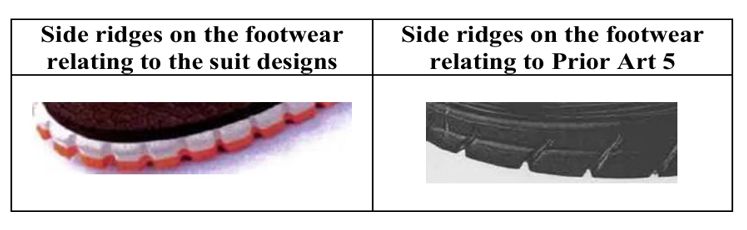
Comparison of side ridges on the suit design (left) and Prior Art 5 (right) as reproduced in the judgment
Novelty in Footwear
The Court acknowledged the inherent difficulty of claiming novelty in footwear, referencing the observation of S. Ravindra Bhat, J. in Crocs Inc. v. Bata India Ltd.6that footwear manufacturers have limited creative “play” due to the functional constraint of accommodating the human foot. Nevertheless, the Court reaffirmed that footwear remains registrable under the Designs Act (now classified under Class 2 of the Locarno Classification) and that side ridges, being external to the basic functional shape of a hawaii slipper, were capable of imparting genuine novelty. Unlike purely functional elements, such ridges represent an aesthetic addition that appeals to the eye within the meaning of the Act.
Aesthetic Appeal, Not a Pre-Condition
The Court also rejected Aqualite’s written submission that the designs were invalid for lack of aesthetic appeal. It held, persuasively, that aesthetic appeal is an entirely subjective notion and that the law does not require a design to be beautiful. All that is needed is a distinct visual appeal, which may be positive or negative. So long as the design features are not purely utilitarian or functional, registration is permissible.
Decision
The Division Bench dismissed the appeal, affirming the interim injunction granted by the Single Judge. It held that Aqualite’s footwear was identical in shape and configuration to the suit designs and that the suit designs were not prima facie liable to cancellation under Section 19 of the Designs Act. The balance of convenience and irreparable injury both favoured Relaxo.
Analysis
This judgment makes several noteworthy contributions to design law jurisprudence. Most significantly, it reaffirms with precision that a registered design confers a monopoly not over the article itself, but only over those specific features in which novelty is certified. This prevents design registrations from being weaponised to stifle all competition in an article class, a concern especially pressing in industries like footwear, where structural similarity between products is almost structurally inevitable given the constraints of the human foot.
The Court’s procedural generosity in admitting the later-filed prior arts, despite the absence of formal pleadings, also deserves appreciation. Given that Aqualite was never served summons before the impugned order was passed, penalising it for procedural non-compliance would have been plainly inequitable. The Court’s approach here reflects a commendable sensitivity to the realities of litigation procedure.
Most impressive, however, is the rigour of the instructed eye analysis. By physically examining product samples and conducting a granular visual comparison, the Court drew a meaningful distinction between the saw-like ridges in the prior art and the crenellation-shaped ridges of the suit designs, a distinction a less careful court might have dismissed as inconsequential.
The one area of concern is the Single Judge’s failure to provide cogent reasoning on novelty, effectively leaving that entire analytical exercise to the appellate court. Greater judicial articulation at the trial stage remains essential, both for the integrity of the process and to reduce the burden on appellate courts to conduct what is, in effect, a fresh examination from scratch.
Footnotes
1. Aqualite Indus. Pvt. Ltd. v. Relaxo Footwears Ltd., 2025:DHC:10128-DB (Delhi H.C. Nov. 18, 2025) (India).
2. Designs Act, No. 16 of 2000 (India).
3. B. Chawla & Sons v. Bright Auto Indus., AIR 1981 Del 95 (India); T.T.K. Prestige Ltd. v. K.C.M. Appliances Pvt. Ltd., 2023:DHC:002494 (Delhi H.C. 2023) (India).
4. Bharat Glass Tube Ltd. v. Gopal Glass Works Ltd., (2008) 37 PTC 1 (S.C.) (India).
5. B. Chawla & Sons v. Bright Auto Indus., AIR 1981 Del 95 (India).
6. Crocs Inc. v. Bata India Ltd., (2019) 78 PTC 1 (Delhi H.C.) (India).
The content of this article is intended to provide a general guide to the subject matter. Specialist advice should be sought about your specific circumstances.
