

Haryana has over the past decade rapidly evolved into a growing nucleus for industrial investments. The State's progress has been widely acknowledged through several national recognitions, reflecting the effectiveness of its policy framework and institutional reforms.
Haryana recognized its need to update its Industrial policy to proactively respond to the growing business landscape and therefore has recently notified its ‘Make in Haryana Industrial Policy 2026’ replacing the erstwhile Haryana Enterprises & Employment Policy 2020’ with a view “to establish Haryana as an internationally competitive and favored industrial hub with balanced, inclusive, sustainable and resilient economic development”.
The policy was notified on 26 May 2026 and will be valid for a period of 5 years from the date of its notification.
For an investor weighing where to ground a project – or already holding land in Haryana it is relevant to note that, benefits under the policy are intrinsically linked to the size and location of the project and to the stage at which the investor approaches the State.
The objective of this note is to give our readers an overview of the policy highlighting key practical considerations that investors should keep in mind before investing in a project in Haryana
The framework - Guiding principles for availing incentives under the Policy
A. Who is eligible?
The policy extends benefits to Enterprises1 engaged in manufacturing, production, processing, contract manufacturing etc. or engaged in the following services:
- Healthcare
- Education
- Tourism and Hospitality
- Research and Development
The incentives under the policy are only available for Ultra Mega, Mega and Large units While benefits for MSME2 Units are addressed under separate State policies.
These categories are defined by the size of their FCI3. A Large Project is one with an FCI exceeding INR 125 crore. A Mega Project requires an FCI ranging from INR 400 crore in Prime/Focus Areas to INR 700 crore in Core Areas. An Ultra Mega Project sits at the top of the scale, requiring an FCI ranging from INR 1,500 crore in Prime/Focus Areas to INR 6,000 crore in Core Areas.
Significantly, the Policy does not treat investment as the sole route to eligibility; it accords employment generation equal importance, in line with its objective of creating local employment. Consequently, a project that may not be investment-intensive can nevertheless qualify on the strength of the employment it generates. For instance, a project may qualify as a Mega Project, irrespective of its location, where it entails an FCI of at least INR 125 crore and generates direct employment for not less than 1,250 persons (whether on payroll or contract, each having an ESI/PF number for at least one year). Similarly, a project may qualify as a Large Project where it entails an FCI of at least INR 50 crore and generates direct employment for not less than 500 persons.
Investors should carefully consider the eligibility conditions under the policy. In particular, applications for seeking incentives are required to be made prior to commencement of commercial production. At the same time, the policy also covers existing Large, Mega and Ultra Mega units for the purposes of availing incentives for expansion or diversification, subject to satisfaction of the applicable eligibility requirements..
B. Location
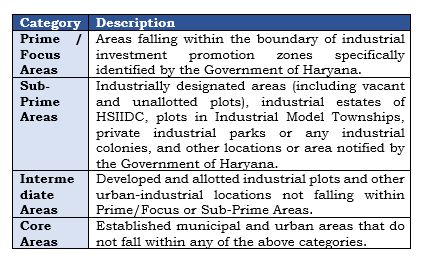
Availment of the incentives under the policy is not just dependent on the size of the enterprise but also on the geographical location of the unit in the state.
The policy divides the State into 4 categories area wise – Prime/Focus, Sub-Prime, Intermediate and Core.
Incentives offered under the policy
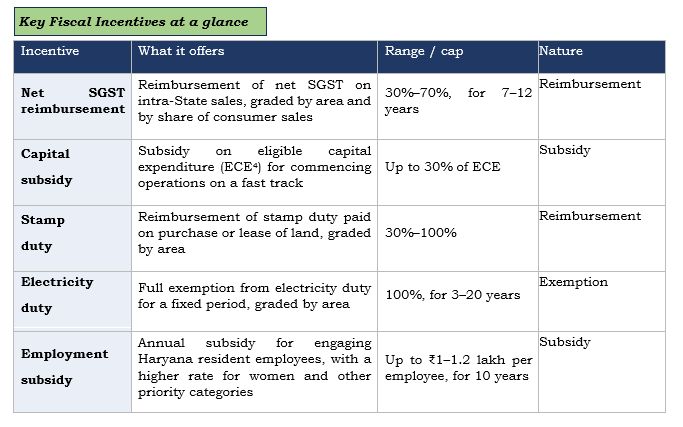
The incentives available under the policy may broadly be categorised as fiscal and non-fiscal incentives.
While fiscal incentives provide financial support through subsidies, reimbursements and concessions, non-fiscal incentives are designed to facilitate investment through streamlined approvals, regulatory relaxations and infrastructure support. Certain large or strategically significant projects may also be eligible for customised incentive packages.
Importantly, incentives under the Policy are available over and above any benefits that an eligible unit may avail under a Government of India scheme, subject to an overall ceiling of 100% of the project's FCI. Accordingly, the State incentive package is intended to supplement, and not replace, incentives available under separate Government of India schemes.
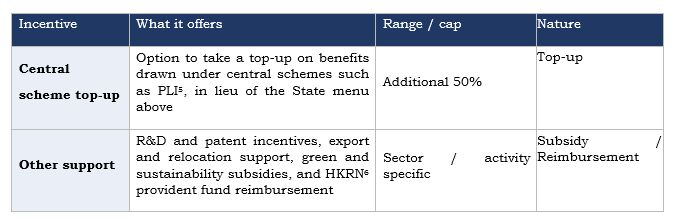
Further, Ultra-Mega and Mega Projects shall be offered customized packages of incentives by Haryana Enterprises Promotion Board (HEPB), over and above the standard package of incentives, based on the approved Cost of Incentives-Benefit to State model of the Government of Haryana, as amended from time to time.
Non-fiscal Incentives/Initiatives
Keeping in mind the State Government's thrust on ease of doing business, the Government has introduced certain innovative initiatives vide the Policy which are intended to provide further impetus to investment and industrial development in the State. Some of the key non-fiscal incentives and initiatives under the Policy are set out below:
- Land on lease. To address concerns around the economic viability of industry arising from high land costs, HSIIDC7 will introduce a Land on Lease Policy, under which industrial plots will be offered on a long-term lease basis, with the flexibility to convert the leasehold into freehold at any time during or at the end of the lease period. The initiative is intended to significantly reduce upfront capital expenditure for industry, improve project viability, and enable enterprises to achieve breakeven earlier.
- Plug-and-play and ready-built factories. To accelerate industrialisation and reduce the time taken to commence operations, HSIIDC will develop and offer on lease ready-built industrial factories and sheds with plug-and-play facilities across key industrial estates of the State. Equipped with pre-approved infrastructure and utilities, these enable a manufacturing unit to start operations almost immediately, with minimal set-up time.
- Worker housing and relocation. To meet the critical need for industrial worker housing, HSIIDC will construct dormitories and single-room units in its industrial estates, offering accommodation at affordable daily, weekly, monthly, half-yearly and yearly rentals. The policy also provides a one-time relocation grant equal to 50% of the eligible relocation cost, subject to a ceiling of INR 5 crore per unit for a facility relocating from outside the State but within the country, and INR 10 crore per unit for one relocating from outside the country- aimed at drawing established industry into the State from elsewhere.
- A single, integrated window. The Invest Haryana Single Window Portal is an integrated online platform designed to simplify and expedite the setting up of business in the State, offering over 140 business-related services. It is integrated with the National Single Window System, so that an investor can access both Government of Haryana and Government of India services and approvals through one unified digital platform, without navigating separate systems. Where a service is not rendered within the notified timeline, a deemed clearance is auto-issued.
- AI-enabled land and project tools. The State is also putting technology to work to ease land procurement. Through the single-window portal, an investor can obtain an automated site assessment of a land parcel and generate project reports through an AI-based toolbox. The State will further institutionalise a land feasibility certificate- a digitally issued, single-point verification document, obtainable within 45 working days from the revenue and other concerned officials, verifying ownership, encumbrances and zoning, which is intended to significantly compress the due diligence phase before an investment is made.
- Timely processing of applications. The policy builds in a firm disbursal discipline: 50% of the eligible incentive is to be released within 7 working days of preliminary scrutiny of the claim, and the balance within 45 working days, with interest payable by the State on any delay attributable to it. A commitment of this kind signals an intent to make the incentives dependable rather than merely available.
- Support for green industry. The policy rewards units that reduce their environmental footprint, offering support for carbon credits generated within the State (at INR 100 per carbon credit unit, subject to a cap of INR 1 crore per unit), the establishment of captive renewable energy projects, zero liquid discharge systems, and green building certification such as GRIHA8 and LEED9 - encouraging cleaner operations and more efficient use of resources.
- Deregulation and ease of doing business. The policy carries a wide deregulation agenda, identifying 23 reform areas across land use, building and construction, labour and utilities. Among the measures, the timeline for consent to establish and consent to operate has been reduced from 30 to 21 working days; the threshold under the Haryana Shops and Commercial Establishment Act has been raised to 20 workers, easing compliance for smaller establishments; daily working hours have been increased from nine to ten, with quarterly overtime of up to 156 hours; and the Haryana Building Code has been amended to allow third-party agencies to grant occupation certificates for high-risk buildings.
Remarks
At its core, the Policy marks a deliberate shift in approach, from the Government acting as a regulator to the Government serving as a strategic facilitator and partner in industrial growth. That shift is centred around three key objectives: enhancing competitiveness through a lower cost of doing business, promoting agility through faster and simpler approvals, and driving sustainable growth through future-ready, green development.
The Policy seeks to further strengthen Haryana’s position as a preferred industrial investment destination in India, with renewed emphasis on making factors of production more cost competitive, easing the regulatory burden on the industry, promoting balanced and sustainable development and encouraging innovation and technology driven growth.
Given the complexities associated with land acquisition, real estate and tax considerations, it is imperative to carry out an extensive due diligence as a pre-investment step for investors looking to invest in Haryana.
Finally, the Policy is built to move quickly within its 5-year life. The various schemes are to be notified within 3 months, and an investor is not held back merely because a scheme has not yet been notified. Read together with the single-window clearance mechanism and the State's prescribed timelines for disbursal of incentives, the message is clear: the Policy is intended to translate opportunity into on-ground investment, rather than process into delay.
Footnotes
1. Enterprises – Enterprises constituted as partnership firm, including an LLP, Society, Trust, Industrial Cooperative Society or Proprietary concern.
2. MSME – Micro, Small and Medium Enterprises.
3. FCI - being the new investment in land, infrastructure/associated utilities, buildings (including for R&D activities, storage, testing, hostel/dormitories for workers, office space etc.), plant, machinery, equipment, hardware and software, power back up arrangements, constructions of captive renewable energy plants, effluent treatment plants, waste management plants, air pollution control systems, zero liquid discharge equipment, made by the units withing the premises of the project.
4. ECE – Eligible Capital Expenditure, computed on the same basis as FCI but excluding the cost of land.
5. PLI – Production Linked Incentive scheme of the Government of India.
6. HKRN – Haryana Kaushal Rozgar Nigam, the State's manpower engagement portal.
7. HSIIDC – Haryana State Industrial and Infrastructure Development Corporation.
8. GRIHA – Green Rating for Integrated Habitat Assessment.
9. LEED – Leadership in Energy and Environmental Design.
The content of this article is intended to provide a general guide to the subject matter. Specialist advice should be sought about your specific circumstances.

