

Overview
- Draft Rules: On July 21, 2026, India’s central bank (i.e., Reserve Bank of India (“RBI”)) published draft Foreign Exchange Management (Foreign Investment) Rules, 2026 (“Draft Rules”). These Draft Rules will replace the Foreign Exchange Management (Non-debt Instruments) Rules, 2019 (“NDI Rules”) once notified.
- Scope: The Draft Rules cover “equity” investment in an “eligible investee entity” by any person resident outside India, and any transfer of such “equity” investment.
- IFSC Carve-out: The Draft Rules do not apply to investments in financial institutions set up in an International Financial Services Centre (e.g., GIFT City).
- Grandfathering: All actions taken under the NDI Rules before supersession will remain valid.
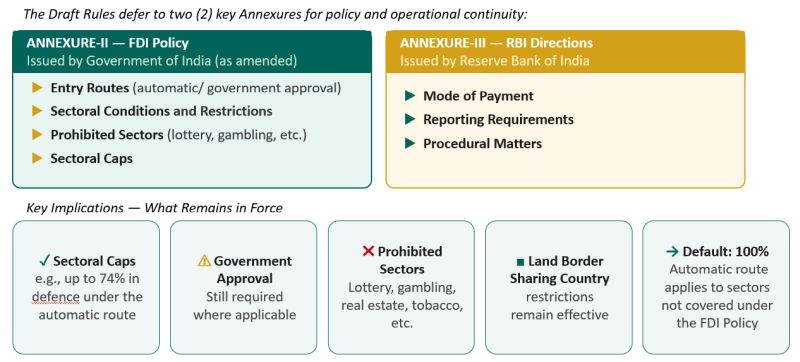
- Simplification: The Draft Rules comprise of nine (9) rules plus three (3) annexures, which is a significant simplification of the schedule-heavy NDI Rules, which contain eleven (11) schedules. However, many provisions require further assessment and clarification once the final rules are notified.
- Comments Invited: Stakeholders can submit feedback until August 31, 2026.
The Continuing Framework
Definitions of Equity and Eligible Investee Entities Broadened
- Equity: The Draft Rules replace “non-debt instruments” with “equity,” defined to mean:
(a) instruments the investee classifies as equity under the applicable accounting standards;
(b) units of a SEBI-registered investment vehicle; and
(c) participating interests or rights in Indian oil fields or mines.
Implication: Fixed-term convertibles (i.e., CCPs and CCDs) still qualify as equity. Variable-term ones (i.e., optionally convertible instruments) may need to be assessed by a chartered accountant or an auditor under Indian accounting standards.
- Eligible Investee Entities: Eligible investee entities include companies, body corporates, limited liability partnerships (“LLP”), investment vehicles registered with the Securities and Exchange Board of India (“SEBI”) (including REITs, InvITs, AIFs, VCFs, mutual funds, ETFs or other vehicles investing more than 50% in equity), registered partnership firms, and registered proprietary concerns. Societies and trusts are excluded.
Implication: The Draft Rules now permit all foreign investors to invest in partnership firms and proprietary concerns without RBI approval, unlike the NDI Rules, which permitted only NRIs and OCIs to make such investments on a non-repatriation basis.
Pricing and Investment Thresholds: What's Changing
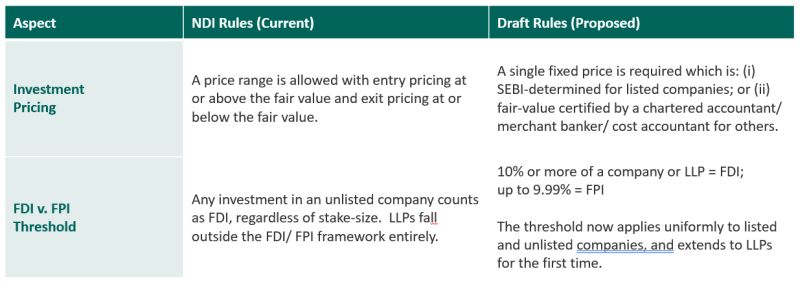
Open questions: How will premium pricing on equity be structured? How will pricing guidelines apply when an FCE (see next slide) is involved? How classification and reclassification of FDI versus FPI will be effectuated and how the compliances will differ for FPI investments in listed versus unlisted companies and LLPs?
FOCC → FCE: A New Ownership and Control Test
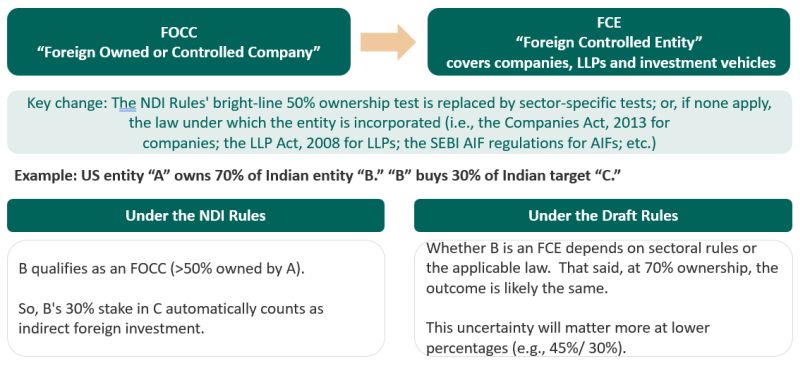
Indirect Foreign Investment
Indirect Foreign Investment: The Draft Rules compress indirect investment into a single definition, covering investment made through an FCE (downstream investments), or through another non-resident entity that the foreign investor owns or controls, or that sits under common ownership or control with the foreign investor.
For such a non-resident entity (excluding an FCE), ownership means holding more than 50%, and control means the right to appoint most of the directors or to control management or policy decisions, including through shareholding, management rights, or shareholders’ or voting agreements carrying 10% or more of the votes.
.
Implication: The Draft Rules introduce a 10% voting rights threshold for determining “control” when tracing indirect foreign investment. This threshold is aligned with the revised 10% beneficial ownership threshold under Press Note 2 of 2026 applicable to investments from entities in land border sharing countries. This creates greater consistency in the thresholds used under India’s foreign exchange framework to identify control and beneficial ownership.
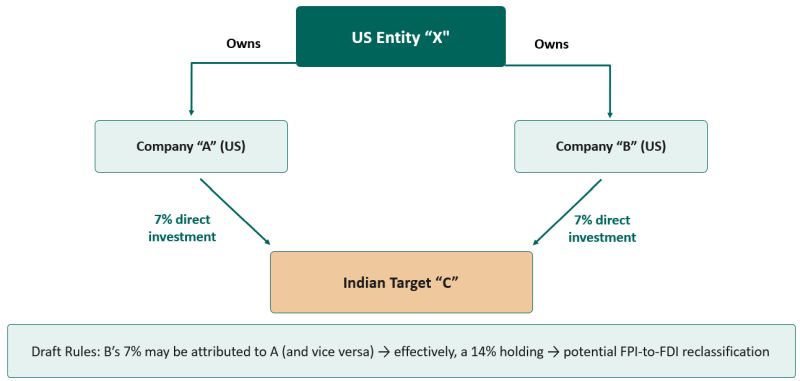
Illustration on Indirect Investment Attribution
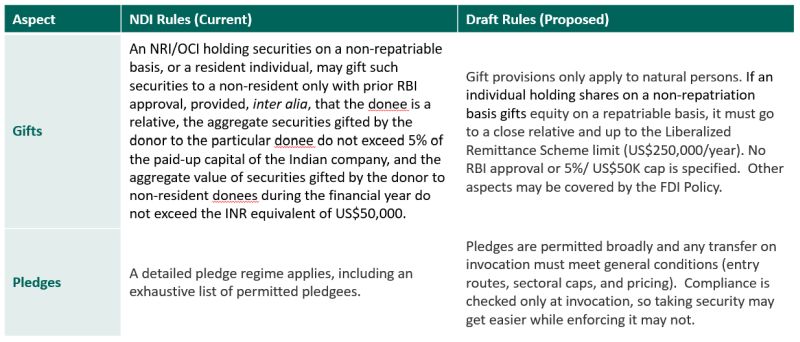
Gifts and Pledges: Current vs. Proposed
Compliances and Missing Items
- Compliance Burden: The Draft Rules place the onus of compliance on the foreign investor and the eligible investee entity (i.e., both, the transferor and the transferee).
Implication: Under the NDI Rules, the onus was on the Indian counterpart. With the shift in burden, foreign parties will need to conduct more thorough diligence on foreign exchange compliances. This must be factored into deal negotiations, particularly indemnities, and representations and warranties. However, it remains to be seen how the Draft Rules will be enforced against non-residents. - Missing Items: The Draft Rules are silent on deferred consideration, tribunal-approved merger issuances, acquisition and transfer of immovable property, ESOPs and share-based employee benefit schemes, and the startup convertible note regime. However, these aspects are likely to be covered under the Annexures to the Draft Rules (i.e., the FDI Policy and the RBI’s directions). It should not be assumed that these requirements have been dropped.
Takeaways
- The primary intent of the Draft Rules seems to be to eliminate the duplication that existed under the NDI Rules, where sectoral caps, entry routes, and conditions were reproduced in detail even though they already formed part of the FDI Policy. Once the Draft Rules are enacted, a change in the FDI Policy will not require a corresponding amendment to the Draft Rules.
- The Draft Rules also aim at an overall simplification of language and structure. However, the simplified provisions require a careful reading. Many practical outcomes and positions established under historic foreign exchange regulatory jurisprudence may change, not necessarily by design, but as a consequence of ambiguity in the Draft Rules.
The content of this article is intended to provide a general guide to the subject matter. Specialist advice should be sought about your specific circumstances.
