

The Federal Court has handed down its decision in Black Star Pastry Pty Ltd v Richards (No 2) FCA 383, concerning, in effect, Black Star Pastry’s ability to sell coffee.
In the decision, the Federal Court upheld the appeal and found that Black Star Pastry had not infringed registrations held by a third party, due to the invalidity of one registration, and a lack of deceptive similarity in relation to the other.
The decision has important implications for brand owners and reaffirms the importance of ensuring that trade mark applications are filed in the correct name, especially when a trade mark is jointly owned. It is also a useful reminder of the potential limitations in enforcing logo or composite trade mark registrations.
Black Star background
In 2007, Martin Richards (Richards) and a third party commenced a coffee business under the trade mark BLACKSTAR COFFEE. The business secured two trade mark registrations:
- a registration for the plain word mark BLACKSTAR (No 1172976) (BLACKSTAR Word Mark); and
- a registration for BLACKSTAR COFFEE in logo form which included a large star device (No 1288833) ((BLACKSTAR COFFEE Logo) :
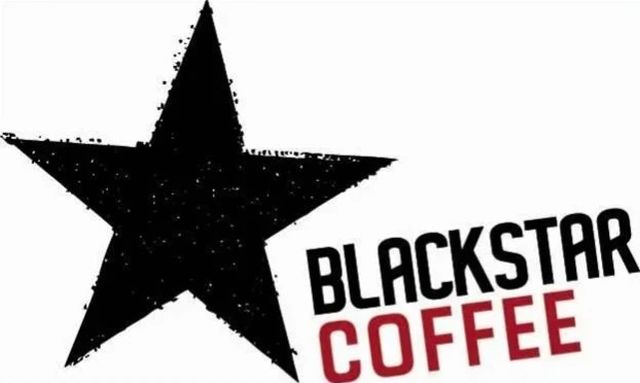
Importantly, Mr Richards had applied to register the BLACKSTAR Word Mark solely in his own name, even though he and a third party (Ms Evonne Andrews) had jointly authored the mark, jointly intended to use it, and jointly used it in the Blackstar business. The application for the BLACKSTAR COFFEE Logo was filed at a later date jointly in Mr Richards’ and Ms Andrews’ names.
Separately, in 2008, Black Star Pastry Pty Ltd (BSP) commenced operating a specialty bakery business selling cakes, pastries and coffee products under the trade mark BLACK STAR PASTRY and various related logos. BSP is notably famous for creating the “world’s most Instagrammed cake”, being BSP’s Watermelon Strawberry Cake.
Richards commenced infringement proceedings against BSP in May 2023, alleging that BSP’s use of its BLACK STAR PASTRY trade marks when selling coffee infringed the two registrations.
In the original decision, the Federal Circuit Court found that:
- Mr Richards’ BLACKSTAR Word Mark was valid, as he obtained consent from Ms Andrews to apply for the trade mark solely in his name
- BSP’s use of the various BLACK STAR PASTRY trade marks infringed both of Mr Richards’ trade mark registrations
This effectively meant that by selling coffee at its Black Star Pastry stores, BSP was infringing Richards’ registrations.
The Appeal
Given the implications of the Federal Circuit Court’s decision on BSP’s business model, it was not surprising that BSP appealed the decision. The two main grounds of appeal were:
- that the BLACKSTAR Word Mark was invalid, as it had been filed in Richards’ name but should have been filed in both Richards’ and Andrews’ names
- secondly, the BLACKSTAR COFFEE Logo was not deceptively similar to BSP’s various BLACK STAR PASTRY trade marks and logos
Joint ownership and entitlement to apply
On the first ground, the Court upheld the appeal and found that the BLACKSTAR word mark registration was invalid, as it had been filed in the wrong name.
At issue was the fact that Richards filed the application in his own name, when both he and Ms Andrews were correctly joint owners of the trade mark.
Section 27 of the Trade Marks Act (TMA) relevantly provides that a person may apply for the registration of a trade mark if the person claims to be ‘the owner’ of the trade mark.
In the decision, Downes J held that where a trade mark is owned by joint owners, an application for registration must be made by the joint owners together, and one joint owner cannot validly obtain registration solely in their own name. Her Honour held that consent is legally irrelevant to this question, including because Sections 27, 28 and 58 of the TMA do not expressly refer to it or allow it.
In addition, the Court observed that if only one of two joint owners could register a trade mark, the registered owner would obtain the exclusive rights conferred by s 20 of the TMA, while the other joint owner would remain off-register and not have any statutory rights, creating practical and legal uncertainty.
The Court also emphasised the role of the accuracy of the Register. That is, a Register that records only one owner where the true position is joint ownership does not accurately reflect title, and that cuts across the principle that the Register should “speak for itself” when parties inspect it.
Having found the BLACKSTAR Word Mark invalid, the Court exercised its discretion under s 88(1) to cancel that registration. As a result, Richards was no longer entitled to relief for any infringement of the BLACKSTAR Word Mark.
Deceptive similarity and composite logo marks
The second part of the appeal concerned Richards’ allegation that the BLACKSTAR COFFEE Logo was infringed by BSP’s use of the various BLACK STAR PASTRY trade marks for coffee.
Importantly, the application to register the BLACKSTAR COFFEE Logo was filed jointly in Mr Richards’ and Ms Andrews’ names, so there was no validity issue.
The issue on appeal was therefore whether the BLACKSTAR COFFEE Logo was deceptively similar to the various BSP trade marks and logos as follows:
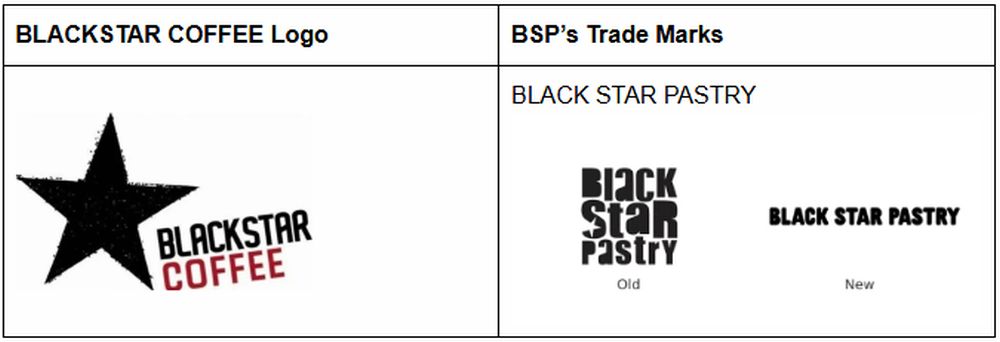
Downes J considered that the BLACKSTAR COFFEE Logo comprised three elements: a large star graphic, the word “BLACKSTAR” and the word “COFFEE”, and then noted that that the primary judge had treated the “BLACKSTAR” word as the dominant feature of the registration and, on that basis, found that it was deceptively similar to BSP’s registered trade marks. Downes J held that this approach was erroneous because the evaluation of the registered logo was conducted on an incomplete basis. Specifically, the primary judge’s description of the mark omitted the word “COFFEE”, and the analysis did not adequately explain why the large star graphic and the additional wording should be treated as subordinate.
Her Honour reiterated that a composite mark must be assessed as a whole. While deceptive similarity can arise where an alleged infringer takes an essential or distinguishing feature of a registered mark, the Court must be cautious not to reduce a composite logo to one verbal element too readily, because doing so may transform the registered mark into something different from what was actually registered.
In determining deceptive similarity, Her Honour found that:
- the star logo in the BLACKSTAR COFFEE Logo was the “essential feature”, given its size and prominence
- BSP’s registered trade marks all contain the word “PASTRY”, which word “looks and sounds different” to the word “COFFEE”
- while the respective trade marks have in common the word “BLACKSTAR” which is not a descriptive term, this similarity alone was not sufficient to deceive or confuse the ordinary consumer, given “the substantial and crucial” differences between the trade marks
- a notional buyer would not recall the word BLACKSTAR without also recalling the black star device in relation to the BLACKSTAR COFFEE Logo, and as such, they would not be confused by the use of the BSP trade marks, in which the black star logo was not present
The Court also placed considerable weight on the manner in which BSP’s marks were actually used. BSP’s stores were specialty bakeries, and in that context, ordinary consumers were unlikely to regard use “BLACK STAR PASTRY” in relation to the bakery as indicating the source of the coffee beans used in beverages sold in-store.
Based on these matters, the Court concluded there was no real risk that an ordinary consumer with an imperfect recollection of the BLACKSTAR COFFEE Logo would wonder whether BSP’s coffee beverages or coffee beans came from the same trade source.
The infringement finding in relation to the BLACKSTAR COFFEE Logo was therefore set aside.
Key issues
Although it may be appealed further, the decision means that Black Star Pastry is currently free to sell coffee (and cake) once again.
The decision highlights the importance of filing a trade mark application in the name of the true owner. If a trade mark application is filed in the name of one of two joint owners or otherwise in the name of a party who is not the owner, the application and any subsequent registration will likely suffer from an incurable defect which could be exploited by a third party in response to an infringement claim.
The decision also reinforces the potential limitations on the effectiveness of composite and/or logo registrations. That is, owners of composite marks cannot assume that particular elements of a logo will be afforded more weight than other elements when determining deceptive similarity.
Practical takeaways for brand owners
- ensure that a trade mark is filed in the name of the true owner. If a mark has been jointly created and used by business partners, spouses, founders or collaborators, ownership should be documented before filing
- do not assume consent “fixes” entitlement to a registration. This decision indicates that consent from a co-owner will not cure a filing made without statutory entitlement
- assess logo marks as registered. For clearance and enforcement, the comparison must address all components of the mark, including devices, layout, size and additional words
The content of this article is intended to provide a general guide to the subject matter. Specialist advice should be sought about your specific circumstances.
[View Source]
