

Pabian Law Clients and Friends,
We hope this H-2B Quarterly Update finds you well. We are excited to share the Pabian Law Quarterly Update for June 2026, serving as an educational update on government and regulation changes, trends, alerts, and other pertinent information.
Please read on for information about the following topics:
- What is Pabian Law’s H-2B Visa Team Currently Working On?
- Certified Seasonal Employer (CSE) exemption included in draft text of Homeland Security funding bill – great news, but there is a long way to go!
- The new DOL “joint employer rule” – potential risks for users of contract labor
- The use of AI and waiver of attorney-client privilege
- H-2B visa cap strategy warning: employers should not change start dates due to numerical cap considerations
- Recent study finds that ICE raids reduce jobs for U.S. workers
- The 2026 Staffing Summit is just around the corner – last chance to register!
What is Pabian Law’s H-2B Visa Team Currently Working On?
The Summer 2026 season: the summer season is upon us, and Pabian Law is working hard to finish the last applications for our summer clients (those with June start dates). With only a few petitions left to file, we continue to receive Approval Notices every day. Despite challenges created by government delays, along with the most H-2B visa petitions ever filed for the summer season, Pabian Law had an incredibly successful filing season. We saw the lowest amount of government requests in the history of our firm (and we already were industry leaders in how few requests we annually receive). Thank you to all of our incredible summer-season clients for such a wonderful filing season! We hope that you have a wonderful summer!
Now that your seasons are starting, it is important to keep compliance at the forefront of your mind while employing H-2B visa workers. The current immigration climate is volatile, and compliance violations can have serious consequences. Please continue to reach out to us with any questions you have, as we always want to help. As a reminder, we offer complimentary H-2B overview trainings, as well as manager trainings, to our clients. We also provide our clients with compliance guides (such as the After Approval Guide), which are great resources to consult throughout your season.
We will be reaching out to schedule planning calls for Summer 2027 H-2B visa petitions in the coming weeks. In the meantime, if you would like to have a phone call sooner, please feel free to let us know. Work on summer 2027 H-2B visa petitions will begin in mid-September.
Finally, if you are not a current Pabian Law client and are interested in learning more about working with us, please reach out right away! We have very, very limited capacity for new summer-season clients, so please reach out now!
The Winter 2026/2027 season: We started work on H-2B visa petitions for the winter 2026-2027 season a few months ago. We are currently gearing up to file our clients’ applications with the U.S. Department of Labor (DOL) at the 90-day mark (the first possible day to file with the DOL). During this step, we collect seasonality evidence from clients to ensure that we are able to meet the main criteria for H-2B visa status – that the business is seasonal. Applications are submitted to the DOL ninety (90) days before the start date, so for October 1st employers, this means we must be ready to file on July 3rd!
Pabian Law winter-season clients, please remember to join us on June 17th at 2:00p.m. EST for our Town Hall Webinar, “Filing for In-Country Workers, including a Discussion on Successful In-Country Recruitment.” If you would like to attend this complimentary, client-only webinar, please email us for the registration link.
Certified Seasonal Employer (CSE) exemption included in draft text of Homeland Security funding bill – great news, but there is a long way to go!
On June 5, 2026, the House Homeland Security Appropriations Subcommittee approved draft text of the Fiscal Year 2027 (FY27) Department of Homeland Security (DHS) appropriations bill. The proposed bill includes a provision that many H-2B organizations have been lobbying for in recent months – the Certified Seasonal Employer (CSE) exemption. Although it is great news that the text was included, there are still many hurdles for the bill to overcome, and its passage is far from certain.
The CSE exemption would provide an exemption from the annual numerical limit on new H-2B visas (the “H-2B cap”) for any employer who received certification from the U.S. Department of Labor (DOL) for an H-2B application in each of the past five fiscal years (FY2022-2026). The exemption would apply to specific applications and would exempt a number of H-2B visas equal to the highest number of workers certified in the past five years. For example, under the proposed rule, if an employer received certification for 10 H-2B Cooks in each of the past five years, but recently added a Server application in 2025, its 10 Cooks would be cap exempt in 2027, but its Servers would not be. Also, if the employer filed for 12 Cooks in 2027, only 10 of them would be eligible for cap-exempt status.
As background, the H-2B cap is divided into two (2) separate caps: 33,000 visas for the winter season (October through March start dates) and 33,000 visas for the summer season (April through September start dates). The cap primarily applies to out-of-country workers, as in-country workers are already cap-exempt. Each year, applications for multiple hundreds of thousands of H-2B spots are filed for only 66,000 spots, leaving employers subject to a lottery if they wish to hire out-of-country workers. The CSE exemption is an effort to build more certainty into the program and reward long-term filers with a more predictable application process for out-of-country H-2B workers.
If passed, this new exemption would benefit not only long-time filers who would qualify for the exemption, but also new filers. This is because even H-2B organizations who do not qualify for the exemption would still be competing with far fewer other employers for those limited 66,000 visas. Therefore, odds in the lottery for everyone would likely improve significantly.
This new bill has been receiving strong advocacy from seasonal labor organizations and some advocates in Congress. However, we have seen similar provisions with strong support (such as the “returning worker exemption”) disappear during committee review or voting several times in the past.
In fact, we have heard from a lobbyist working directly to advance this bill that it is unlikely that this provision becomes law in the near future. First, powerful labor organizations have begun lobbying against this provision. The provision still must pass through multiple rounds of revisions and voting. We have seen similar cap-exemption provisions make it all the way to the final vote before being stripped out at the last minute before a final vote. Secondly, the bill may not even see a vote anytime soon, as a continuing resolution (CR) could be passed to avoid voting on the bill itself. DHS funding is always politically volatile, and this has become even more so recently due to the debate surrounding Immigration and Customs Enforcement (ICE) funding. Due to the volatility, members of Congress may be hesitant to reach an agreement on DHS funding specifically, especially if they can use a CR to delay a vote until after the midterm elections in November 2026.
In other words, while it is great news that the language made it into the bill and it is encouraging to see strong advocacy in favor of the CSE exemption, there is still such a long way to go and, unfortunately, there is a good chance that it will ultimately not be enacted. We will continue to monitor this in the coming months and will provide updates as soon as we receive definitive news.
The new DOL “joint employer rule” – potential risks for users of contract labor
On April 23rd, the U.S. Department of Labor (DOL) published a proposed rule revisiting how “joint employer” status is defined under the Fair Labor Standards Act (FLSA) and other federal laws. Although not yet implemented, the rule potentially increases liability risks for employers who use H-2A or H-2B contract labor from staffing companies.
Under the proposed rule, the DOL would apply an “actual control” test centered on four core factors: whether the potential joint employer (1) hires or fires the employee, (2) supervises and controls the employee’s work schedule or conditions of employment, (3) determines the employee’s rate and method of pay, and (4) maintains the employee’s employment records. The rule emphasizes whether control is actually exercised in practice, either directly or indirectly. This differs from the current, broader framework, which can give weight to reserved or theoretical control (even if not exercised) or other factors.
While the proposed “actual control” test is not necessarily stricter than the current framework, it is more concrete and well defined. There is currently no uniform federal rule and, instead, enforcement is based on judicial interpretations, which vary from region-to-region. Therefore, uncertainty may have led federal investigators (including DOL Wage & Hour auditors) to enforce joint-employer rules less strictly. Under a uniform national standard, federal investigators will be armed with a stronger and more concrete enforcement framework and are expected to apply the “joint employer” label to users of contract labor more consistently.
In contract labor arrangements, the end employer often has significant control over the workers’ daily activities. Even if the end employer does not provide payment or fully control schedules, discipline, or personnel decisions, it could still be held as a joint employer if there is enough control over work activities. In other words, if contractors are treated similarly to employees for day-to-day purposes, the end employer may be found to be a joint employer.
The possibility of a “joint employer” designation is critical because joint employers are held jointly and severally liable for violations under federal law, which includes the FLSA and H-2B regulations. When companies hire contract workers, the end employer is blindly trusting that the labor contractor/staffing company is complying with minimum wage and other laws. This especially true for H-2B labor contractors, since H-2B laws impose even stricter wage rules and compliance requirements. If found to be a “joint employer,” the end-employer can be held liable for all violations of the contractor, resulting in potentially severe financial liability.
Assuming the proposed rule is finalized, it will become riskier to use contract labor, especially from H-2B visa labor contractors. In this new landscape, it would be far more cost/risk-effective for companies to sponsor their own H-2B workers rather than relying on staffing companies. We will continue to monitor the proposed rule closely and will provide updates if and when this becomes law.
The use of AI and waiver of attorney-client privilege
As the use of artificial intelligence (AI) continues to spread, please keep in mind that, while AI can provide many benefits and conveniences, it can also create dangers that attorneys and clients must navigate. Importantly, we want to emphasize that the use of AI can waive attorney-client privilege.
Recently, a New York court held in United States v. Heppner that a defendant’s written exchanges with a generative AI platform are not protected by attorney-client privilege. This is because many AI platforms (including the one in Heppner) have terms and privacy policies that explicitly allow them to disclose user data to third parties. Therefore, because the use of AI allows third parties to access communications, the court in Heppner held that users had no reasonable expectation of privacy in any communications involving AI, thus destroying privilege.
Why should this matter to you?
Pabian Law often leads trainings, webinars, and client calls through Microsoft Teams, Zoom, and other platforms that our clients may use. These platforms sometimes offer an AI feature (e.g., Otter.ai or Copilot) to capture notes for meetings. We highly recommend against using (or accepting the use of) these AI notetakers on calls with Pabian Law, as any communications throughout the call that would normally be covered by attorney-client privilege would no longer be protected. This is because many AI tools store conversations in the cloud, erasing any expectation of confidentiality and making the information obtainable in the event of a lawsuit.
At Pabian Law, we are committed to protecting client privacy and confidentiality. Therefore, we have worked with our IT provider to disable the use of these AI notetakers on all external calls and only use them in internal meetings. In this new world of AI, it is more important than ever to work with a knowledgeable and leading law firm to guide you, as well as to create internal policies and procedures for your properties to ensure data security and privacy. Before interacting with AI, remember to think about who can access your confidential information and what privileges you may be waiving.
H-2B visa cap strategy warning: employers should not change start dates due to numerical cap considerations
We have recently become aware that some employers are being advised by certain agencies and H-2B visa providers to change their employment dates as a strategy to improve their chances in the H-2B visa cap. This is risky and, frankly, awful and irresponsible advice!
Specifically, we learned that some organizations and recruiters are advising winter-season employers to move their H-2B visa start dates from October or November to September to pursue summer-season supplemental cap visas. This would, under this theory, allow those employers to avoid any risk of missing the winter-season H-2B visa cap. Pabian Law strongly recommends against this strategy for the reasons outlined below.
As background, the H-2B visa annual numerical limit (called the “H-2B cap”) is divided into two (2) separate caps: 33,000 visas for the winter season (October through March start dates) and 33,000 visas for the summer season (April through September start dates). The cap primarily applies to out-of-country workers, as in-country workers are generally cap-exempt. We expect the winter-season cap to be highly competitive this year, and it is likely that for the first time ever, some October 1st start dates may miss the cap and be unable to recruit out-of-country workers. (Note: we still expect most October 1st filers to be able to recruit out-of-country workers, as data suggests that the cap will narrowly be reached for October 1st start dates). In addition to the H-2B cap out-of-country allotment, the government historically makes additional visas available through a supplemental cap to help with the supply and demand issue. This year, the government released additional visas through the supplemental cap, including a special allotment for petitions with start dates ranging from May 1st to September 30th. The flawed logic of the organizations and recruiters is that winter-season employers could move their start dates to September to fall into this supplemental cap allotment. In short, the proposed strategy is an effort to avoid the winter-season cap by using an earlier start date and “jumping ahead” to request summer-season supplemental visas instead.
Changing a start date to avoid the cap is an awful, terrible, and irresponsible idea for several reasons. First, your start date must be based on actual business needs. Changing a start date primarily to improve cap positioning, instead of having a legitimate business need, can be viewed by the government as a misrepresentation. This can expose you to audits, delays, denials, and broader compliance concerns.
Secondly, artificially altering start dates can also create long-term issues for future filings. If you attempt to move back to your original start date, the government may question the legitimacy of your seasonal need and prior seasonality evidence. Inconsistencies in filing histories – especially without business-based reasons – may be difficult to explain in subsequent years.
Lastly, and most convincingly, from a practical standpoint, there is no guarantee that supplemental visas will remain available long enough for anyone attempting this strategy. Supplemental cap relief changes every year and is inherently unpredictable. This year is the first time that this specific supplemental cap allotment is available, and it is very likely that the visa numbers are exhausted well in advance of September start dates. Therefore, an organization might take all the risks outlined above and still be left without workers.
For employers with October 1st start dates, we remain confident that the vast majority can obtain out-of-country visas under the regular cap, although no outcome is ever guaranteed. For organizations with later start dates or who otherwise miss the cap, in-country recruiting remains the safest and most reliable backup plan. Ultimately, attempts to “game” the H-2B cap by changing start dates can create serious compliance issues and could leave you in a difficult position – not only without workers, but with bigger problems too.
This is a good reminder to always work with a law firm on your H-2B visa petitions. Recruiters and non-legal providers who file visa petitions often gloss over, or ignore, legal requirements and risks and routinely provide bad legal advice. This is a perfect example of terrible advice being provided by non-lawyers.
Recent study finds that ICE raids reduce jobs for U.S. workers
A recent study found that enhanced U.S. Immigration and Customs Enforcement (ICE) presence during the Administration’s second term actually harms U.S.-born workers. According to the University of Colorado Boulder’s April 2026 study (linked), the Administration’s goal of improving U.S.-born workers’ economic situation through mass deportation has had the opposite effect. In fact, the study found that “enforcement may contract, rather than reallocate, labor demand.”
According to the study, in an average area, approximately six (6) undocumented immigrants drop out of the labor force for every ICE arrest. This is because workers are fearful of performing any daily activities, including going to work. This lack of workforce, in turn, harms U.S. workers, specifically those who are male with a high school education or less.
Because males make up most ICE arrests, the study focused on sectors that are male dominated and where undocumented workers are strongly represented (i.e. agriculture, construction, manufacturing, and wholesale). The findings show a clear correlation: sectors experiencing the largest negative effects on male undocumented workers also tend to experience negative effects for U.S.-born male workers. This is because U.S. workers and undocumented workers are complements in the labor force rather than substitutes. In other words, they are not competing for the same jobs (or at least, it is not that simple).
Specifically, when there are fewer undocumented workers to fill certain roles, employers will take on less work, which in turn decreases their need for other related roles that U.S. workers are typically hired for. For example, the construction industry feels this impact significantly: where there are fewer undocumented workers available, companies build fewer homes, which means they hire fewer U.S. workers as well. Finally, the research found that employers are not increasing wages to attract U.S. talent in the face of immigration enforcement.
Overall, the study’s findings show that “immigration enforcement reduces [the] number of immigrant workers and has harmful effects on U.S.-born workers.” As employers are forced to scale back operations due to labor shortages, the study suggests that industries enduring persistent workforce gaps may find the most effective solution is to bring in workers through legal pathways such as temporary or seasonal visa programs, including the H-2B visa program. These legal pathways can help employers “have their cake and eat it too” – allowing them to fill staffing gaps, grow their businesses, and ultimately hire more U.S. workers in the long run.
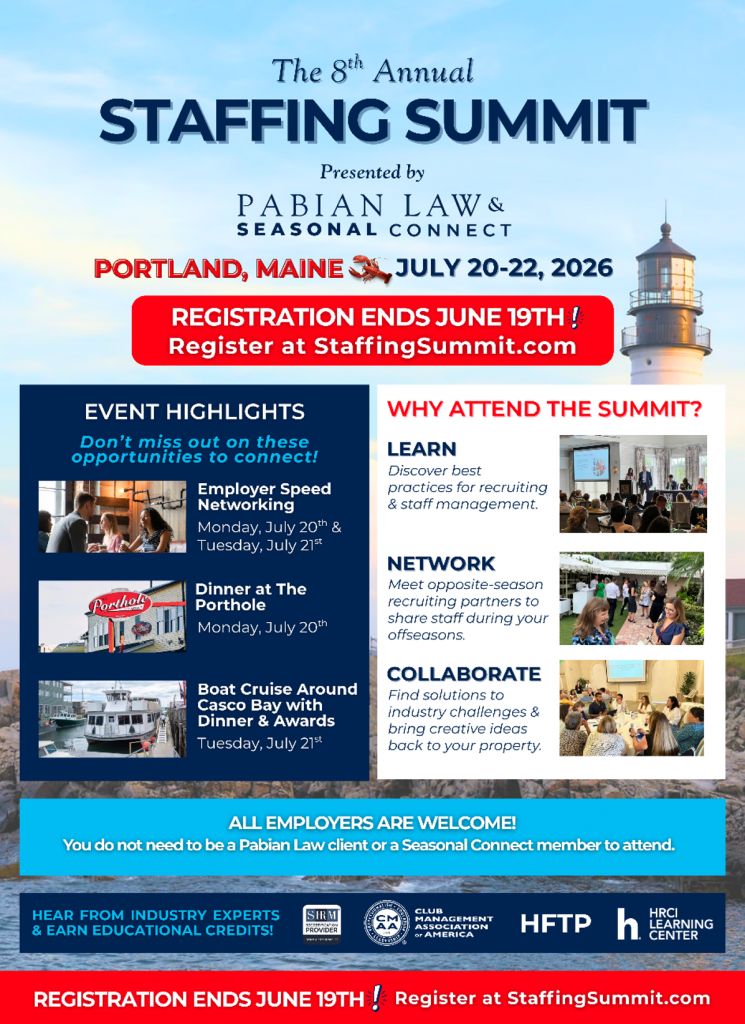
The 2026 Staffing Summit is just around the corner – last chance to register!
Our 8th annual Staffing Summit is shaping up to be our biggest Summit yet! With over double the number of registrants as this time last year, we are anticipating many new employers joining us, as well as so many returning employers from years’ past.
This year’s event features new, highly requested educational sessions, double the allotted time for Employer Speed Networking, and a networking boat cruise in Casco Bay.
Registration ends on Friday, June 19th.Additionally, both the hotel rooms and the Monday night dinner are nearing capacity. Don’t wait to register and risk missing out!
The Summit is an excellent opportunity to learn about H-2B visas, immigration compliance, recruiting, employee retention, and more! You will also have several opportunities to meet potential recruiting partners for your seasonal staffing through our many networking activities and events.
Register today and join us at the 2026 Staffing Summit (linked)! You can find more information, including the agenda and hotel details, at www.staffingsummit.com.
I am excited to see so many of you this July in Portland, Maine!
Conclusion
We hope that you enjoyed this Quarterly Update. Please do not hesitate to contact us with any questions about the topics listed above or any other immigration-related matters.
The content of this article is intended to provide a general guide to the subject matter. Specialist advice should be sought about your specific circumstances.
[View Source]