
- within Law Department Performance and Accounting and Audit topic(s)
Duane Morris Takeaway: As authors and editors of our firm's our Class Action Review, we identified ten (10) key trends in class action litigation over the past year. Trend # 1 focuses on how in 2025 settlement numbers reached an unprecedented level in class action litigation. In 2024, settlement numbers broke the $40 billion mark for the third year in a row. In 2025, the cumulative value of the highest ten settlements across all substantive areas of class action litigation surpassed that benchmark and totaled $79 billion.
In today's video blog, Duane Morris partner Jerry Maatman discusses how the aggregate monetary value of class action settlements continued to reach incredible highs in 2025, as plaintiffs' lawyers and government enforcement agencies monetarized their claims into enormous settlement values. In 2025, the plaintiffs' bar was successful in converting case filings into significant settlement numbers again. Tune in below to hear all about this or read the blog post blow for more information.
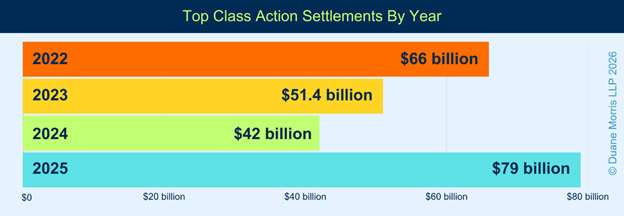
In 2025 settlement numbers reached an unprecedented level in class action litigation. In 2024, settlement numbers broke the $40 billion mark for the third year in a row. In 2025, the cumulative value of the highest ten settlements across all substantive areas of class action litigation surpassed that benchmark and totaled $79 billion.
That number is the highest value tallied in the past two decades, and exceeding the settlement numbers from 2022, 2023, and 2024 by a significant margin. In 2022, these settlement numbers totaled $66 billion; in 2023, they totaled $51.4 billion; and, in 2024, these settlement numbers totaled $42 billion.
Combined, the settlement numbers of the past four years exceeded $238 billion, representing use of the class action mechanism to redistribute wealth at an unprecedented level.
On an aggregate basis, across all areas of litigation, defendants settled class actions and government enforcement lawsuits for more than $79 billion in 2025.
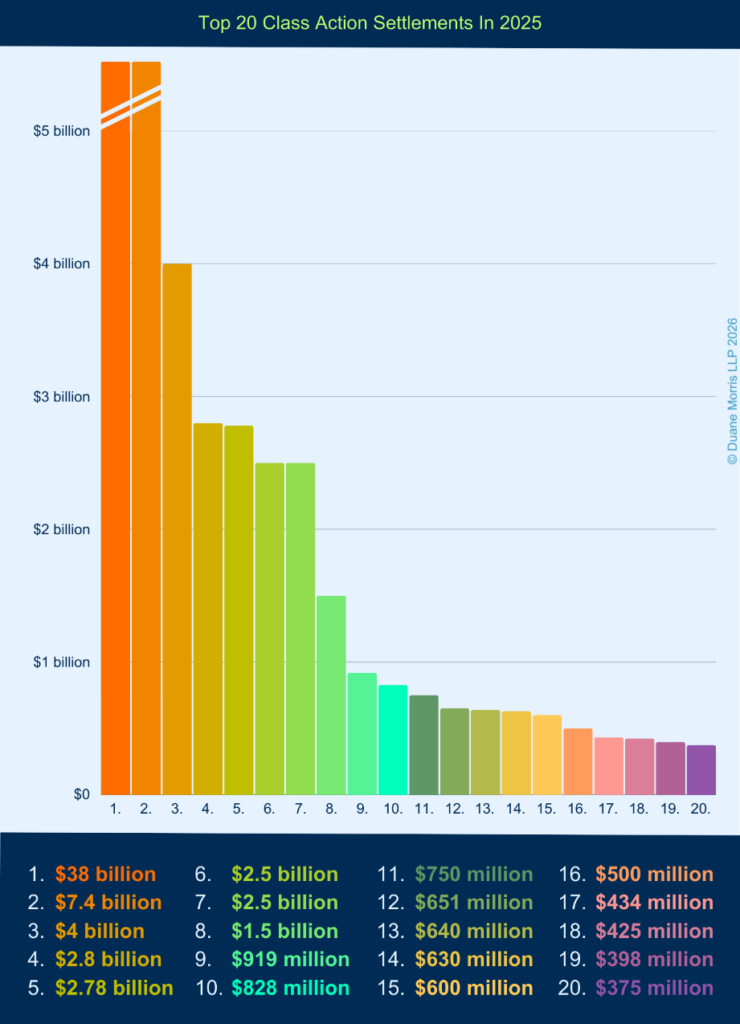
The following chart illustrates the highest 20 settlements during 2025, which collectively totaled $68.63 billion.
The highest 20 settlements during 2024 totaled $34.6 billion, which fell slightly short of the numbers seen in 2023 and 2022.
The value of the highest 20 settlements in class and government enforcement actions topped $51 billion in 2023, whereas the highest 20 settlements topped $66 billion in 2022.
Combined, the four-year settlement total eclipses any other four-year period in the history of American jurisprudence.
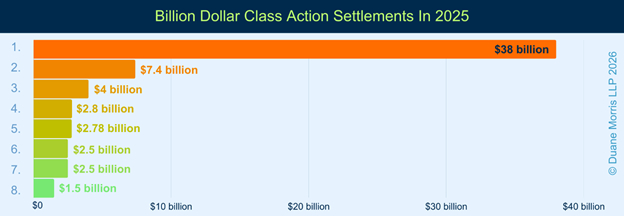
In 2025, several settlements met or exceeded the one-billion-dollar mark.
In 2025, parties agreed to settle eight matters for one billion dollars or more.
There were 10 settlements of one billion dollars or more recorded in 2024, and nine settlements of one billion dollars or more in 2023 and 15 class action settlements of one billion dollars or more in 2022.
Together, corporations have agreed to 42 settlements of one billion dollars or more over the past four years. This string of settlements marks the most extensive set of billion-dollar class action settlements in the history of the American court system. These expansive settlement numbers spanned nearly every area of class action litigation.
In fact, the ten highest settlements cumulatively exceeded one billion dollars in six different areas of class action litigation, including antitrust, consumer fraud, generative artificial intelligence and crypto cases, government enforcement litigation, products liability, and securities fraud.
The following shows the cumulative value of the ten highest settlements in each key area of class action litigation:
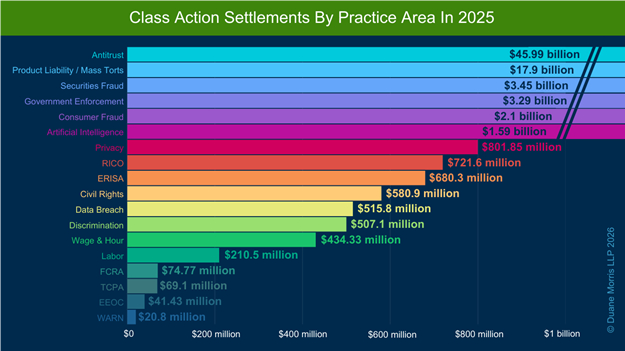
- Antitrust Class Actions: $45.99 billion (up from $8.412 billion in 2024)
- Products Liability Class Actions: $17.9 billion (down from $23.40 billion in 2024)
- Securities Fraud Class Actions: $3.45 billion (up from $2.55 billion in 2024)
- Government Enforcement Litigation: $3.29 billion (up from $335.9 million in 2024)
- Consumer Fraud Class Actions: $2.1 billion (down from $2.44 billion in 2024)
- Generative AI & Crypto Class Actions: $1.59 billion
- Privacy Class Actions: $801.85 million (down from $2.01 billion in 2024)
- ERISA Class Actions: $680.30 million (up from $413.3 million in 2024)
- Civil Rights Class Actions: $580.9 million (up from $313.8 million in 2024)
- Data Breach Class Actions: $515.79 million (down from $593 million in2024)
- Discrimination Class Actions: $507.1 million (up from $356.8 million in 2024)
- Wage & Hour Class/Collective Actions: $430.58 million (down from $614.55 million in 2024)
- Labor Class Actions: $210.5 million (down from $237.0 million in 2024)
- BIPA Class Actions: $136.6.0 million (down from $206.85 million in 2024)
- TCPA Class Actions: $69.1 million (down from $84.73 million in 2024)
- FCRA Class Actions: $74.77 million (up from $42.43 million in 2024)
- EEOC Enforcement Litigation: $41.43 million (up from $25.95 million in 2024)
The value of the ten highest settlements in the antitrust, government enforcement, EEOC, securities fraud, ERISA, government enforcement, civil rights, and FCRA areas increased in 2025, reflecting the growth of class action litigation in these areas, as they account for a higher percentage of the overall total.
By contrast, the value of the ten highest settlements in the privacy and BIPA class actions decreased to up to 50% below their 2024 total. In 2025, we began tracking a new category of settlements, for class actions in the generative artificial intelligence and crypto areas of law. The top ten settlements in that category equaled $1.59 billion in 2025.
Implications: Particularly when viewed in conjunction with the settlement values observed in 2023 and 2024, the settlement numbers in 2025 confirm that corporate defendants are operating in a new era of enhanced class action risks. Corporations should expect these numbers to continue to incentivize the plaintiffs' class action bar to be equally if not more aggressive with their settlement positions in 2026.
Disclaimer: This Alert has been prepared and published for informational purposes only and is not offered, nor should be construed, as legal advice. For more information, please see the firm's full disclaimer.