

- within Food, Drugs, Healthcare and Life Sciences topic(s)
- in United States
- with readers working within the Healthcare and Pharmaceuticals & BioTech industries
- within Food, Drugs, Healthcare, Life Sciences, Intellectual Property, Government and Public Sector topic(s)
On August 7, 2026, the Centers for Medicare & Medicaid Services (CMS) issued a notice with comment period proposing the “Regulatory Alignment for Predictable and Immediate Device (RAPID) Coverage Pathway” (the “Proposed Notice”). RAPID is intended to accelerate Medicare coverage for certain medical devices that have received breakthrough designation from the Food and Drug Administration (FDA) by aligning CMS coverage review with FDA premarket review before market authorization.
Specifically, RAPID is designed to identify Medicare evidence expectations earlier, while a pivotal investigational device exemption (IDE) study for FDA can still be shaped to address evidentiary questions pertinent to Medicare coverage. The proposal is aimed at enabling CMS to release a proposed National Coverage Determination (NCD) on the same day FDA authorizes an eligible device, with the goal of finalizing coverage as soon as 60 days after authorization for Class II devices and 90 days after authorization for Class III devices.
As proposed, the RAPID pathway excludes in vitro diagnostics (IVDs), but software as a medical device (SaMD) does not appear to be categorically excluded from the program. In addition, devices actively being investigated in an IDE pivotal study would not be eligible for consideration, but the Proposed Notice requests comment on whether there should be a pathway to include these devices in RAPID. The Proposed Notice also proposes to pause Transitional Coverage for Emerging Technologies (TCET) while continuing parallel review. Notably, NCDs for RAPID devices would be prioritized over other NCDs on the CMS wait list.
The Proposed Notice does not address coding or payment for technologies that qualify for RAPID.
Comments are due by October 13, 2026. CMS will respond to comments in a final notice. The Proposed Notice does not identify an effective date for RAPID.
RAPID general principle
The central purpose of RAPID is to reduce the gap between FDA authorization and Medicare coverage. In part, as noted in the Proposed Notice,1 this gap is driven by the fact that “[c]linical studies that are conducted to gain FDA market authorization are not necessarily required to include participants with similar demographics and characteristics of the Medicare population.” RAPID is intended to address this issue by requiring a manufacturer seeking coverage under the RAPID pathway to “test, as part of an IDE study, whether the device improves health outcomes for Medicare beneficiaries that FDA determines are appropriate for the device and that CMS confirms would qualify as health outcomes relevant to Medicare beneficiaries.”
Relevant FDA pathways
FDA classifies medical devices into three classes based on risk. Regulatory control increases from Class I (lowest risk) to Class III (highest risk). FDA generally must clear or approve the commercial sale of new medical devices in Classes II and III, respectively. Marketing authorization for Class II medical devices (except for Class II exempt devices) is obtained via a 510(k) notification (Class II, generally) or the granting of a De Novo reclassification request (Class II). Marketing authorization for Class III medical devices is obtained via the Premarket Approval (PMA) pathway. As the risk of the device increases, so do FDA’s requirements to obtain market authorization.
- 510(k) Notification (Class II, generally)
- Demonstrate substantial equivalence to Class I or Class II legally marketed device (“predicate”)
- Requires new product to meet two criteria:
- Same intended use, AND
- Similar technology as the predicate.
- De Novo Request (Class II)
- Low to moderate risk, such that general and/or special controls would provide reasonable assurance of safety and effectiveness of device
- Absence of a suitable predicate (i.e., ineligible for 510(k) pathway)
- Probable benefits outweigh potential risks.
- PMA (Class III)
- Safety and Efficacy of device must be demonstrated with valid scientific evidence.
Appropriate candidates for RAPID
CMS proposes to establish the following requirements for a device to be eligible for RAPID:
- Device has breakthrough designation from FDA and is either:
- A Class II device for which the manufacturer is participating in FDA’s Total Product Life Cycle Advisory Program (TAP) and is planning to submit a De Novo request to FDA.
- A Class II device for which the manufacturer is participating in TAP and will seek marketing approval via the 510(k) pathway so long as the primary predicate was authorized via the De Novo classification pathway no earlier than 18 months prior to acceptance into the RAPID coverage pathway; or
- A Class III device for which the manufacturer is planning to submit a PMA application regardless of whether they are participating in TAP.
- Device is at the IDE pre-submission stage and the manufacturer plans to conduct an IDE study that enrolls Medicare beneficiaries and evaluates clinical outcomes that FDA determines are appropriate for the device and that CMS agrees would demonstrate improved health outcomes for the Medicare population. CMS solicits feedback on whether it “should establish a temporary process under which devices that have progressed beyond the IDE pre-submission stage and are currently being studied under an IDE could become eligible for the RAPID coverage pathway.”
- No evidence that the device cannot fall under a Medicare benefit category.
- Device is not already subject to a controlling NCD.
- Device is a separately payable device that, if approved, can be billed to Medicare, though the Proposed Notice offers no further information as to how CMS would interpret or operationalize this requirement.
- Device is not otherwise excluded from coverage by statute or regulation.
The following standards proposed by CMS are noteworthy:
- Exclusion of IVD devices from RAPID
The Proposed Notice states that “IVD products will not be accepted into the RAPID coverage pathway.” CMS describes IVDs as a highly specific area of coverage policy development and states that it has historically delegated review of many such products to specialized Medicare Administrative Contractors (MACs). CMS states that most coverage determinations for breakthrough-designated IVDs should continue through existing MAC pathways. CMS notes that in cases where CMS and a manufacturer agree that an NCD is appropriate for an IVD, the manufacturer may still submit an NCD request through the conventional process (i.e. not through RAPID).
The eligibility of IVDs for RAPID is likely to be an active area for stakeholder comment. Notably, the only two parallel review NCDs were for IVDs – Colorectal Cancer screening (210.3) and Next Generation Sequencing for Advanced Cancer (90.2) and certain types of IVDs such as screening tests must be covered under the NCD process.
By contrast, software as a medical device (SaMD) does not appear to be categorically excluded from RAPID.
- Ambiguity on inclusion of significant risk versus non-significant risk IDE studies
As discussed in the “RAPID Process” section below, the Proposed Notice makes clear that it intends to leverage the IDE submission process to facilitate the execution of the RAPID program. However, while the Proposed Notice focuses on IDE studies as the vehicle for CMS input, the discussion fails to address whether the RAPID program is restricted to significant risk (SR) studies only.
As background, there are two types of IDE studies governed by 21 CFR Part 812: SR studies and nonsignificant risk (NSR) studies. SR studies investigate significant risk devices as defined by 21 CFR 812.3(m) (e.g., implanted devices with the potential for serious risk to health, devices for supporting or sustaining life, etc.) while all other investigational device studies are NSR. SR studies must adhere to all the requirements of Part 812, including obtaining FDA approval for an IDE application and filing an IDE final report. By contrast, NSR studies have abbreviated requirements under Part 812, including no IDE final report, and they do not require separate FDA approval for an IDE application.2 Notably, many Class II devices and even some Class III devices are investigated under NSR pivotal studies.
Consequently, the question of whether NSR studies are eligible for the RAPID program should be addressed by CMS in the near future, as their inclusion would necessitate updates to the proposed framework.
RAPID process
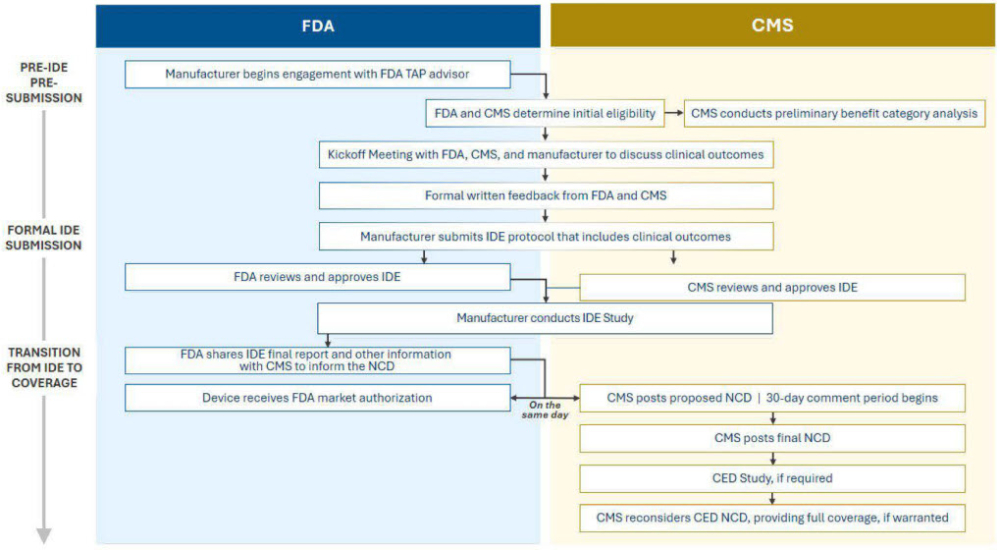
The Proposed Notice details a three-stage process for the RAPID pathway:
- Pre-submission
Prior to IDE submission, a manufacturer of an eligible device would express interest to FDA, which would assess initial eligibility and, if it determines the device to meet initial eligibility, will consult CMS. It appears that FDA will confirm with CMS that the eligibility criteria pertaining to Medicare coverage and payment are met. This will include a preliminary benefit category analysis by CMS to “evaluate whether information exists that immediately makes clear that the device will not fall under a benefit category.” The result of this preliminary benefit category determination “is subject to change upon FDA’s decision regarding market authorization of the device.”
If the candidate appears appropriate, FDA, CMS, and the manufacturer would hold a RAPID kickoff meeting to discuss a clinical study synopsis and the evidence needed for both FDA authorization and Medicare coverage purposes. The manufacturer would then submit a request for written feedback to FDA for the two agencies to review the IDE study protocol. CMS will “provide FDA with written feedback regarding whether the health outcomes to be evaluated in the study are sufficient to support an NCD, satisfy the CMS IDE criteria and any other feedback CMS would require to be addressed.” The two agencies “will also provide feedback regarding potential evidence gaps that manufacturers can choose to address in their planned pivotal IDE study or can begin planning to address in potential postmarket studies, including FDA post-approval studies (if applicable).”
- Formal submission
Next, the manufacturer would submit the formal IDE application to FDA. FDA would review the IDE through its ordinary process and share the decision letter and study design considerations (SDCs) with CMS. CMS would identify to the manufacturer “SDCs that must be addressed to continue participation in the RAPID coverage pathway.” The Proposed Notice describes this feedback as “a key step in the process that provides an opportunity for the manufacturer to address CMS concerns during the premarket phase.”
After the manufacturer addresses any SDCs, a revised protocol is submitted to and approved by FDA, and then the manufacturer would submit the IDE protocol to CMS through the existing CMS IDE review process. If CMS approves the IDE study and RAPID criteria are satisfied, CMS would issue an approval letter indicating its intent to issue a proposed NCD concurrently with FDA authorization, assuming the evidence ultimately supports coverage. Inclusion in RAPID does not appear to impact whether Medicare will provide coverage of routine care items and services and/or a Category B device in the IDE study under 42 C.F.R. § 405.201 et seq.
The Proposed Notice states that “if a manufacturer wishes to make any changes to the IDE study protocol after CMS approval, these changes must be reviewed and agreed upon by FDA and CMS to continue participation in the RAPID coverage pathway.”
- Transition to coverage
When FDA accepts the marketing submission for the device, it will share with CMS “the clinical study report and any other relevant information needed for CMS to confirm if the device has demonstrated an improvement in the clinical outcomes that FDA has determined are appropriate for the device and which CMS has confirmed is a qualifying health outcome for purposes of Medicare coverage.” If the manufacturer decides to pursue national coverage through RAPID, it will submit a formal NCD request cover letter and any additional materials in support of the request. The Proposed Notice states that “most, if not all, of the clinical evidence needed to conduct the RAPID NCD analysis would be included in the IDE final report and other information FDA shares with CMS,” although it should be noted that IDE final reports are frequently filed later than the device marketing application because extended safety follow up may still be ongoing.
Per the Proposed Notice, if a device in the RAPID pathway receives FDA marketing authorization “and has satisfactorily demonstrated improvement in a clinical outcome that FDA has determined is appropriate for the device and that CMS has confirmed would qualify as a health outcome, CMS will initiate the NCD process by posting a tracking sheet and proposed NCD on the CMS website on the same day as FDA market authorization.” This timing is contingent on the relevant FDA Decision Summary or Summary of Safety and Effectiveness Data being made publicly available on the day of FDA market authorization. Manufacturers may withdraw from the RAPID pathway until CMS has issued the proposed NCD.
As per statutory requirements, there will be a 30-day public comment period on the Proposed NCD. The Proposed Notice states that CMS’s goal is “to release the final NCD approximately 60 days after FDA market authorization for Class II devices and 90 days after for Class III devices.” The Proposed Notice makes clear that a RAPID NCD may be more streamlined than a conventional NCD, with a more concise evidence summary.
RAPID NCDs remain in effect until reconsidered. Depending on the results of the IDE study, the RAPID NCD may be one that is conditioned on the development of additional evidence (i.e., coverage with evidence development (CED)).
The Proposed Notice offers the following graphical summary of the RAPID process:
Figure 1: Rapid Coverage Pathway
Interaction with other coverage pathways
The Proposed Notice briefly discusses RAPID’s interaction with other coverage pathways, as follows:
Parallel review. Parallel review remains available, and the Proposed Notice states that “CMS intends to work with FDA to consider updates to the Parallel Review program and other initiatives to align procedures, as appropriate.”
TCET. The Proposed Notice states that TCET will be paused for new candidates so that CMS can focus on the successful implementation of the RAPID pathway.
Current NCD waitlist. Perhaps most impactfully, CMS states that “due to CMS’ commitment to issue proposed NCDs for devices in the RAPID coverage pathway on the same day as FDA market authorization, CMS proposes to prioritize the opening of RAPID NCDs over non-RAPID NCDs from the NCD Wait List if we are unable to address the total volume of NCDs within our available resources at any given time.” If finalized as proposed, this provision may be particularly problematic for IVDs that must be covered through an NCD, as they may find themselves both excluded from RAPID and deprioritized for coverage relative to devices that are eligible for RAPID.
Next steps
CMS is now accepting comments on the RAPID coverage pathway proposed notice. If you are interested in submitting a comment, or have any questions about coverage for breakthrough devices more generally, please contact the Hogan Lovells Cadwalader attorney with whom you regularly work or any of the authors of this alert. We will continue to closely monitor CMS activities and keep you apprised of notable updates, including finalization of the notice.
References
1 91 Fed, Reg, 51710 (Aug. 11, 2026).
2 Once the IRB approves the study protocol and NSR status, the study is considered to have an approved IDE application by default per 21 CFR § 812.2(b).
The content of this article is intended to provide a general guide to the subject matter. Specialist advice should be sought about your specific circumstances.
[View Source]


