

- within Corporate/Commercial Law topic(s)
- in United States
- with readers working within the Advertising & Public Relations, Property and Law Firm industries
- within Transport, Employment and HR and Antitrust/Competition Law topic(s)
- with Inhouse Counsel
Latest update
- Agreement on CSRD and CSDDD Amendment Directive: On 16 December 2025, the European Parliament voted to approve the proposed 'CSRD and CSDDD Amendment Directive' which forms part of the Omnibus I Package (the "Omnibus"). This is the final approval needed before this Directive comes into effect as the Council had already confirmed on 10 December 2025 that it will approve the European Parliament's position. The only steps now required for the Directive to come into force are procedural steps, including a review by the lawyer linguists and translation into the 24 official languages and publication in the EU Official Journal. In this deck, we compare the final text of the CSRD and CSDDD Amendment Directive against the existing position under CSRD and CSDDD.
- Deferral on additional reporting for wave 1 companies: the 'Quick Fix' Delegated Regulation for wave 1 companies already reporting under CSRD was published in the EU Official Journal on 10 November 2025. This Delegated Regulation amends the current ESRS to defer additional reporting requirements that wave 1 companies under CSRD would otherwise have been required to meet for reporting on FY2025 and FY2026.
- Simplified ESRS: EFRAG released its Draft Simplified ESRS on 3 December 2025– for more details on the content please refer to our note here .
Catching up with the Omnibus
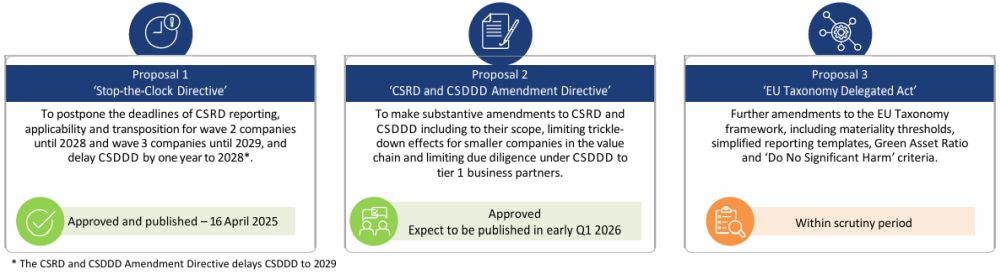
The Omnibus proposals, first published by the Commission in February 2025, aims to simplify the three key pillars of EU sustainability regulation– CSRD, CSDDD and the EU Taxonomy framework.1
These regulations are highly technical, and many organisations have struggled with implementation. As a result, regulatory simplification has been a widely supported priority within the industry. The Omnibus has therefore been broadly welcomed for its promise to improve usability and simplify regulatory burdens. But it also creates uncertainty about the future of the EU's ambitious sustainability framework to which many companies have dedicated significant resources.
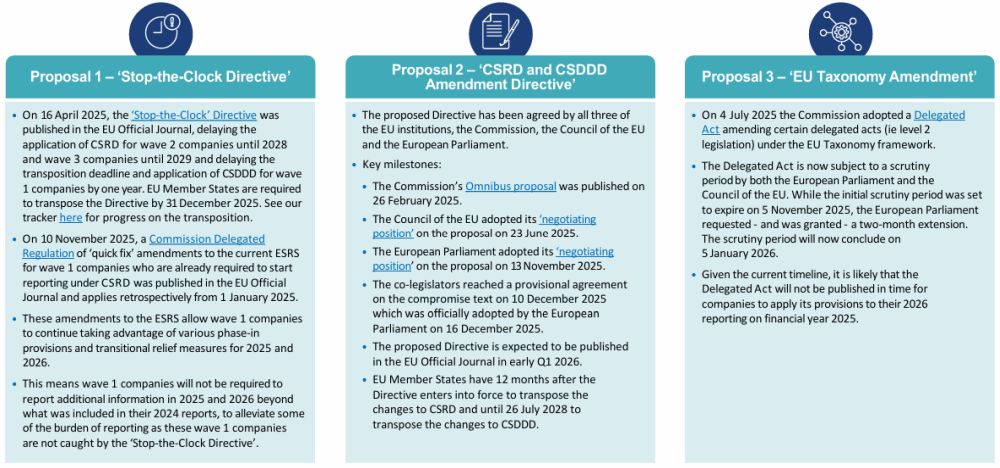
The CSRD and CSDDDAmendmentDirective has now beenagreedbyallthreeEU institutions–the Commission, the Council of the EU and the European Parliament, and we expectit will be published in the EU Official Journal and to come into force in early Q12026.
Key proposals in the Omnibus
Next steps
- The CSRD and CSDDD Amendment Directive will now be reviewed by the lawyer-linguists and translated into the 24 official languages, signed by the Presidents of the European Parliament and the Council, and published in the EU Official Journal. Publication in the EU Official Journal is expected in early Q1 2026. The Directive will enter into force on the date falling 20 days after publication in the EU Official Journal. EU Member State must then transpose the changes to CSRD into national law within 12 months after entry into force (ie by Q1 2027) and transpose changes to CSDDD by 26 July 2028
- EFRAG's final draft of the revised ESRS marks a significant shift towards simplification, reducing mandatory datapoints and enhancing interoperability with ISSB standards. EFRAG is expected to publish the Basis for Conclusions, Explanatory Note and Cost-Benefit Analysis for the revised ESRS by the end of December 2025, providing further insight into the changes proposed in the final draft of the revised ESRS. The Commission will use EFRAG's advice as the basis for a Delegated Act amending the existing ESRS, with adoption targeted for mid-2026. For more detailed insights on the latest published versions of the final ESRS draft, refer to our note here.
Currentstatusofproposals
Proposed changes to CSRD
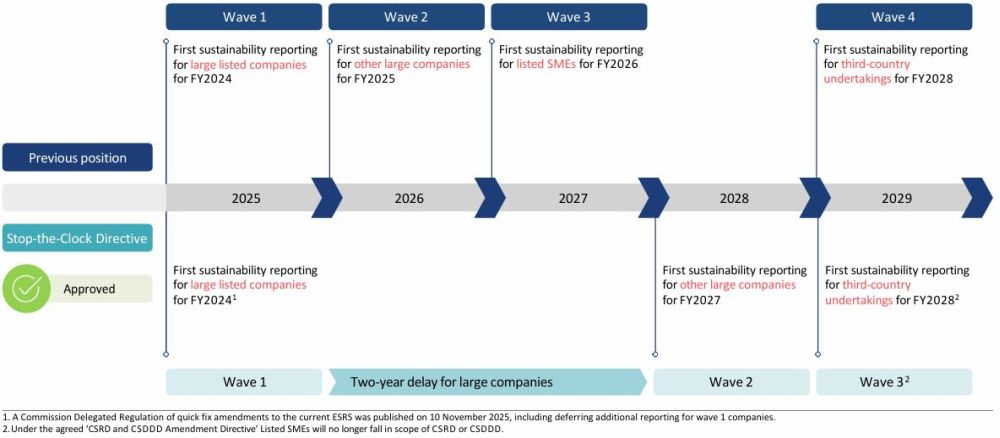
1) 'Stop-the-Clock' Directive
To view the full article click here.
Footnote
1. This publication does not cover the amended Regulation to simplify and strengthen the Carbon Border Adjustment Mechanism ("CBAM").
The content of this article is intended to provide a general guide to the subject matter. Specialist advice should be sought about your specific circumstances.
