

This review is again relatively short because the case law in this field is becoming increasingly settled, and many decisions repeat points that have been made before.
Nevertheless, there are plenty of cases of interest, especially where the Board's approach is developing after G1/19, the simulation case. Several cases provide useful guidance in countering objections from Examining Divisions and on the level of detail required to support invention in machine learning. Many cases show that proper presentation of an invention in the initial drafting is essential to successful outcomes.
Statistics
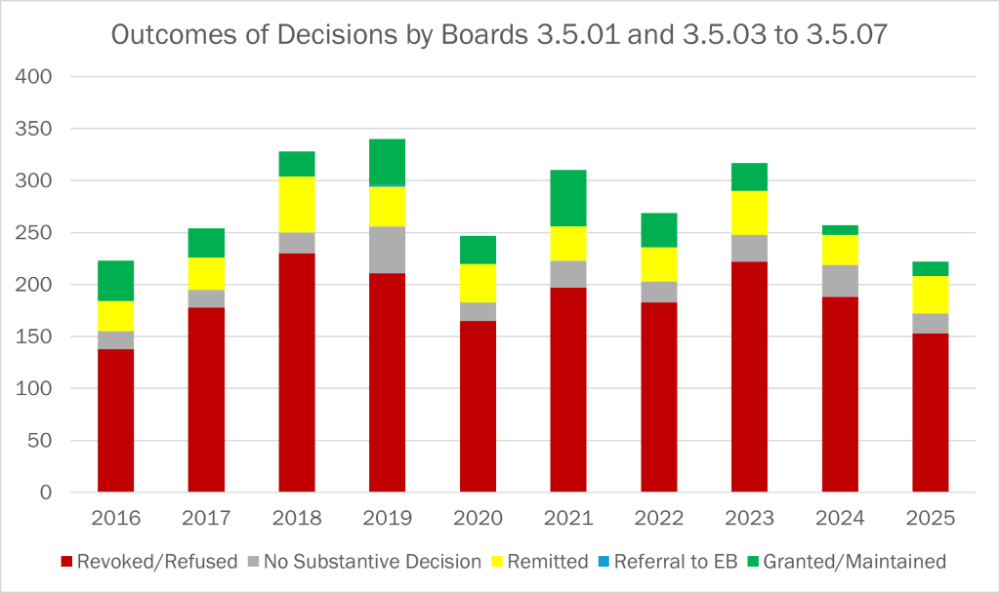
As can be seen, the Boards covering most computer-implemented inventions (3.5.01 and 3.5.02 to 3.5.07), have had a relatively slow year with only 222 decisions of which 69% resulted in the application being refused or the patent revoked. This is pretty close to the long-term average of 67% and within normal variation. The proportion remitted is high at 16% meaning the proportion granted is low at 6%. Without having done any analysis, it does seem that the backlog is reducing.
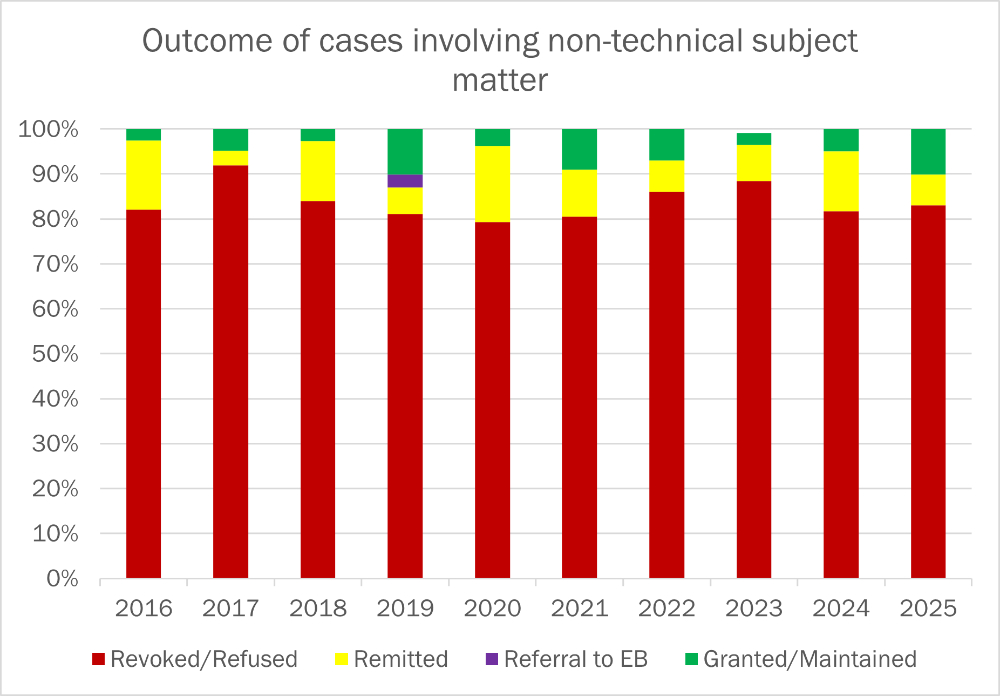
Looking across all boards at cases where the problem addressed or some feature of the claims was considered to be non-technical, the rejection rate of 83% is again pretty close to the long term average, but the proportion granted or maintained in some form, at 10%, is high.
Machine learning and other AI
In spite of the huge impact during 2025 of machine learning, and in particular large language models, there have been few interesting EPO Board of Appeal decisions involving AI.
T 1309/23 of 17-12-2024 illustrates one of the difficulties in protecting inventions involving ML: providing sufficient detail, not just to enable the invention to be carried out, but also to support inventive step. In this case the Board asserted "neither the measurement target nor the specific use of the measurement data for training the model, nor the model itself or its use are specified in sufficient detail in claim 1 to credibly derive a technical effect external to the computer system". The description was pretty sparse, a high proportion being boilerplate, and was said to work with a laundry list of different models, always a bad sign.
Another difficulty is illustrated in T 2082/22 (Automatisierte Planung eines Glasfaser-Rollouts/DEUTSCHE TELEKOM) of 28-01-2025. Since a neural network is a mathematical model, use of one for classification per se is not a technical contribution, nor is optimisation of the model itself. Therefore, if the model effects a non-technical administrative or business method, there is no technical content bar the generic computer on which it is run.
Non-technical subject matter
Notional Business Person
The Notional Business Person was called into play in T 1737/21 of 11-02-2025 by the applicant who argued that the "fictitious business person" would not be aware of a desire to save energy in a logistics operation. However, Board 3.4.03 held that "the businessman knows simple technical concepts that he has to deal with regularly, especially when these concepts concern business aspects, such as costs." Therefore, energy saving can be considered a part of the non-technical requirements to be implemented by the technical person skilled in the art and cannot contribute to inventive step.
In T 1851/22 (Shipping documentation/AUCTANE) of 12-12-2025, Board 3.5.01 reminds us that for a feature to be technical, it is not sufficient that it be outside the purview of the notional business person. Here, some steps in a method for automatically creating shipping documentation were "not strictly business-related and are arguably conceived by a computer programmer rather than by a person with a business background." But since computer programs per se are excluded from patentability, features addressed by a programmer can only be considered technical if they address technical issues.
Business and administrative methods
In a decision relating to in-car infotainment systems, T 1248/24 (Vorschlagen eines Software Downloads für einen Fahrer/VOLKSWAGEN) of 10-11-2025, Board 3.5.01 considered the invention a business idea "comparable to the recommendations of a car salesman who advises a customer who frequently drives long stretches of motorway to add a lane keeping assistant." The invention recommended to a driver that software be downloaded on the basis of "a type of route to be travelled" but lacked any technical detail as to how the outputs of claimed "sensors" were used to determine the type of route.
An interesting case relating to agricultural methods is T 1717/22 (Management zones in agricultural fields/CLIMATE LLC) of 16-05-2025. Based on crop-yield data, "a plurality of management zone delineation options" were generated, and one or more options were selected and used, along with one or more planting plans, "to control agricultural equipment". Prima facie, this would seem technical, but Board 3.5.01 considered that "the provision of planting plans ... may be based on non-technical economic considerations, such as maximising the grower's profits" and so did not contribute to the technical character of the invention. This seems to be a problem with the breadth of the claim: "the technical purpose of improving crop yield cannot be derived from the broad wording of claim 1", whilst merely "using" plans "does not alter their abstract nature". Also, the zones are not "technical quantities of the agricultural field", instead being "conceptual subdivisions created for practical management purposes, rather than inherent properties of the agricultural field that reflect its physical state."
T 0710/22 (Risk management of sports-associated businesses/CRYSTAL WORLD) of 26-06-2025 was the second trip to the Board of Appeal for this application. Previously, the Board had overturned a refusal based on an added matter objection and remitted the application for further search, no decision on inventive step having been taken. Following that search, the application was rejected for lack of inventive step, which the Board upheld. Both the Examining Division and the Board considered that a "structured and hierarchical arrangement of successive display screens whereby a user is able to make selections" was not new, and the differentiating features, relating to deriving "a sports risk index (SRI) model", were regarded as business-related and non-technical.
Presentation of information
The two most common arguments for patentability of an invention involving a presentation of information are that the invention is a continued and guided process of human-machine interaction, or that the invention addresses limitations of a display device.
Both arguments were unsuccessful in T 0285/24 (Information display/HUAWEI TECHNOLOGIES) of 10-03-2025. The novel features related to the display of information depending on a "context", but the Board did not accept that the "contexts" were technical in the absence of any definition of how they are selected.
A continued and guided interaction requires that a technical effect follows directly from the claimed process and not as "an indirect consequence of the cognitive processing by the user of the information presented", as was the case in T 1460/22 (Lautstarke-Visualisierung/SIVANTOS) of 16-01-2025. This related to programming of hearing aids.
User preferences
T 0992/20 (Textes aléatoires/SHORT EDITION) of 19-11-2025 illustrates several issues of non-technical subject matter. Firstly, the distinguishing features were said by Board 3.5.01 to "essentially define a set of criteria or constraints for selecting the cognitive content of printed texts. These constraints are not based on objective technical considerations but exclusively on a subjective assessment of the user's presumed preferences, with the aim of offering a fun experience to the user". Hence, they were not taken into account in inventive step, consistently with cited decisions T 0306/10 (Relationship discovery/YAHOO!), and T 2469/12 (Generating a subgroup of media items/MICROSOFT TECHNOLOGY LICENSING).
Secondly, a problem suggested by the applicant of "how to make an interactive terminal with literary content attractive/fun, and more generally with content to read, for the greatest number of individuals likely to use the terminal" was not considered a technical problem and so cannot be taken into consideration for the purposes of assessing inventive step (citing T 1025/08). Whilst in some cases an inventive step can be recognised in the identification of the problem to be solved, this does not apply if the problem is not technical.
Thirdly, a commercial success argument was rejected on the basis that the success was "attributed exclusively to the commercial idea underlying the invention."
A system for monitoring the distance between a motorcycle and the vehicle ahead seems clearly technical, but in two related cases (T 0764/23 of 15-07-2025 and T 0813/23 of 15-07-2025), Board 3.5.04 held that the only distinguishing features were related to prioritisation of warnings. The Board held that "the risk of losing control of the motorcycle at a larger bank angle is given a higher weighting than the collision risk" was a "non-technical risk assessment" – perhaps an issue of user preference – whose implementation was obvious.
A problem expressed as "how to make the use of security tokens more attractive to a given population" was held not to be technical as "its formulation depends on the user's subjective preferences or expectations" in T 0201/21 (Product authentication/TESI) of 08-04-2025.
Other non-technical matter
Two cases of applicant IT-Seal relating to phishing test emails were refused. T 1908/23 (Personalisiertes Phishing-Dokument/IT-SEAL) of 17-09-2025 held that tailoring a phishing test email so that the recipient is "deceived on a psychological level" is a business objective. Whilst T 0790/24 (Täuschungsmaß für einen Phishing-Angriff/IT-SEAL) of 19-09-2025 held that a "deception measure" said to predict the success of a phishing attack, and derived in an unspecified manner from the measured time taken to prepare the attack, "is not a technical quantity but a measure that may be relevant in the business area of phishing attack training."
The patentability of "indirect measurements in the sense of G 1/19" was considered in T 0660/22 (Cell analysis/NIKON) of 20-01-2025 by Board 3.5.06. G 1/19 suggested that a mathematical method that derived information from a measurement of physical reality, could be considered a technical method. Board 3.5.06 agreed with the appellants submissions that for a method to be considered, a technical indirect measurement did not depend on the number of calculations involved, nor the use to which the end result of the method is put. However, they did hold that the calculations must "correspond to a known factual relationship between the quantities involved and [be] used to determine the physical quantity of interest." Thus, "the calculation of a value which does not represent information about physical reality at all, e.g. the price of a refreshment which rises with the measured temperature, is not part of a measurement method." The case at hand determined "characteristic quantities" of a (biological) cell, but these were not described as representing any physical quantities of the cell, nor did correlations between them represent "any specific and predefined physical phenomenon relating two quantities". Hence the application was refused.
T 1297/23 (Digital stroke grouping/Microsoft) of 05-02-2025 related to novel algorithm for grouping "digital strokes" in a GUI. Since there was no suggestion that the algorithm was specifically adapted to be performed by a computer, no (novel) use of the resulting grouping was claimed or implied; and grouping strokes not itself considered a technical task, the features of the novel algorithm could not be considered in determination of inventiveness.
A rare refusal as a mental act occurred in T 0425/24 of 17-11-2025. This claimed "[a] method for optimizing a work cycle in a robot system comprising at least two manipulators with a common work area ...", but without an explicit statement that the method is carried out by a computer, this was held to be a mental act and unpatentable. Claims that might have got around this objection were not admitted because they were presented too late in the proceedings. A reminder that under the current Rules of Procedure of the Boards of Appeal, all foreseeably useful requests must be submitted at first instance.
T 1919/22 of 13-03-2025 held that a scheme to deliver a certain number of "free wins" in a gambling game more quickly was a game rule, and any savings in technical resources, such as bandwidth, were "merely secondary effects resulting from the implementation of a gaming scheme and the direct technical consequences of such an implementation".
Some other cases with short points on non-technical subject matter include:
- T 0371/23 (Consent categories/MAGIC LEAP) of 20-01-2025: 'it is not a "technical task" to give consent to sharing of information.'
- T 0588/22 (Access decision evaluation for building automation and control systems/SIGNIFY HOLDING) of 28-05-2025 (also discussed under inventive step): in an access control system, sending an access-control policy to an accessed device is not technical if "the access policy could be based on purely financial rather than technical considerations" and "sending the derived policy together with the decision could merely serve the non-technical purpose of informing the accessed device about the reasons for the decision".
- T 1499/22 (Infrastructure resource states/ALCATEL LUCENT) 17-09-2025: "hierarchical relationships amongst the owners and amongst the tenants" of a cloud computing system are not technical limitations if they relate to contractual relationships and a corresponding flow of information is consequently not a technical solution to a technical problem.
- T 2078/22 (Blockchain storing supply-chain data/STOLLMAN AND MATEEV) of 19-11-2025: a feature that "does not improve the known blockchain technology in terms of security or otherwise but merely uses it to record a particular business content" lacks technical character.
- T 2619/22 (Restricting low performer's access to system/FUJI) of 10-02-2025: monitoring performance of an operator on a generic "production device" "merely automates the work of a manager, i.e. observing workers on an individual basis, detecting performance issues of individual workers, and restricting the type of work that those workers are authorised to do"
- T 0754/22 (Allocating time-slots to trucks/BEN-ALEXANDER) of 04-11-2025: "[c]hoosing and setting up a scheduling method generally does not require any technical insight. For example, appointments at a doctor's office, repair shop, or hair salon typically follow a bookable time-slot model rather than a walk-in basis. In practice, it is usually the shop owner or manager who defines the scheduling rules, such as how far in advance customers may book, the duration of time-slots, or whether appointments are required at all. These are administrative decisions which do not require technical skill or address a technical problem."
- T 0848/21 (Erfassung von Informationen für Wartungs- oder Reparaturverträge/MCON GROUP) of 31-01-2025: in a car parts ordering system, "the vehicle-specific selection of component information is a self-evident administrative task" and "has no direct impact on the vehicle."
- T 1613/22 (Secure payment/GRE-LAB) of 12-12-2025: "avoiding the unauthorised display of sensitive personal data (the user image) [is] a non-technical requirement"
Simulation
Since G 1/19 overturned previous case law, a common problem with inventions involving a model or simulation is to sufficiently limit the output of the model or simulation to "a further technical use". In T 0799/24 (Optimisation of vehicle body joint position/JFE STEEL CORPORATION) of 21-08-2025 it was held to be enough that additional welded points simulated in an "automotive body frame model (31) during driving" are "to be added" to the automotive body to improve its stiffness during driving. "In the board's view, this formulation at least implicitly specifies a further technical use".
On the other hand, in T 1676/23 (Contact modeling/SIEMENS) of 10-02-2025, a limitation that modeling gear contact is done for designing a gear box and/or individual gears and optimizing their performance to ensure the overall product quality in terms of performance and efficiency, was not enough to limit the output to a further technical use. Similarly to other cases (e.g. nuclear fuel rods, wiring loom), the Board commented that "the use of calculated information representing predicted physical properties for the evaluation and comparison of different designs is not a technical use or effect but amounts to gaining knowledge about the designs, which is in itself not a technical effect".
T 0613/23 (Apprentissage d'un modèle de décision/SAFRAN) of 17-07-2025 is another case where the claim was not technical over its whole scope, because the alleged technical effect – an improvement in model performance – "would crucially depend on non-technical factors which are not defined in claim 1, such as the level of competence and experience of the expert" who modifies the model.
Technical subject matter
Board 3.5.01 in T 0725/21 (Eye-tracking/MICROSOFT TECHNOLOGY LICENSING) of 27-02-2025 considers the limits of what is "notoriously known", and hence does not need to be evidenced by a particular prior art document. Here the Board agreed with the examining division that a personal computer with a web-browser (which may perform the function of an e-reader) is notorious, but that the further inclusion of eye-tracking capabilities is not. Hence the case was remitted for further search. The issue arose because the application lacked a detailed description of eye-tracking, leading to objections that if eye tracking is common general knowledge then its use is obvious, and if not, the application is insufficient.
In T 1392/20 (User device configured to function as PoS terminal/HILLOA) of 15-07-2025, Board 3.5.01 applied the "Notional Business person approach" of T 1463/11 – Universal merchant platform/CardinalCommerce and T 1749/14 – Mobile personal point-of-sale terminal/MAXIM to a payment system. They concluded that "[w]hile the abstract goal of avoiding the transmission of card data to the merchant may come from the business person," features relating to configuration of a secure application on a user device "define a specific technical solution for achieving it". The distinguishing features involved modifying the existing system infrastructure, including how the user device is configured and integrated into the payment flow, which required technical knowledge of the system architecture and so fell within the expertise of the technically skilled person – not the business person. Although the Board was not convinced there would be a security advantage, they considered that there was no motivation, except in hindsight, to change the user device's functionality so that it acts as a PoS terminal directly completing the transaction. Hence an inventive step was found.
The same board considered another payment system in T 2153/22 (Payment for IoT device/CPLABS) of 05-12-2025, in this case using a blockchain. It was noted that executing a smart contract is a technical feature, and the case was remitted for further examination because the examining division had not properly considered the interaction between the claimed payment method and the technical entities involved; in particular, a server that interacts with the blockchain database, managing a link between the IoT device and a wallet (so that the IoT device can make automatic payments without human intervention).
T 2353/22 (Lineage metadata/AB INITIO) of 10-10-2024 is an instructive example of programming steps being considered technical through interaction with a computing device. Board 3.5.07 noted that "the fact that the ultimate goal of the claimed method is not technical is not sufficient to conclude that the whole implementation is not technical". The appealed decision "confuses commonplace features and/or obvious solutions with non-technical subject-matter by expressing that the programmer, who was identified as the technically skilled person, does not have to overcome any technical problem because only commonplace programming skills and computer knowledge are necessary." The Board acknowledged that 'since computer programming involves technical and non-technical aspects, it is difficult to distinguish between the "programmer as such" who, as long as they only develop abstract algorithms, are not a skilled person within the meaning of the case law, and the "technical programmer"'. They went on to say, "even though a pointer to data in computer memory is commonplace, its purposive use in a method for retrieving data from computer memory makes a technical contribution ... and cannot be ignored in the inventive-step assessment." Likewise, "[t]he data structure specified in the claim serves the technical purpose of providing access to the data stored in memory ... and thus makes a technical contribution."
The Comvik approach applied outside the software field
T 2497/22 (Transparent or translucent liquid detergent/PROCTER) of 07-04-2025 is a rare example of a debate about the technicality of a feature in a chemical field. Here, the issue was whether the feature that an eco-friendly laundry detergent is transparent or translucent could be taken into account in the assessment of inventive step. The opponent (appellant) considered it "merely aesthetic". However, the Board (3.3.07) disagreed, holding that "transparency or translucency is not only a technical feature that physically characterises the claimed composition. It is, in fact, also a technical effect resulting from the combination of ingredients" and does not have "to produce additional technical effects in order to be taken into account in the assessment of inventive step." Being transparent or translucent is a desirable feature and producing it is a valid objective technical problem.
Another interesting non-software case is T 0564/23 (Fermentation of juice/WILD) of 29-07-2025, where the opponent tried to argue that the addition of an acidifier to a low alcohol drink to improve flavour did not have a technical effect and so could not contribute to inventive step. However, the Board considered that it did have a technical effect in that it limited the ingredients of the drink, even if the purpose of adding it was subjective.
Inventive step
There are several interesting points relating to inventive step in T 1249/22 (Development and deployment of analytical models/ACCENTURE) of 13-01-2025. Firstly, in applying the Comvik approach to inventive step, it is not always appropriate to define the technical problem as being to implement non-technical requirements on a specific technical architecture. In some cases, the choice of technical architecture may be a task for the technical person skilled in the art, in which case it might contribute to inventive step. However, if "the IT infrastructure used in the invention is a computer system that is commonly used to implement methods of the same kind as the non-technical method (e.g. a generic computer for most applications or a generic client-server architecture for e-business applications)", then the choice of infrastructure will not be inventive, and it doesn't matter if it is included in the statement of the technical problem.
Secondly the Board criticised the Examining Division's approach to identifying technical and non-technical features by selective underlining – a common approach – as it "does not result in two sets of meaningful features but in two separate bags of words."
Thirdly, the Board considered that separate chapters of a book should be treated as separate pieces of prior art – which cannot be combined without motivation – if they are "self-contained papers which do not build on each other, unlike chapters of a textbook." The Board stated "[t]he mere fact that the papers are published in the same book, which has a single ISBN (as noted by the examining division), does not imply that the whole content of such a book forms a single piece of prior art."
T 0588/22 (Access decision evaluation for building automation and control systems/SIGNIFY HOLDING) of 28-05-2025 reminds us that "a central assumption of the problem-solution approach is that the skilled person starts with a problem and looks for a solution to it." Thus, the closest prior art should be in the same field as the claimed invention (in this case building automation and control), and if a similar solution has been applied in a different field (here medical automation), it is not obvious to look for "an automation domain which might profit from that solution". The attack on the patent would have been better structured as starting from some prior art in building automation identifying a problem and presenting reasons why the person skilled in the art would look to the medical automation field for a solution.
Clarity
Clarity and support – and the distinction between these issues – have been lively topics in EPO case law, with a judgment of the Enlarged Board (G1/24) that the description should always be "consulted" to interpret the claims. However, T 2027/23 (Turnable ladder/IVECO) of 30-06-2025 is one of several cases across different boards indicating that this does not mean that the description overrides the natural meaning of a claim to the person skilled in the art, and that "[i]n cases of discrepancy between the claim language and the description, it falls upon the patentee to remedy this incongruence by amending the claim." Here, the description could not be used to import to the claims a limitation that a control system was electronic rather than mechanical.
Also, T 1775/23 (Service Request/KPN) of 08-10-2025 reminds us that consulting the description doesn't help if the description is itself ambiguous. The invention related to provisioning of cloud services, and various terms in relation to services and request for services were considered unclear in both the claims and the description.
T 1371/22 of 27-01-2025 illustrates an issue that quite often arises in defining inventions with business aspects – that business terminology is not always precise. Here the limitation that a server was "outside the sphere of influence of the operator of the energy supply network" was inherently unclear, as the sphere of influence might cover any of "a purely technical, administrative or organizational influence".
A useful reminder that breadth of claim does not necessarily equate to a lack of clarity is given in T 1508/23 of 18-02-2025. The final feature of the main claim was that a processing step "takes into account the uncertainty associated with the mesh", but without saying how that is done. Although broad, this is clear because a person skilled in the art could determine whether or not the uncertainty is taken into account in any way.
J A Kemp LLP acts for clients in the USA, Europe and globally, advising on UK and European patent practice and representing them before the European Patent Office, UKIPO and Unified Patent Court. We have in-depth expertise in a wide range of technologies, including Biotech and Life Sciences, Pharmaceuticals, Software and IT, Chemistry, Electronics and Engineering and many others. See our website to find out more.
The content of this article is intended to provide a general guide to the subject matter. Specialist advice should be sought about your specific circumstances.
