

- within Wealth Management and Intellectual Property topic(s)
Effective collaboration between technology leaders and business leaders has never been more essential. A majority of executives surveyed by AlixPartners expect to make major changes in their business models, with digital transformation their number-one focus. The need to invest in and manage technology innovation, always high, has jumped as artificial intelligence rolls out.
Technology and business leaders must also manage the competing claims for attention and resources to maintain extensive, essential, and aging legacy technology. Meanwhile , the need for enhanced cyber-security has soared, with 46% of companies surveyed saying their data security is significantly threatened—a 20-point increase from a year ago.
Managing in this environment requires not only a high-performing team but strong technology governance—that is, structures and processes to set policy, make decisions about investments, manage projects and ongoing capabilities, and assign accountability for results.
Yet technology governance falls short at too many companies, as we learned in a survey of 750 C-level executives—a mixture of business and technology leaders.
Consider:
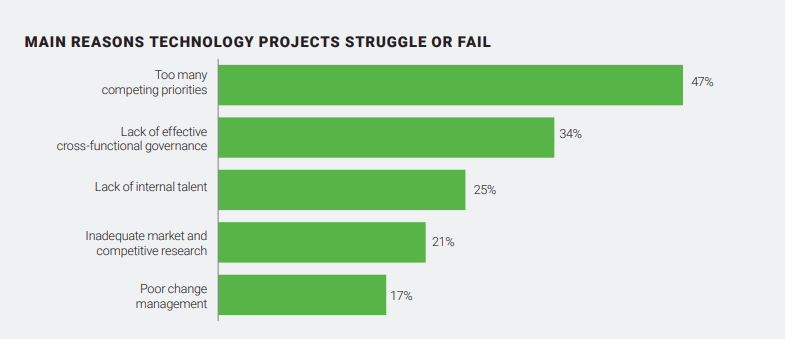
- Though 91% of executives said their companies have a comprehensive technology roadmap, nearly half (47%) said that technology projects struggle or fail at their company because of too many competing priorities
- 34% identified lack of effective cross-functional governance as a major reason technology projects fail
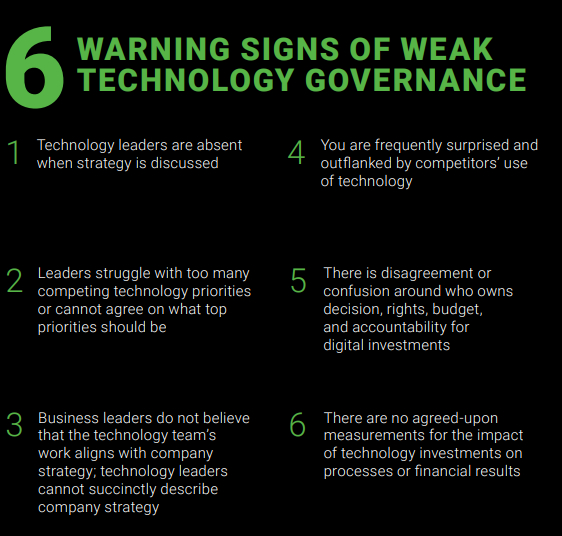
- Among the technology leaders surveyed, only 31% strongly agreed that their business-side colleagues gave them a seat at the table when strategy was discussed
- Just 41% of business executives believed that their technology colleagues ensure that technology's priorities and practices are aligned with company strategy
These are unacceptable numbers. How can leaders make fundamental changes—or even manage a budget—if they cannot agree about what's most important or if the technology team is out of the loop?
It is telling that the technology-governance report card looks different for companies that say they are driving digital disruption. At these companies, leaders are eight points less likely to say their companies struggle with too many priorities. Their technology executives are 13 points more likely to have a seat at the strategy table. Their business-side leaders are 22 points more confident that the tech team's work aligns with strategy.
These numbers point to some of the results of successful technology governance. But how do you get there?
All governance is a combination of structures and behaviors—what academics call a sociotechnical system. Our research, proprietary data, and client experience have uncovered several key principles and leading practices of companies whose technology governance helps them achieve superior performance. This, the first of two articles, is about structure; its companion piece focuses on behaviors.
Structures are formal, hierarchical arrangements about accountability, budgeting, and decision rights: who reports to whom, who holds the purse, who can say "yes," who can say "no." Behaviors are the less formal but critically important conversations, processes, and customs that involve setting and communicating priorities, agreeing upon goals, resolving disagreements, and responding to change. Hierarchies are like chess pieces lined up on a board; behaviors are what happens once the match begins.
SETTING YOURSELF UP FOR SUCCESS
When it comes to technology governance, there are typically three players in the game: senior executives at the corporate center, technology team leaders, and the heads of business units or functions. How a company distributes power among these three groups depends on its strategic goals and its view of technology's role in achieving them. A company in a mature, regulated industry will structure technology activities differently from an aggressive upstart with an appetite for M&A. The model used by digital disruptors might be inappropriate for a company whose strategy is to wait until technology is tried and true. But insights from the data, academic research, and practical experience can help companies see what will work for them.
Business and technology leadership must share accountability for delivering desired results within the agreed-upon parameters of budget, schedule, and scope. Don't leave execution to the tech team alone.
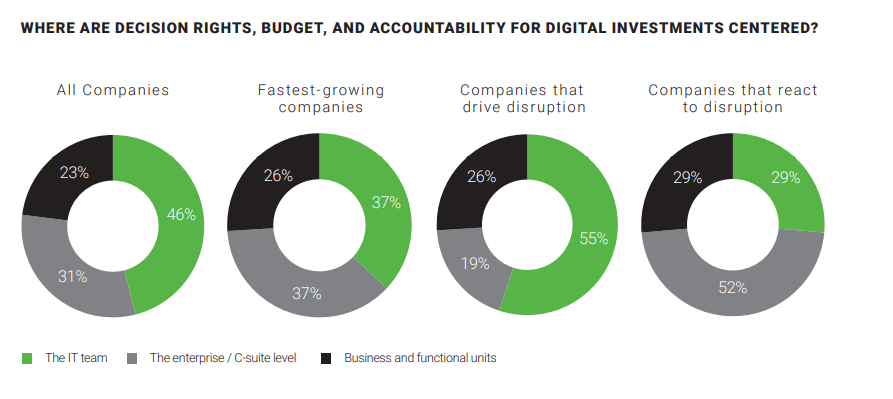
- Overall, companies are least likely to vest structural authority in business and operating units and most likely to put it in the hands of the technology team. Almost half — 46% — say that decision rights, budgets, and accountability for digital investments belong to technology, while 31% say the corporate center, and 23% say the business units.
- For the fastest-growing companies, power shifts away from the tech team toward the corporate center and, to a lesser extent, operating units. For these companies, technology and the C-suite are equally in charge—it's 37% for each, with 26% nesting authority in operating units. Fast growers seem to emphasize making sure digital investments are in sync with strategic goals and business plans, with the combined sway of non-tech executives considerably greater than that of the technology leaders.
- Digital disruptors—companies that say they usually or always drive disruption in their industry— put the technology team firmly in the driver's seat (55%), with the business units riding shotgun (26%) and the corporate center in back That is, tech investments are decided by those close to the action, giving a freer rein to business units and technologists.
By contrast, at companies that usually or always react to disruption rather than drive it, the C-suite retains decision rights and budget accountability for digital investments 52% of the time; these companies are least likely to vest decision rights in the tech team.
Company size is a factor in these choices.
The bigger the organization, the more likely decision rights are to be delegated to the technology team or business units.
But the overall message holds:
Centralized decision rights are associated with growth and a desire to ensure that technology and strategy are tightly synchronized; decentralized decision rights are more often found in companies that emphasize innovation and disruption
To view the full article clickhere
The content of this article is intended to provide a general guide to the subject matter. Specialist advice should be sought about your specific circumstances.

