

- within Environment and Antitrust/Competition Law topic(s)
This November 2025 edition focuses on some of the proposed reforms in the Employment Rights Bill including the new Fair Work Agency and what it will mean for businesses, trade union reforms and the options being put forward to enhance dismissal protections for pregnant women and new mothers set out in the recent consultation. Our new Employment Rights Bill tracker which will keep you up to date with developments on the new measures and the timetable for their implementation. We take a look at what further immigration rule changes have been announced and the new recruitment rules under the Labour Code coming into effect soon in Poland. We also include our usual round-up of news, our UK and EU horizon scanners, our EU Pay Transparency Hub and a link to our survey on trade union reforms.
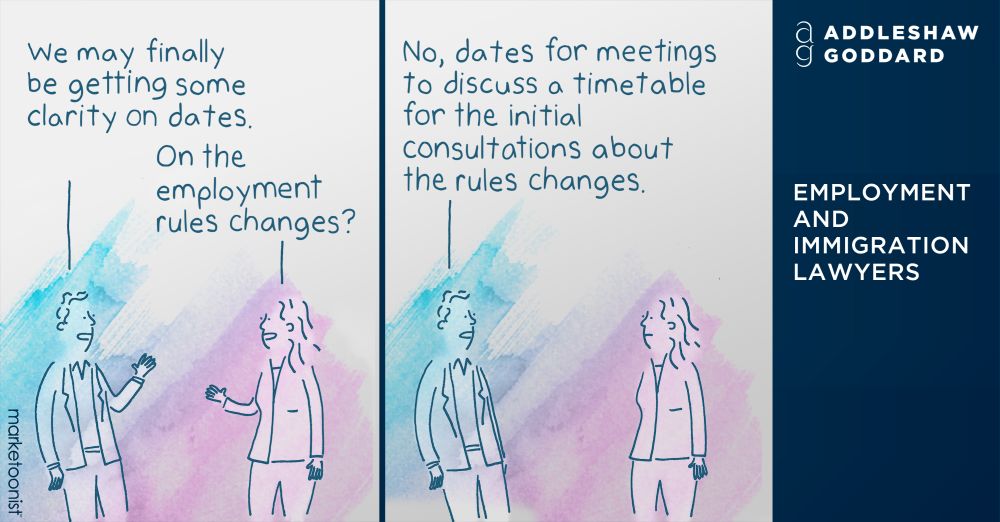
The times they are a-changin' but is the ERB timetable on track?
This November edition looks at the onward march of the Employment Rights Bill (ERB). Described by the Government as the "biggest upgrade to workers' rights in a generation", the ERB is a mammoth piece of legislation. Employer groups have raised concerns about the additional burden/costs it will bring but the Government has confirmed its commitment to the ERB, which was a cornerstone of its election manifesto.
We still don't know all the detail - the legislation is currently subject to "ping pong" between the Lords and the Commons and the timetable for implementation of the ERB is now at risk of slipping. In the meantime, the Government has published a raft of consultation papers. We have articles that drill down into some of the ERB reforms, such as enhanced dismissal protection for pregnant women and new mothers and the new Fair Work Agency and the future of enforcement of and compliance with employment rights. With so much reform in the pipeline, early preparation will be key in order to employers to keep on top of the ERB.
Editorial – by Richard Yeomans
A new era of enforcement for UK employers: Are you ready for the Fair Work Agency
In April 2026, the Employment Rights Bill will establish the
Fair Work Agency, a new single enforcement body with new powers
over a wider range of employment rights.
Find out what it means for business here.
Enhanced maternity protection – What do we know?
The Government is consulting on the proposed reforms in the Employment Rights Bill to enhance protections for pregnant women and new mothers. We take a look at the options being put forward on how they will work in practice.
Industrial Relations: Consulting on trade union reforms
The Government has launched two consultations on the proposed new right for union access to the workplace and on the duty on employers to inform workers of their right to join a trade union.
Find our brief synopsis of how these reforms will work in practice here.
UK Business Immigration: A radical shake-up of Indefinite Leave to Remain
We look at the Government consultation on proposals to change
the current settlement system and the impact on employers.
Read about the changes here.
International Update: Pay Transparency: Recruitment process under new rules – 5 steps to prepare your company for upcoming changes
With new recruitment rules under the Labour Code coming into effect in Poland from 24 December 2025, we look at what it means for employers here.
ERB Consultations on Trade Union Rights Survey:
We have been having conversations with clients on the trade
union consultations (see our article above) and have created a
short survey to gather your views on the proposals.
If you would like to take part in the survey which closes on
10 December 2025, you can find it here.
What else you should know
Latest consultations on the Employment Rights Bill
The Government launched four more consultations in October 2025 on some of the proposed employment reforms set out in the Employment Rights Bill. Two of the consultations are on the enhanced dismissal protections for pregnant women and new mothers (see our article above) and the proposals on leave for Bereavement including Pregnancy Loss, seeking views on introducing a new day-one right to unpaid bereavement leave for employees who experience the loss of a loved one, including pregnancy loss before 24 weeks. Both of these consultations close on 15 January 2025.
Two of the consultations are on industrial relations looking at the reforms relating to the right of trade unions to access workplaces and also on an employer's duty to inform workers of their right to join a trade union (see our article above), both of these consultations close on 18 December 2025.
A further consultation was published last week on electronic workplace balloting and is seeking views on the draft Code of Practice which gives practical guidance on the conduct of ballots using new electronic and workplace balloting to ensure ballots meet the required standards. The consultation closes on 28 January 2026.
The Government has also recently published their terms of reference for a review of employment rights for unpaid carers. In its plan to Make Work Pay it has promised to review the implementation of unpaid carers leave, an entitlement which was introduced in April 2024. The review was launched in autumn 2024 and the Government expects the review to conclude by the end of 2026.
Updated digital HR1 form must be used from 1 December 2025
From 1 December 2025, employers wishing to submit an HR1 form will need to do so using a new digital version, which will be the only way to notify the Secretary of State of proposed redundancies.
The new form will not accept consultation start dates in the future. The requirement to provide breakdowns of affected employees by occupational groups has been removed and there's a new redundancy reason option of "Change in supply chain/loss of supply chain contract". Employers may upload up to four attachments at the end of the form if these are needed. Guidance for employers here.
It will only be possible to save any information in the form when it is submitted, so employers who close or leave the form open for longer than 90 minutes will need to start again. Once submitted, the form cannot be saved or retrieved (and any email confirmation will only state that your form has been received), so employers requiring a copy of the form for their own records/to be able to share a copy with appropriate representatives will need to save and/or print the form as a PDF before submitting.
Acas early conciliation period to increase from 6 to 12 weeks from 1 December 2025
The Government has introduced regulations to increase the EC period from 6 weeks to 12 weeks. The explanatory notes explain that the change is to ease pressure on Acas in response to increased demand for early conciliation (EC) and more complex cases. The 12-week period will apply to any case notified to Acas for EC on or after 1 December 2025. The EC period will be reviewed again in October 2026 to decide if 12 weeks is still appropriate.
- There have been a series of changes to the UK Immigration Rules announced this Autumn which we explore in our articles Further UK immigration White Paper changes announced and and in UK Business Immigration – Autumn 2025 round-up.
- Read our article on age discrimination in partnerships and LLPs which you can find here.
- For all the latest information on employment law reforms and implementation of the Employment Rights Bill, please visit our Employment Rights Bill Tracker which you can find here.
- Keep track of the latest developments on the EU Pay Transparency Directive by visiting our Pay Transparency Hub on our website here.
- Alongside our UK Employment Horizon Scanner, we now have our new Employment Horizon Scanner for Ireland, France, Germany, Spain and Poland. For all the latest legislative developments, see our latest Horizon Scanners by visiting the resources section of our website page here.
The content of this article is intended to provide a general guide to the subject matter. Specialist advice should be sought about your specific circumstances.
