

Introduction
In the case of Sterling Holiday Resorts Limited 1, while examining the conditions for a tax-neutral demerger under the Income-tax Act, 1961 (IT Act), the Income-Tax Appellate Tribunal (Mumbai Bench) (ITAT) has, inter alia, held that where the company receiving the demerged undertaking does not itself issue shares to the shareholders of the demerged company, the transaction fails to satisfy the definition of "demerger" under Section 2(19AA) of the IT Act, even if shares are issued by its 100% holding company. Consequently, the benefit of carry forward and set off of accumulated business losses and unabsorbed depreciation under Section 72A(4) of the IT Act was denied to the company receiving the demerged undertaking.
Background
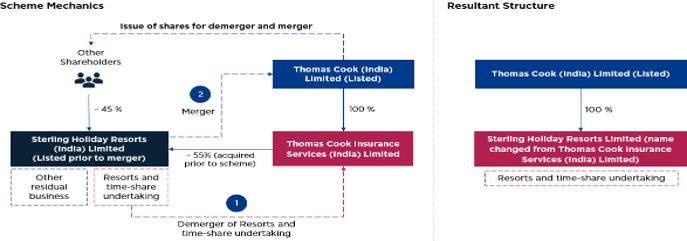
Sterling Holiday Resorts Limited [formerly known as Thomas Cook Insurance Services (India) Limited] (WOS or Taxpayer), was a wholly owned subsidiary of Thomas Cook (India) Limited (HoldCo). In Financial Year 2014-15, a Composite Scheme of Arrangement (Scheme) was sanctioned by the Hon'ble Bombay High Court involving:
- Sterling Holiday Resorts (India) Limited (SHRIL): the demerged / transferor company;
- Thomas Cook (India) Limited (HoldCo): Amalgamated company; and
- Sterling Holiday Resorts Limited (WOS or Taxpayer): the company in which resorts and time-share undertaking of SHRIL was demerged.
The Scheme entailed: (i) demerger of resorts and time-share undertaking of SHRIL into WOS; and (ii) merger of SHRIL (residual business) into HoldCo. Importantly, it was HoldCo that issued shares to the shareholders of SHRIL (except against the shares held by WOS in SHRIL) as consideration for both the parts of the scheme (including for the demerger wherein the undertaking was demerged to WOS). The pictorial depiction of Scheme mechanism and resultant structure is provided below:pic
WOS, in its Income-tax return for financial year 2014-15, claimed set-off of unabsorbed depreciation and carried forward of business loss and unabsorbed depreciation, both relating to the demerged undertaking of SHRIL (Demerged Losses). They were claimed by WOS under Section 72A(4) of the IT Act, which deals with treatment of carry forward of business loss and unabsorbed tax depreciation of the demerged company.
The tax officer disallowed such losses in the hands of WOS on the ground that demerger carried out as per the Scheme did not satisfy one of the conditions of a tax-neutral demerger provided in Section 2(19AA) of the IT Act which states that ‘resulting company’ issues, in consideration of the demerger, its shares to the shareholders of the demerged company.
The definition of ‘resulting company’ provided in Section 2(41A) of the IT Act states that “resulting company means one or more companies (including a wholly owned subsidiary thereof) to which the undertaking of the demerged company is transferred in a demerger and, the resulting company in consideration of such transfer of undertaking, issues shares to the shareholders of the demerged company……”
The tax officer reasoned that since shares were issued by HoldCo and not by WOS (the entity receiving the undertaking), the conditions under Section 2(19AA) were not satisfied, meaning the transaction did not constitute a valid ‘demerger’ for tax purposes. The Commissioner of Income Tax (Appeals) [CIT(A)] upheld the tax officer’s order and highlighted that ‘resulting company’ is one or more companies to which the undertaking of the demerged company is transferred which includes its subsidiary company and does not include its holding company. Aggrieved by the order of CIT(A), WOS filed an appeal before the ITAT.
Taxpayer’s Arguments before ITAT
The Taxpayer advanced the following principal arguments:
- Section 2(41A) defines "resulting company" to mean "one or more companies (including a wholly owned subsidiary thereof)" — and accordingly, holding company and wholly owned subsidiary must be read as interchangeable resulting companies, such that share issuance by either satisfies the statutory condition.
- If Section 2(19AA) is read to require that only the company receiving the undertaking must issue shares, the bracketed phrase "(including a wholly owned subsidiary thereof)" in Section 2(41A) would be rendered wholly redundant – an interpretation that renders a part of the statute redundant must therefore be rejected in favour of an interpretation that gives the bracketed phrase a distinct and operative meaning. The bracketed phrase can acquire independent operative content only under the construction where the undertaking is transferred to the wholly owned subsidiary while the holding company issues shares, which is also the only economically coherent arrangement since a holding company's shares necessarily consolidate and reflect the value of its wholly owned subsidiary, whereas the reverse (where a wholly-owned subsidiary of a company receiving the demerged undertaking, issues shares) would not hold true.
- In case the undertaking is to be transferred to holding company whereas the shares were to be allotted by the wholly owned subsidiary, then it would defeat the purpose of demerger since the wholly owned subsidiary will cease to be the wholly owned subsidiary of the holding company due to this allotment.
- Provisions granting deductions and incentives for economic restructuring must be construed liberally, and where two reasonable constructions are possible, the one favouring the assessee must be
ITAT Ruling
The ITAT framed the core issue as to whether the issuance of shares by HoldCo could be treated as compliance with the conditions provided in the definition of ‘demerger’ under Section 2(19AA) read with definition of ‘resulting company’ provided in Section 2(41A), so as to entitle WOS to set-off and carry forward the Demerged Losses.
The Tribunal rejected all of the Taxpayer’s contentions and upheld the disallowance of set-off and carry forward of Demerged Losses by WOS, by giving the following reasons:
- The statutory language of Sections 2(19AA) and 2(41A) is plain and unambiguous. Section 2(41A) defines the "resulting company" as the entity to which the undertaking is transferred and which, in consideration of such transfer, issues shares to the shareholders of the demerged Both conditions — receiving the undertaking and issuing shares — must be satisfied by the same legal entity. There was no textual basis for bifurcating these obligations between two separate companies.
- ITAT also highlighted that it is settled principle that taxation statutes must be interpreted strictly by their literal and plain meaning, with no room for presumption, intendment, or The reliance placed by the assessee for liberal-construction cases was specifically held to be misplaced.
- ITAT noted that a holding company and its subsidiary are distinct legal entities with independent existences, rights, and obligations, and the holding company cannot discharge obligations that are cast by statute on the subsidiary.
- Taxpayer’s contentions were not supported by any judicial precedent of higher courts of law.
Comments
Section 2(41A) and Section 2(19AA) were introduced in the IT Act by the Finance Act, 1999 and this is a first ruling at the ITAT level on the issue of interpretation of the term ‘resulting company’ under section 2(41A) for the purposes of tax-neutrality of a demerger and hence, assumes significance. The ITAT has rejected the position that the share issuance condition under Section 2(19AA) is satisfied where the 100% holding company of the entity receiving the demerged undertaking issues shares to the shareholders of the demerged company.
The ITAT, placing reliance on the well-settled principle that taxation statutes must be interpreted strictly and literally, held that the language of Sections 2(19AA) and 2(41A) is plain and unambiguous, leaving no room for any other interpretation. ITAT accordingly ruled that the entity receiving the demerged undertaking must itself issue shares to the shareholders of the demerged company. However, it is notable that despite concluding that the provision is unambiguous, the ITAT has not specifically addressed the question of what independent operative meaning the bracketed phrase ‘(including a wholly owned subsidiary thereof)’ in Section 2(41A) carries, if the entity receiving the undertaking and the entity issuing shares should be the same.
The ruling challenges well-established market practice and prevailing understanding on the ingredients of a tax-neutral demerger. It will be interesting to see whether the ITAT’s view is accepted by higher courts. Until then, such demergers may face increasing scrutiny from the tax authorities.
Footnote
1 Judgment dated 25 June 2026 in ITA No. 843/MUM/2024 & ITA No. 941/MUM/2024
The content of this document does not necessarily reflect the views / position of Khaitan & Co but remain solely those of the author(s). For any further queries or follow up, please contact Khaitan & Co at editors@khaitanco.com.

