

The application relates to a system that enables remote game playing of physical gaming machines through a real-time interface. The Examination Division considered automatically blocking the remote player if a local player standing in front of the machine has no technical effect. The Board disagreed and considered it technical as it both maintains and improves data security standards, as well as simplifies and accelerates the switch between remote player and local player.
Here are the practical takeaways from the decision: T 2030/22 of November 27, 2025, of the Technical Board of Appeal 3.4.03
Key takeaways
Increased gaming efficiency and security is a techical effect
The effect described above is of a technical nature, since feature both maintains and improves data security standards as well as simplifies and accelerates the switch between remote player and local player compared to a situation where a log-in / log-out process via a GUI or the operation of buttons would be necessary
The invention
The Board defined the invention as follows:
1. The invention
The invention relates to a system that enables remote game playing of physical gaming machines through a real-time interface. Key components include:
(a) Real-time video streaming: A digital camera captures live images of the gaming machine's display, transmitting them to a remote user's device.
(b) Interactive remote control: Players can interact with the gaming machine using virtual controls analogous to the physical buttons.
(c) Secure payment and payout management: Integrated mechanisms manage payments and payouts for remote users securely.
(d) Control signals and video signals are separated by using two separate servers/channels (feature (W)).
(e) Automatic switching: The system automatically blocks remote commands when a local player is using the machine and vice versa (feature (X)).
The system combines the tangible aspects of physical gaming machines with the convenience of remote accessibility, addressing both trust and practicality issues.
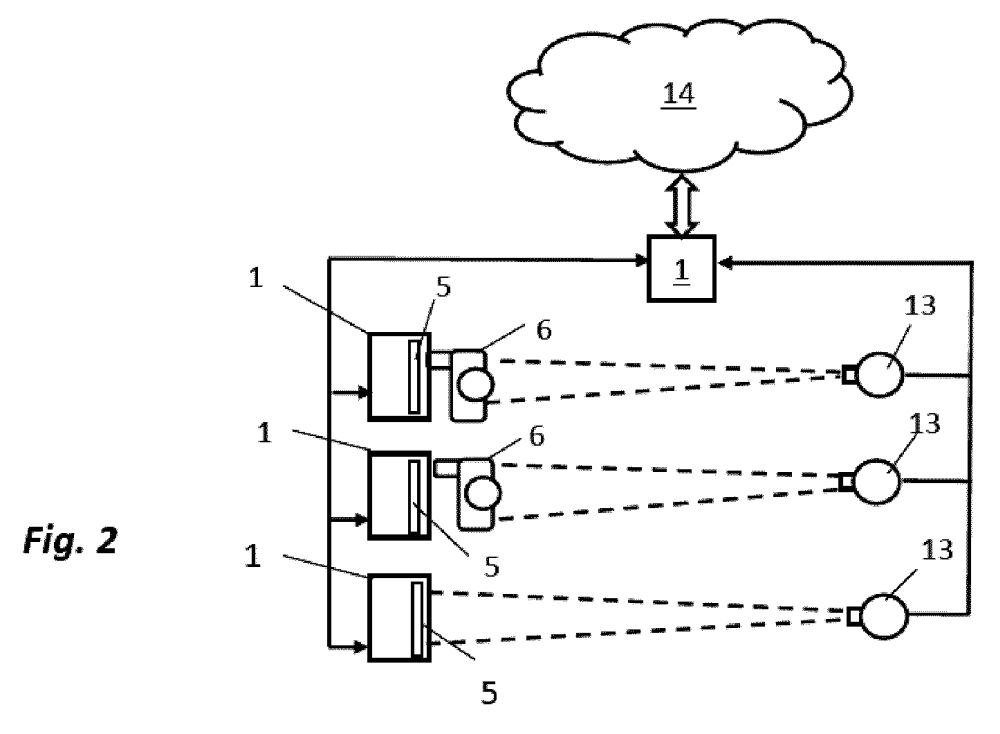
Fig.23 of EP 3 525 115 A1
Claim 1 - (labelling (A), (B), ... introduced by the board)
(A) A gaming installation comprising at least one gaming machine and a control device for controlling the operation of the at least one physical gaming machine (1), the at least one gaming machine being governed by a programmable electronic control logic (2),
(B) wherein the control device comprises a remote server (3) and first telecommunication means (4) to exchange data between the gaming machine (1) and the remote server (3),
(C) wherein the gaming machine (1) comprises a physical viewing display (5) to show an on-site player (6) information on gaming stages,
(D) physical selector means (7a, 7b, 7c, 7d) to allow the on-site player (6) to select on-site commands available with respect to a game session of the game,
(E) payment processing means (2b) for activating the gaming machine (1) when an on-site player (6) has paid a price to be able to play the game,
(F) status collection means (2d) integrated in the control logic that capture position signals, which identify positions of the images displayed on the physical viewing display (5) at each time;
(G) payout processing means (2c) for the payment of prizes to the on-site player (6) when he has won at least one game session of the game from the gaming machine (1),
(H) the physical viewing display (5), the physical selector means (7a, 7b, 7c, 7d), the payment processing means (2b), the payout processing means (2c) and the first telecommunication means (4) being connected to the control logic (2),
(I) and wherein the control device comprises an accounts manager module (3b) integrated in the remote server (3), to manage collections and payments in the respective accounts of remote players;
(J) at least one digital camera (13) for the real-time taking of images connected to image transmission means (8), the digital camera (13) arranged to take images (5′) in real time of the physical viewing display (5) of the gaming machine (1);
(K) second telecommunication means (9) to perform interactive wireless communications of data related to the game, between the remote server (3) and at least one remote player terminal (10) of a remote player, and for the real-time transmission of images to the remote user terminal (10),
(L) the second telecommunication means (9) designed to transmit to the remote user terminal (10) the images (5′) of the physical viewing display (5) taken by the digital camera (13);
(M) a gaming interface (11) that, at least when it is in communication with the remote server (3), shows in real time on a screen (10a) of the remote player terminal (10) the images transmitted by the image transmission means (8),
(N) as well as remote selecting means (7a', 7b', 7c', 7d') which are analogous to the physical selector means (7a, 7b, 7c, 7d) of the gaming machine (1),
(O) the gaming interface (11) further allowing the remote player to select, on the remote player terminal (10), commands available in the stages of the game session and transmit them in real time via the second telecommunication means (9) to the remote server (3), the gaming interface (11) designed to display on the screen (10a) of the remote user terminal (10) the images (5′) of the physical viewing display (5);
(P) a control module (12) connected to the control logic (2) of the gaming machine (1) for automatically blocking, when receiving blocking commands from the remote server (3), at least the activation of remote selection commands when the gaming machine (1) is activated by an on-site player (6),
(Q) and for automatically blocking at least the activation of the on-site selection commands, the payout processing means (2c) and the payment processing means (2b)
(R) and for activating at least the selection process module (2a) in remote gaming mode, when the gaming machine (1) is activated by the remote player, the image transmission means (8) being integrated in the control module; characterized in that
(S) the control device further comprises selection process means (3a), integrated in the remote server (3), for the real-time processing of commands selected by the remote player in the gaming interface (11) of the remote player terminal (10), and for real-time transmission of the processed selected commands to the control module (12) via the first telecommunication means (4)
(T) and in that the remote server (3) comprises a control server (3c) designed to control the functionalities of the system, to store data transmitted between the gaming machine (1) and the remote server (3), images (5′) taken by the digital camera (13), data transmitted between the remote server (3) and the remote player terminal (10),
(U) and to route the images (5′) to the respective remote player terminals (10) from which the remote players are playing on different gaming machines (1);
(V) a video server (3d) designed to collect the images (5′) captured by each digital camera (13) and transmit them to respective remote player terminals (10) indicated by the control server (3c);
(W) where the control server (3c) and the video server (3d) are separate from each other,
(X) and further in that the digital camera (13) is mounted at a distance from the gaming machine, the control module (12) further comprising a recognition unit programmed to issue a blocking signal which prevents activation of the gaming machine (1) from the remote player terminal (10) when the digital camera (13) does not capture images (5′) of the physical viewing display (5) of the gaming machine (1).
Is it patentable?
The Examining Division considered that the claim lacked inventive step, starting from D1. The Board disagreed and identified the distinguishing features as follows:
2.3.2 D1 therefore fails to disclose
(a) a separate video server and providing two distinct, separate servers each having a particular function instead of one single server (features (V) and (W)), and
(b) the control module further comprising a recognition unit programmed to issue a blocking signal which prevents activation of the gaming machine from the remote player terminal when the digital camera does not capture images of the physical viewing display of the gaming machine (feature (X)).
Then the Board discussed the technical effect of the distinguishing features:
2.4 Effect – objective technical problem
2.4.1 Differing feature (a) has the technical effect that the data transmission is made more efficient, because less image and video data transmitted leads to higher data transmission efficiency.
2.4.2 Differing feature (b) has the technical effect that the gaming efficiency and security is increased, because just by local players standing in front of the machine, the possibility of said machine being activated by a remote player is automatically blocked. According to feature (X) data security standards are maintained or even improved and the switch between remote player and local player is simplified and accelerated, because a log-in / log-out process via a GUI or the operation of buttons is not any more necessary.
The Board accepted the feature provided a technical effect :
2.5.1 The board comes to the conclusion that D1 neither discloses nor suggests at least feature (X):
2.5.2 Based on the objective problem to be solved, the skilled person would not be prompted by the teaching of D1 or its common general knowledge to install a complex video data evaluation system based on image recognition that can evaluate whether a person is standing in front of the slot machine.
2.5.3 D1 only mentions a combination mode for both local and remote players. D1 does not provide any details how to implement this combination mode, in particular how remote gaming is disabled when a local player uses the gaming machine.
2.5.4 The skilled person might have considered a button for local players or a detector to recognize whether local players are activating the gaming machine's user interface.
2.5.5 However, the skilled person would not consider that the camera disables remote gaming if physical viewing of the display cannot be detected. This is a fairly efficient, quick, and relatively simple solution for disabling remote gaming when a local player wants to use a gaming machine, because (1) the local user does not need to press a specific button, (2) no such button needs to be provided, and (3) the player can start playing immediately.
2.5.6 However, detection software must be provided to recognize the patterns displayed on the gaming machine's display. D1 does not provide any indication that such software should be installed for the camera recordings. This solution is also not part of the common general knowledge of the skilled person in the given context.
2.5.7 Instead, starting from D1, the skilled person would implement the standard solutions described above (button, detector). Also to increase security, the skilled person would have considered other solutions.
2.5.8 Consequently, the solution defined by feature (X) is not obvious in view of the disclosure of D1 and the skilled person's common general knowledge.
2.5.9 The examining division held in the contested decision (point 4.3 of the Reasons) that feature (X) had no technical effect or, if it did have a technical effect, the feature was not sufficiently disclosed (Article 83 EPC), as the application did not disclose sufficient details in this regard.
2.5.10 However, the board is of the opinion that the effect described above is of a technical nature, since feature (X) both maintains and improves data security standards as well as simplifies and accelerates the switch between remote player and local player compared to a situation where a log-in / log-out process via a GUI or the operation of buttons would be necessary. The implementation of an algorithm that detects when the gaming display is covered by a player was technically feasible without any problems at the time of filing, so that the skilled person does not require any further details in this regard. Consequently, the present application also fulfils the requirements of Article 83 EPC.
Therefore, the Board considered that the subject-matter was inventive.
More information
You can read the full decision here: T 2030/22 of November 27, 2025, of the Technical Board of Appeal 3.4.03
The content of this article is intended to provide a general guide to the subject matter. Specialist advice should be sought about your specific circumstances.
