

It's well established that people with disabilities have the right to equal participation in society, and yet they still face significant challenges, particularly at work. Below, we examine the specific disability protections that exist in Germany, together with practical strategies for employers looking to better integrate people with disabilities into their workplace. We have then also set out the position in 21 other countries via a summary table at the end of the article, with further details in the side bar.
The wider context in Europe
Across Europe, only around half of people with disabilities are employed compared to three in four people without disabilities. Safeguarding the rights of people with disabilities and promoting their career-focused integration are therefore key components of an inclusive working environment.
Disability can take many forms – from physical impairments to cognitive or learning disabilities – many of which may not be immediately obvious to others.
Disability rights are enshrined in legal frameworks designed to eliminate discrimination against people with disabilities and to remove structural and attitudinal barriers towards their full inclusion in society.
In 2017, the European Parliament, the Council and the European Commission proclaimed the European Pillar of Social Rights, which outlines 20 key principles and rights, though these are not legally binding. Notably, Principle 17 affirms that people with disabilities are entitled to income support ensuring dignity, access to services enabling labour market participation and a work environment tailored to their needs.
Furthermore, the European Union and all its Member States are parties to the United Nations Convention on the Rights of Persons with Disabilities (the 'UNCRPD'). The UNCRPD obliges signatory states to ensure the full and effective participation of people with disabilities in the world of work. Article 27 of the Convention emphasises the right to work and the need to remove barriers in the workplace. Of particular importance here is the obligation to create reasonable accommodation (Article 2 of the UNCRPD).
Workplace disability rights in Germany
In Germany, disability rights are set out within several regulations. Particularly noteworthy is the Ninth Book of the German Social Code. This requires employers to take comprehensive measures to enable people with disabilities to participate in working life and promote their employment. In this, and other provisions of German law, the level of protection varies according to the so-called 'degree of disability'.
How is disability defined?
In Germany, a person's 'degree of disability' ('DoD' or Grad der Behinderung) indicates the extent to which they are impacted by their disability. A disability with a DoD of 50 or higher is considered a 'severe disability' (or Schwerbehinderung). Applications for a severe disability pass can be made to the local Social Care Office (the Versorgungsamt). The Social Care Office uses a scale of 0 to 100 to measure the severity of a person's disability. Under certain conditions, people with a DoD of 30 or 40 may be granted an equal status to severely disabled persons. This is the case if, for example, the disability results in a significant competitive disadvantage in the labour market.
Despite equal treatment and largely identical protections for both groups (i.e. severely disabled persons and those with equal status), there are some differences between them. These differences mainly relate to the provision of additional leave, free travel on public transport and early retirement after reaching the age of 60. These rights only apply to people with a severe disability.
Labour market integration
Employers should ensure that people with a severe disability and those with equal status can make use of and develop their skills and knowledge to the best of their ability in the workplace.
Among other things, the Ninth Book of the German Social Code regulates the recruitment and employment of severely disabled persons and those with equal status. Companies with at least 20 employees must fill at least 5% of their positions with severely disabled or equivalent employees. If employers are not able to meet this quota, they must pay a compensatory levy of up to EUR 720 for every compulsory role left unfilled.
If at least five severely disabled people or people of equal status are permanently employed by an organisation, a representative body for severely disabled persons (a Schwerbehindertenvertretung) must be elected. They perform a wide range of tasks with the aim of ensuring the professional integration, participation and equality of severely disabled people.
During the application process companies are also required to assess the suitability of severely disabled applicants when filling vacant positions. However, that does not mean that severely disabled applicants have a legal right to an advertised job. In addition, vacant positions must be reported to the Federal Employment Agency (the Bundesagentur für Arbeit), and the representative body for severely disabled persons must be informed and consulted when applications are received. The German General Equal Treatment Act also protects disabled people from discrimination in this context during the application process, as it prohibits discrimination on the grounds of disability.
Support during employment
Employers must provide disability-friendly workplaces that enable people with disabilities to participate equally in working life. Support services such as technical or work assistance can be subsidised by the Federal Employment Agency.
Employers are obliged to ensure that their workplaces are accessible to disabled persons. Safety and health protection must be taken into account, and employers must consider measures to the extent they deem them to be reasonable. This begins with barrier-free access to organisation buildings and individual workplaces and, where necessary, the installation of disabled-friendly sanitary facilities/toilets. It also extends to the review of organisational processes, including environmental influences and work organisation.
In addition to these rights, the representative body for severely disabled people is to act as the point of contact for employees within the organisation for all matters relating to inclusion, such as the promotion of barrier-free workplaces. They also have the right to information and consultation with the employer on these issues.
People with a severe disability are also entitled to additional days of paid leave from work. If a person is unable to work full-time hours due to a severe disability, they are entitled to work part-time hours. The employer cannot demand severely disabled persons to work overtime. If the employer does so, the employee is entitled to refuse.
Protection against dismissal
People with disabilities have special protection against dismissal under German law. This applies once their probation period, which lasts six months, has come to an end. If an employer wishes to dismiss a disabled employee after this period, they must first apply to the Inclusion Office (the Integrationsamt) for consent to terminate employment. The Inclusion Office is responsible for protecting severely disabled people within the framework of the special protection against dismissal and aims to offset the disadvantages such individuals face in the labour market. Prior to giving its decision, the employee concerned must be given the opportunity to have a personal, verbal discussion with the Inclusion Office. The employer is also consulted. This step is a legal requirement to allow the Inclusion Office to check whether the employee's disability is the reason for the dismissal. If this is the case, the Inclusion Office can refuse consent. A termination served without this approval is invalid and can be annulled by the German Labour Court.
The representative body for severely disabled people also must be informed before the termination of employment. This applies without restriction, even in the case of termination during the probationary period.
Funding opportunities for employers
As the implementation of reasonable accommodation in the workplace will result in organisational and financial costs, German legislation provides a range of financial funding instruments and support measures. These measures are intended to ensure that inclusion does not fail due to economic hurdles.
These include, for example, integration subsidies, the financing of technical aids by Inclusion Offices and advice from specialist integration services.
As part of integration grants, subsidies can also be paid to employers to compensate for potential productivity challenges as a result of the disability. The Employment Agency generally pays up to 70% of the disabled employee's salary for a period of up to 24 months. Integration subsidies are so-called 'discretionary benefits' for which there is no legal entitlement. Employers also have the option of applying to the Inclusion Office for financial support for the disability-friendly design of workplaces. Funding is available for height-adjustable desks, screen readers, acoustic or optical signalling systems and other adjustments to enable barrier-free access.
Subsidies of up to 60% of a young disabled person's training salary can also be applied, and up to 80% where the young person has a severe disability.
Takeaway for employers
Employers play an important role when it comes to the integration of people with disabilities in the workplace. Under German law, they are required to make an active commitment to removing structural barriers, so that people with disabilities can enjoy a self-determined and equal participation in society. There are many factors to be considered, but in summary employers must bear the following in mind:
- Employment quota: all employers with more than 20 employees have to fill at least 5% of these positions with severely disabled people or those with equal status. Otherwise, they must pay a compensatory levy.
- Accessible workplace: Employers must provide workplaces that are accessible for people with disabilities. This can also include technical aids or work assistance, depending on the form of disability.
- Special protection against dismissal: The dismissal of a disabled person requires the prior approval of the Inclusion Office.
- The right contact person: Many institutions represent the interests of disabled people. The Federal Employment Agency, the Inclusion Office and the representative body of disabled people are key examples, and employers must choose the right contact person in every situation
The view from other places: A summary table
In the below table, we provide a global overview of the legal rights of disabled persons at work, outlining the position in 21 jurisdictions worldwide. For further details, please see additional comments in the sidebar for each country.
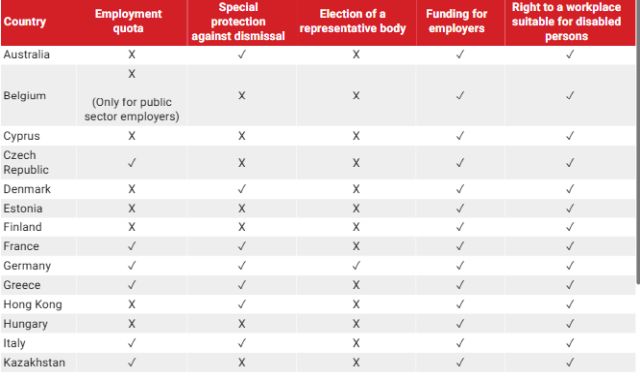
The columns in the above table relate to the following:
- Employment quota – If certain conditions are met, are organisations required to fill a % of roles with persons with disabilities?
- Special protection against dismissal – If certain conditions are met, are there any specific protections against dismissal for persons with disabilities (in addition to general anti-discrimination protection)?
- Election of a representative body – If certain conditions are met, are employers required to elect an internal representative body to be consulted on matters relating to employees with disabilities?
- Funding for employers – Can employers apply for financial funding and/or dedicated support measures to assist with the participation of people with disabilities in their organisation?
- Right to a workplace suitable for disabled persons – Are employers required to provide disability-friendly workplaces?
The content of this article is intended to provide a general guide to the subject matter. Specialist advice should be sought about your specific circumstances.
