From time-consuming data entry to delays in registrability analysis, trademark search professionals face many challenges when handling high-volume trademark clearance projects. Fortunately, technologies now exist to mitigate the headaches of bulk trademark search and review.
Businesses must move quickly to prepare, establish and maintain brand presence in competitive market sectors, with multiple internal stakeholders playing vital and timely roles in the go-to-market strategy of new products and services, not least the internal IP and trademark teams. To match the speed of the modern brand development cycle, these teams require solutions that can help them efficiently process extensive lists of naming candidates, expedite screening and analysis, and provide timely and strategic advice.
As our Trademark SaaS Solutions Specialists Pascaline Bourreau and Leslie Meritt discussed in our recent webinar on ‘Speed & Strategy: Mastering Mass Trademark Screening with Markify and Qthena,’ manual trademark screening processes put trademark professionals at a disadvantage when clearing longlists of potential brand names.
Instead, by combining the Bulk Search capabilities of our trademark clearance search platform Markify with the AI support of our IP digital assistant Qthena, teams can overcome delays and bottlenecks by screening and then analyzing hundreds of names simultaneously. This combined solution not only resolves the time-consuming and repetitive demands of manual search but also helps trademark professionals improve consistency and accuracy, accelerating decision-making in the process.
The Bottleneck: The Hidden Costs of Manual Trademark Screening
Effective trademark screening is not just a legal checkbox; it is a strategic function that directly influences brand launch timelines, budget allocation, and competitive positioning. Little wonder that traditional ‘one-by-one’ searching causes an administrative friction point in high-volume projects.
When tasked with trademark screening across 100 or more candidates, the manual approach introduces several inefficiencies:
- Input Chaos: Managing massive spreadsheets and manually entering data into search platforms is not only slow; it is an invitation for data entry errors that can result in missed conflicts — a critical failure point in any serious trademark screening search workflow.
- The Manual Gap: High-volume projects often succumb to "tab fatigue," the cognitive load of comparing results across dozens of browser tabs. Wasting hours on repetitive search configurations for classes and territories for each individual candidate is a significant drain on resources. Without a structured bulk trademark search capability, even well-resourced teams struggle to maintain consistency and speed.
- The Final Hurdle (Availability vs. Legally Protectable): A traditional trademark screening search may return zero results, suggesting a name is "available." However, discovering absolute grounds for refusal (such as descriptiveness or lack of distinctiveness) only after filing leads to wasted budget, lost time, and failed launch schedules.
How can we speed up the flow without missing a critical conflict?
Markify and Qthena: Two Solutions, One Seamless Workflow
—Quantity & Speed with Markify Bulk Search
Process dozens or hundreds of marks in a single upload; set your classes, territories, and search parameters once for the entire project; and access global trademark databases simultaneously to identify identical and confusingly similar prior rights.
Our Bulk Search tool eliminates administrative friction for Markify users by processing up to 500 naming candidates across trademark, domain name, and pharma databases in a single query. With its "set once, apply all" logic, you only need to configure target classes and global databases a single time to instantly apply those parameters across the entire project. This transforms trademark screening from a sequential manual task, saving time, reducing repetitive work, and ensuring consistency throughout the entire clearance process.
—Intelligent AI Analysis with Qthena
Move past simple conflict checking to assess if a name is actually registrable; generate instant analysis of descriptiveness, lack of distinctiveness, and absolute grounds for refusal; and save budget and time by weeding out weak candidates before running full searches.
It’s a dangerous assumption that a name with zero hits on a trademark screening search is legally safe. Examiners frequently reject marks on absolute grounds regardless of search results. Qthena, our AI Assistant for Search Review, provides a vital "Registrability" check, helping teams identify potential barriers to registration at the earliest stage, saving valuable time and budget.
How it Works: Three Steps to Bulk Screening Success with Markify
1. The Input Phase
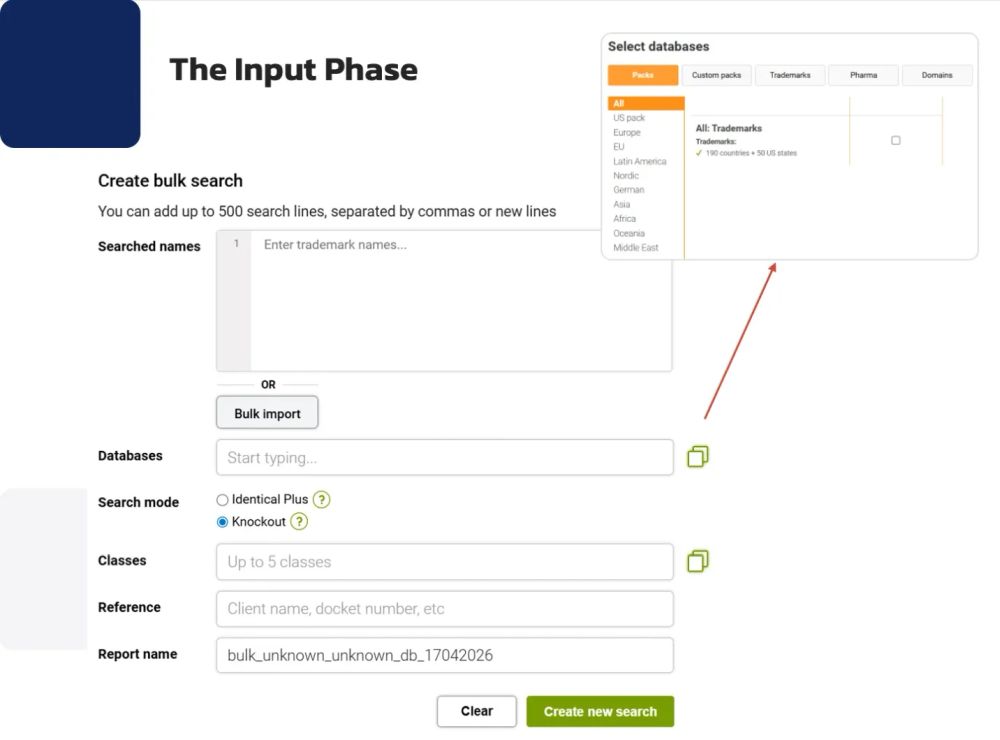
Simply copy and paste your list or upload a file to check the availability of up to 500 candidates across trademark, pharmaceutical, and domain name databases in a single query.
Choose the depth of your screening based on your project's stage:
- Identical Plus: Designed for fast, high-level screening. This mode is the primary tool for identifying immediate "deal-breakers"; identical or near-identical marks that necessitate an instant discard. It is the natural starting point of any trademark screening workflow involving large name lists.
- Knockout Search: Markify's signature algorithm for a deeper dive. This advanced logic captures complex phonetic and visual conflicts, ensuring that subtle similarities do not escalate into future litigation, giving legal teams the confidence that their trademark search is genuinely comprehensive.
2. Navigate and Analyze Your Results
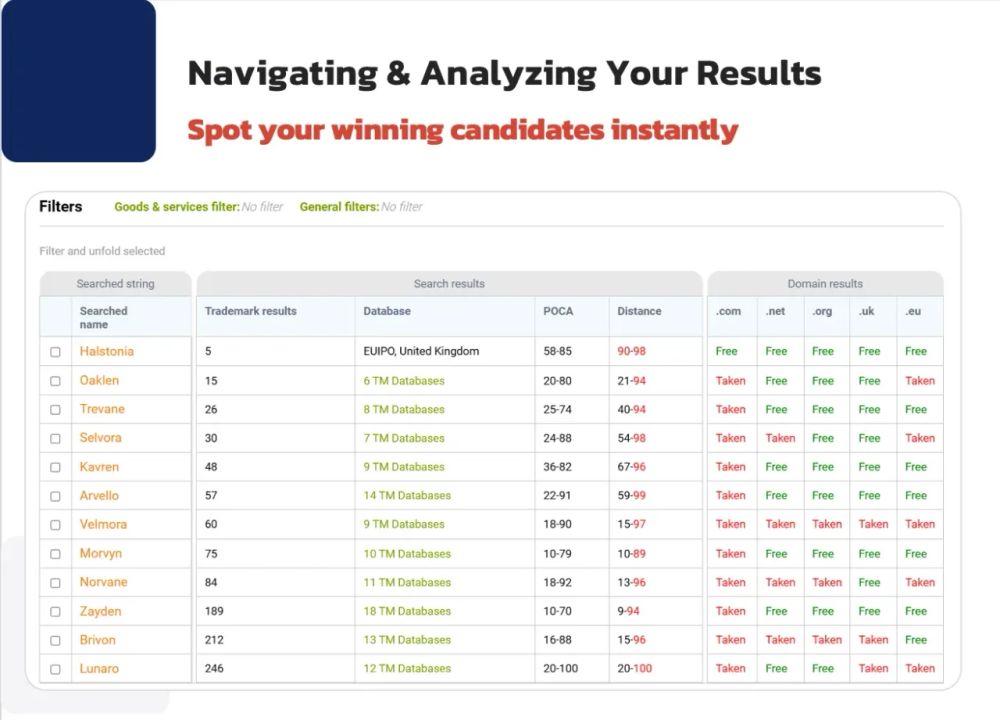
With the Markify platform, you can spot and analyze your winning candidates easily!
- Automatic Triage: The system prioritizes candidates by the number of results found. Candidates with "No Hits" or minimal conflicts are pushed to the top, allowing strategists to identify winning names within seconds. This automated prioritization is one of the most impactful features for teams running bulk trademark search operations at scale.
- The Distance Metric: To quantify phonetic and visual risk within the trademark screening process, results are ranked by "Distance," a calculation of character edits (additions, deletions, or substitutions) required to match the search term. This ensures the most dangerous conflicts are reviewed first, making the trademark screening search results immediately actionable rather than requiring manual sorting.
3. Master Your Data with a Deep-Dive
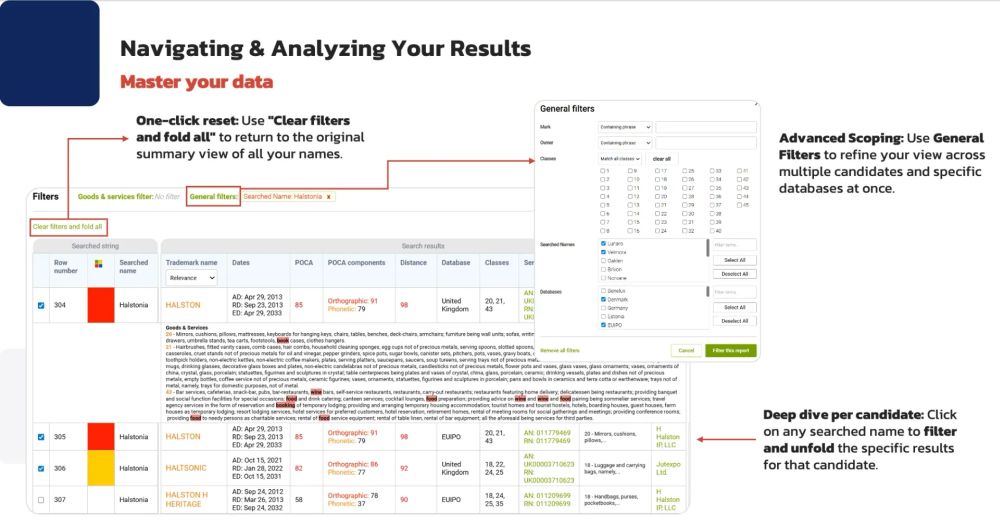
Superior trademark screening strategy requires understanding the "DNA" of a potential opponent. Users can click on any candidate to unfold specific results without losing the context of the search report. General Filters allow for advanced scoping across multiple candidates or specific registries simultaneously, while a "one-click reset" ensures seamless movement between high-level triage and granular analysis, a key advantage when conducting bulk trademark search reviews with cross-functional teams.
And that’s not all. The Markify platform includes a wide range of intelligent features to simplify results review, including a dedicated Owner Identity Card.
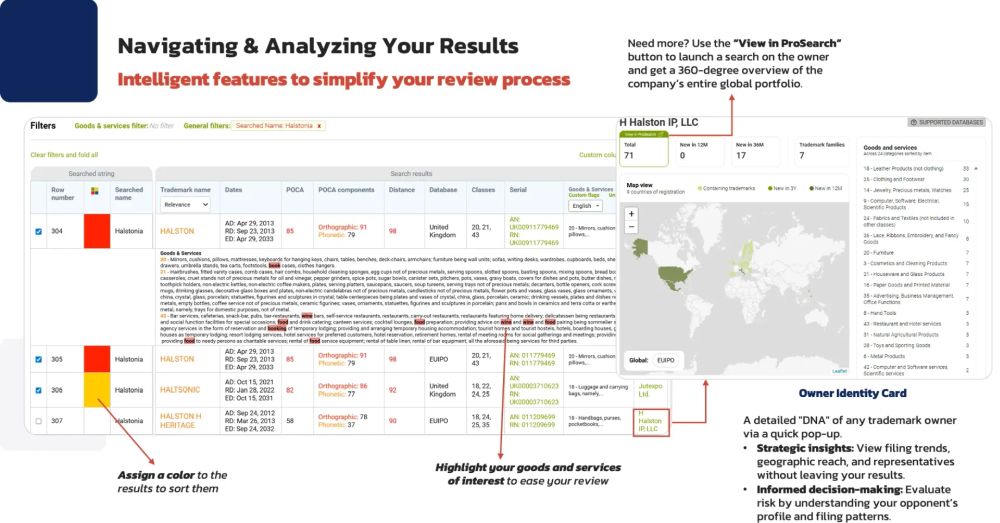
The Owner Identity Card provides an immediate strategic profile of a trademark owner via a pop-up within the results interface, adding a layer of competitive intelligence that standard trademark screening search tools rarely offer.
The card moves beyond simple contact data to provide high-level metrics, including:
- Strategic insights: View filing trends, geographic reach, and representatives without leaving your results.
- Informed decision-making: Evaluate risk by understanding your opponent’s profile and filing patterns.
- Geographic reach: Need more? Use the “View in ProSearch” button to launch a search on the owner and get a 360-degree overview of the company’s entire global portfolio.
Specialist Workflows: Precision Trademark Screening for the Pharma Industry
In the pharmaceutical sector, trademark teams face additional regulatory complexity when managing their trademark screening projects. The Markify platform addresses these regulatory complexities through specialized intelligence:
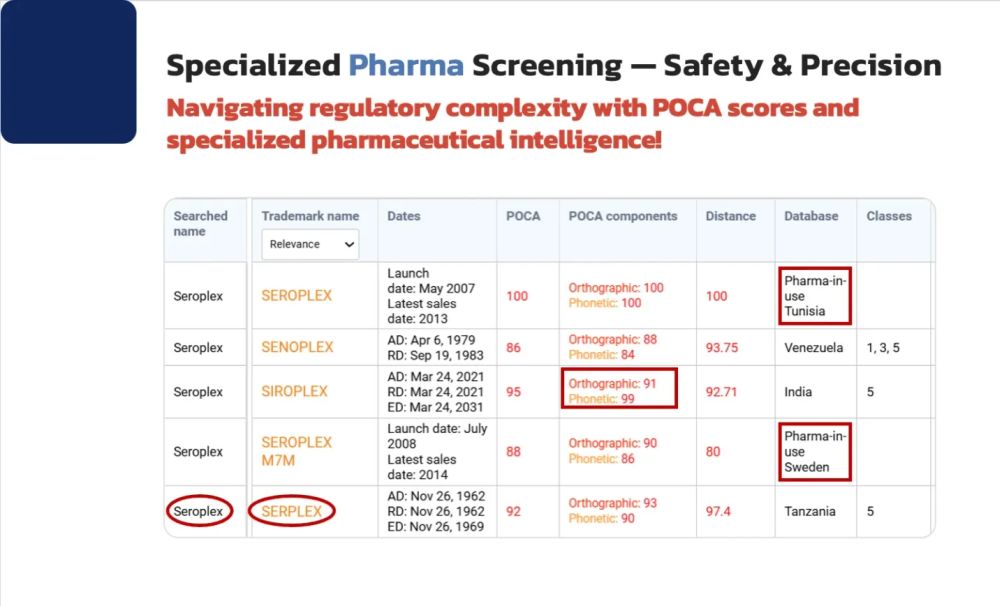
- POCA Scores: Integration of Phonetic and Orthographic Computer Analysis (POCA) scores ensures that the trademark screening process meets the rigorous standards of the U.S. Food and Drug Administration (FDA) and the European Medicines Agency (EMA).
- Granular Similarity Breakdown (POCA Components): Separate analysis for orthographic (visual) and phonetic (sound) components to assess the risk of confusion in a medical context.
- Pharma-Specific Data: Inclusion of "Pharma-in-use" databases (like Tunisia or Sweden in the example) to identify non-registered but active medicinal brands.
- The "Distance" Metric: Identifying high-risk candidates (such as SEROPLEX vs. SERPLEX) where a single missing letter could lead to a rejection.
Checking for Legal Registrability with Qthena
Trademark screening is a vital step in every brand development process, but it doesn’t always provide the full picture. A name without hits could still be rejected by an examiner if it does not meet legal registrability requirements. Avoid wasting resources running full searches for names that are legally “weak” or unprotectable and identify names that are both available and registrable by combining your Markify Bulk Search with an AI-driven triage.
AI-Driven Triage in Action with Qthena
Test your ideas in seconds with our IP digital assistant Qthena. The powerful tool undertakes rapid analysis of naming candidates to identify risks of refusal in specified markets worldwide. Let’s use the shortlist of candidates for a new antibiotic to highlight the AI assistant in action.
Step 1: Prompt Qthena in Natural Language
We are about to launch a new brand name for an antibiotic. Our candidates are Seroplex, Jul, RunCorty, and BurtonsX. The countries of interest are the EU, China, Mexico and Canada. Please act as a Senior Trademark Examiner in these countries and evaluate whether each sign complies with absolute grounds for refusal. For each name, analyze the distinctiveness, potential descriptiveness of each sign, and any other legal barriers to registration.
Step 2: Review the Qthena Results
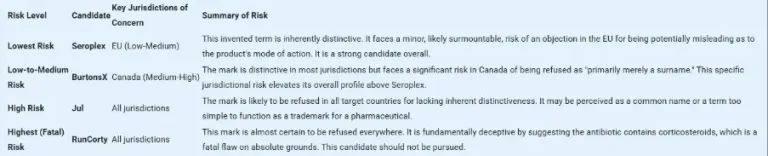
- RunCorty: Qthena immediately identifies this as having a "fatal flaw.” Because the name suggests the presence of corticosteroids, it is fundamentally deceptive for an antibiotic and would be refused globally on absolute grounds. Recommendation: Discard.
- Jul: Qthena also indicates this to be a high-risk mark. It is likely to be refused in all target countries for lack of distinctiveness, as it could be perceived as a name too simple or common to function as a trademark in the pharmaceutical sector.
- BurtonsX: While this mark is considered distinctive in most jurisdictions, Qthena identifies that it is at significant risk of being refused in Canada.
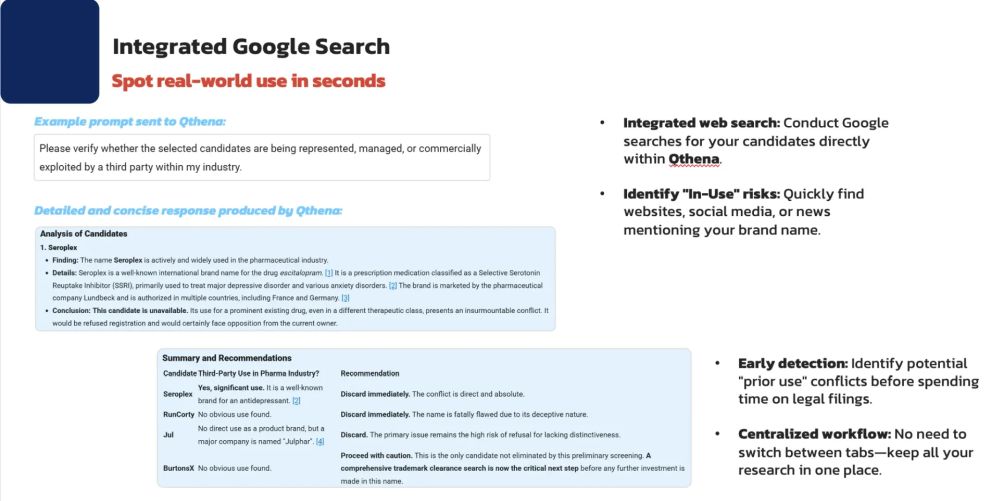
- Seroplex: Here, the initial check suggests this term is inherently distinctive and likely registrable. However, Qthena's integrated Google Search reveals that Seroplex is already a well-known international brand for an antidepressant marketed by Lundbeck. Despite its apparently clean appearance in a conventional trademark screening search, the real-world conflict is direct and absolute.
The Future of Trademark Screening and Analysis
Modern trademark teams are being challenged to act faster without sacrificing precision. As brand launches accelerate across global markets, the ability to conduct rigorous trademark screening at scale is no longer a competitive advantage; it is a baseline operational requirement.
By integrating Markify Bulk Search for quantity and Qthena for registrability analysis, trademark professionals can address weaknesses in the traditional trademark screening search process, optimizing both search results and strategic intelligence.
The content of this article is intended to provide a general guide to the subject matter. Specialist advice should be sought about your specific circumstances.
[View Source]