

I. INTRODUCTION
The legal framework governing solid waste management in the Dominican Republic has undergone, in a very short period, a profound transformation that should be reconstructed in order to understand its current status. General Law on Integrated Solid Waste Management and Co-processing No. 225-20 established in 2020 the modern framework for the matter—management hierarchy, circular economy, extended producer responsibility, and municipal participation—but its implementation revealed gaps and tensions that prompted an intensive reform process.
That process gave rise to a bill amending Law No. 225-20, on which the Executive Branch submitted, through Communication No. 27254 of November 3, 2025, nineteen substantive observations concerning, among other aspects, free competition, municipal autonomy, the State’s environmental oversight role, and the financial sustainability of the system. This report analyzes those observations one by one, evaluates their legal and technical basis, and provides additional considerations on the points observed.
Most of those observations were incorporated into the text finally approved and enacted as Law No. 98-25 of December 15, 2025, which today constitutes the framework in force. This reform introduced far-reaching changes for the private sector: a national and mandatory special contribution payable by legal entities, the reorganization of the DO Sostenible Trust, minimum tariffs for operators, prohibitions on single-use plastics and expanded polystyrene, and a graduated sanctions regime.
However, regulatory developments did not stop there. After the enactment of Law No. 98-25, the Senate of the Republic approved a new bill that again amends Law No. 225-20—already reformed by that law—and directly affects the special contribution, the obligated parties, and the deadlines for certain prohibitions. For this reason, this document has been updated with a twofold purpose: first, to preserve the analysis of the Executive Branch’s observations that shaped the current framework; and second, to set out precisely what Law No. 98-25 currently provides and what would change under the bill approved by the Senate, so that the reader has a complete, comparative, and immediately useful overview for decision-making.
II. WHAT DID LAW NO. 98-25 MODIFY?
The reform process of Law No. 225-20 culminated in the enactment of Law No. 98-25 of December 15, 2025, which incorporated many of the Executive Branch’s observations and today constitutes the framework in force. Before examining what the new Senate bill would change, it is useful to clarify exactly what this law established and modified, since that framework—not the original 2020 text—is the actual starting point for any legal entity operating in the country.
- The reform can be summarized in five main areas:
1) A national and mandatory special contribution (Art. 36).
This is its main innovation. It consists of an annual payment owed by every legal entity and public or private institution domiciled in the country, covered by any tax regime and regardless of whether it earns profits. It is calculated based on the income reported to the Directorate General of Internal Taxes (DGII) according to a six-bracket scale, settled before that entity—with the option of semiannual payment—and deductible from gross income in the fiscal year in which it is paid. Its collection is transferred, through the National Treasury, to the DO Sustainable Trust. In practice, it is a new compliance obligation of general scope.
2) The reorganization of the DO Sustainable Trust and tariffs for operators.
The law structures a public-private trust as the central financing mechanism for the system and establishes minimum payments per kilogram to operators—transfer stations, sanitary landfills, and recovery plants—as well as a contribution to municipalities calculated per inhabitant. In doing so, it seeks to provide financial sustainability to the management chain and predictability for private investment in infrastructure. The destination of these resources is defined by law: the contribution from public institutions is allocated to municipalities and municipal districts for their urban solid waste management expenses, while the contribution from private legal entities—and a percentage of the public contribution—finances the operation of transfer stations, sanitary landfills, and recovery plants, together with the administration of the trust itself, as approved by its Board of Directors.
3) Product prohibitions and extended producer responsibility (EPR).
The importation and marketing of single-use plastics—straws, cutlery, cups—and expanded polystyrene products (foam) lacking biodegradability certification are prohibited, and producers, importers, and marketers are required to join EPR programs. Certification is subject to technical evaluation by INDOCAL and the regulations of the Ministry of Environment, with border control. It should be noted that EPR obligations apply to so-called priority products—including lubricating oils, cells and batteries, pesticides, tires, and containers and packaging—to which electrical and electronic equipment waste (WEEE), already governed by its own regulation, is added. Any company that manufactures, imports, or markets any of these categories must verify whether it is covered and, if so, join an individual or collective management system.
4) A graduated sanctions regime (Art. 164).
The law provides the system with a catalogue of infringements classified as very serious, serious, and less serious, with sanctions ranging from fines measured in minimum wages to disqualification, revocation of authorizations, and closure of facilities, distributing sanctioning authority between the Ministry of Environment and the municipalities. This is the component that most tangibly increases non-compliance risk for companies.
That risk should be properly measured: for very serious infringements, fines range from one hundred to one thousand public-sector minimum wages and, in the case of hazardous waste, rise to a range of one thousand and one to three thousand minimum wages, in addition to possible community service and the obligation to restore the prior situation, with coercive fines in the event of non-compliance. Authority is distributed so that the Ministry of Environment hears serious and very serious infringements, while municipalities hear less serious ones, and the funds from these fines are allocated to the system’s trust.
5) Consolidation of the management framework and institutional governance.
On the basis of Law No. 225-20, the reform confirms the management hierarchy and the principles of circular economy and co-processing, preserves municipal autonomy to set service fees, and maintains the State’s environmental oversight role, thereby addressing the concerns regarding free competition and allocation of powers that had marked the debate.
Taken together, Law No. 98-25 shifted the matter from a predominantly environmental and municipal field to one that combines tax, product, and compliance obligations with direct effects on companies generally. It is precisely this framework already in force—and not the 2020 scheme—that the new bill approved by the Senate affects, as analyzed in Section IV.
Beyond these five areas, every legal entity should keep in mind the set of operational obligations that the framework—Law No. 225-20 and its regulations—already imposes and whose breach triggers the sanctions catalogue described above: registration with the Ministry of Environment and environmental authorization for the handling, transport, treatment, or disposal of hazardous and special-management waste; the preparation of management plans, maintenance of logs, and submission of annual reports by large generators; source separation of waste; and a growing duty of documentary traceability through manifests, certifications, and periodic reports. In practice, the risk is not limited to physical operations: it extends to the company’s ability to document and prove compliance.
It is also important not to lose sight of the other side of the framework. Alongside the obligations, Law No. 225-20 maintains a set of incentives that companies may access: the issuance of green bonds to finance or refinance green projects and incentives for investment in recovery, recycling, and clean technologies, including a five-year exemption from one hundred percent of income tax—excluding dividends. For many organizations, a complete reading of the framework means both quantifying the contribution and sanctions exposure and assessing eligibility for these incentives.
III. STATUS AND PROCEDURE OF THE BILL APPROVED BY THE SENATE
The bill prompting this update is identified as Initiative No. 01682-2026-PLO-SE, filed as a bill under the description “Bill amending Law No. 225-20 of September 30, 2020, General Law on Integrated Solid Waste Management and Co-processing,” in the area of Natural Resources and Environment. Its chamber of origin was the Senate of the Republic, corresponding to legislative year 2026 (2026-PLO legislature) of the 2024–2028 four-year term, and its sponsor was Senator Casimiro Antonio Marte Familia.
The most relevant feature of its processing is its expedited nature: the entire procedure in the chamber of origin was completed in a single day. According to the file history, the bill was filed on June 24, 2026 and, that same day, was placed on the agenda and taken into consideration, released from procedural requirements—that is, without referral to committee study—and approved in first and second reading. Therefore, there was no committee report, legislative analysis, or advisers’ report, as reflected in the corresponding fields of the file.
Finally, the bill was sent on June 25, 2026, to the Chamber of Deputies through Dispatch Letter No. 00232, and was archived in the Senate under number 710. As of the date of this document, its status is “Approved” by the Senate, without enactment, which means that the bill is now before the Chamber of Deputies—the reviewing chamber—for consideration. If approved there without amendments, it would proceed to the Executive Branch for enactment or observation; if changes are introduced, the text would have to return to the Senate. Accordingly, its content is not yet law in force and may change during the pending procedure.
IV. WHAT WOULD CHANGE UNDER THE BILL APPROVED BY THE SENATE?
The bill originates from an initiative by Senator Casimiro Antonio Marte Familia and as noted, was approved by the Senate in an expedited manner on June 24, 2026, released from procedural requirements and without prior committee study. It amends Articles 4 and 36—the latter concerning the special contribution—and adjusts the prohibition on single-use plastics under Article 172, always operating on the text already reformed by Law No. 98-25.
The substance of the bill should be placed in context. The speed of its approval, without regulatory impact analysis or formal technical consultation, has been questioned by the productive sector—in particular by business associations—which warn of the magnitude of the increases in the contribution and the regulatory instability implied by reforming a law barely six months after its enactment. In addition, the proportionality of the contribution calculation is subject to a constitutional challenge. These tensions foreshadow a substantive debate in the Chamber of Deputies, so the content described here should be understood as subject to possible amendment. With these clarifications, the substantive changes that the bill would introduce are as follows.
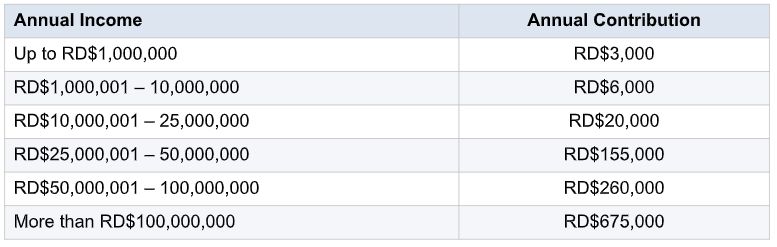
1) New scale for the special contribution (Art. 36): from six to twelve brackets
Reform approved by the Senate (12 tranches)
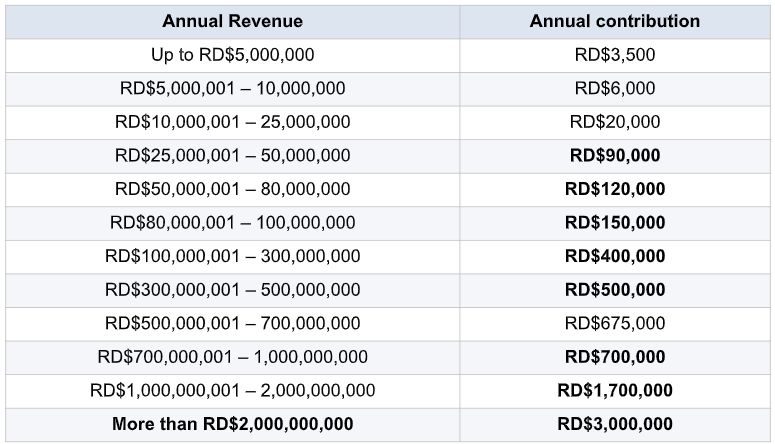
The change with the greatest economic impact is the complete redesign of the contribution table in Article 36. The current scale, introduced by Law No. 98-25, contains six brackets and levels off at a cap of RD$675,000 for any company with income above RD$100 million. The bill replaces that scheme with a twelve-bracket scale that is significantly more progressive: it provides relief to some medium-sized taxpayers and substantially increases the burden on large taxpayers, whose highest bracket rises to RD$3,000,000.
The cap disappears and, above RD$100 million, the contribution becomes genuinely progressive; the largest taxpayer would move from RD$675,000 to RD$3,000,000 annually, while several medium brackets (between RD$25 million and RD$100 million) are reduced compared with the current scheme. Because the contribution is payable regardless of whether profits exist, large companies should anticipate the increase and plan their cash flow accordingly.
2) Redefinition of obligated parties: exclusion of nonprofit entities
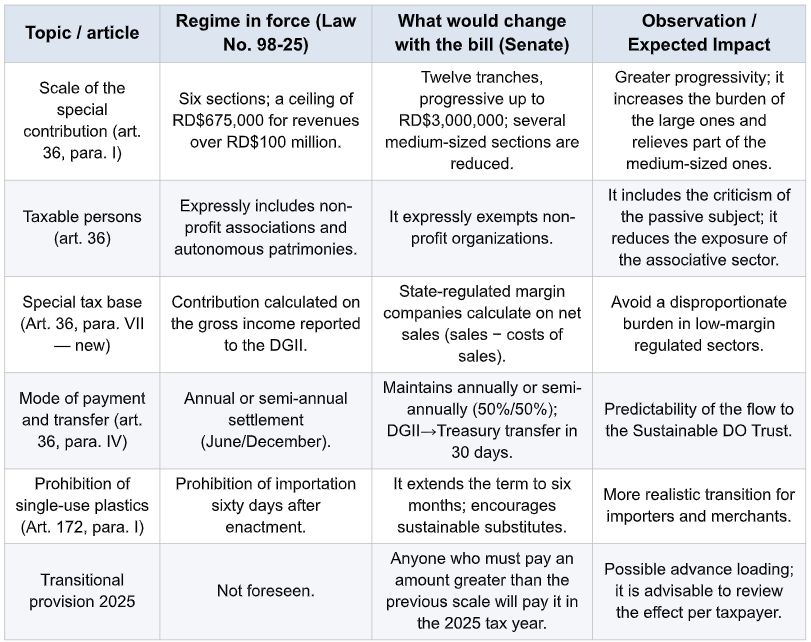
The amended text specifies that the contribution applies to every legal entity, entity, governmental entity, and other autonomous estates that report income to the DGII but expressly excludes nonprofit organizations. This represents a change in approach from Law No. 98-25, whose Article 36 included nonprofit associations among the obligated parties. The clarification reflects one of the technical criticisms previously made by the Executive Branch regarding the suitability of the taxpayer and reduces the exposure of the nonprofit sector.
3) Special taxable base for companies with regulated margins (new Paragraph VII)
The bill adds that companies with margins regulated by the State will calculate their contribution on net sales—understood as sales minus cost of sales—and not on gross income. This distinction in taxable base, aimed at sectors whose margins are administratively regulated, prevents high gross income with a low margin from resulting in a disproportionate contribution. Companies in regulated sectors should immediately assess whether they qualify for this alternative base.
4) Payment method, indexation, and transfer deadlines
The annual indexation of amounts according to the Central Bank’s Consumer Price Index is maintained, as is the possibility of settling the contribution annually or semiannually (50% in June and 50% in December). The DGII must transfer the amounts collected to the National Treasury within the following thirty days and the Treasury, in turn, to the trust account, in line with the concern for the financial sustainability of the system.
5) Deadlines for plastics prohibitions and 2025 transitional provision
Regarding plastics, the bill adjusts the schedule: the prohibition on importing straws, plastic cutlery, and expanded polystyrene products (foam) without biodegradability certification would take effect six months after enactment, while encouraging substitution with recycled paper or cardboard, sugarcane bagasse, bamboo, plant fibers, compostable materials, and reusable containers. Likewise, a transitional provision provides that legal entities whose payable amount is greater than under the previous scale shall pay that amount during fiscal year 2025, which requires careful review of the transition’s effect on each taxpayer. The reference to the tax computed during fiscal year 2025 could be assumed to be a drafting error, since fiscal year 2026 is the relevant period.
Comparative table: current framework (Law No. 98-25) and changes under the bill
V. EXECUTIVE SUMMARY AND RECOMMENDATIONS
The current solid waste framework, Law No. 225-20, as reformed by Law No. 98-25—is no longer an exclusively environmental and municipal matter: it imposes on legal entities generally a mandatory special contribution, product and extended responsibility obligations, and a sanctions regime carrying closure risk. This is the starting point that every company must address today.
The bill approved by the Senate on June 24, 2026, does not repeal that framework, but rather intensifies it in specific yet sensitive aspects: it redesigns the contribution scale (from six to twelve brackets, up to RD$3,000,000), excludes nonprofit entities, introduces a net sales base for regulated-margin sectors, adjusts payment deadlines, and extends the deadline for the plastics prohibition to six months. It is, however, still a pending bill before the Chamber of Deputies and is surrounded by questions regarding its technical basis and proportionality.
Accordingly, we recommend that companies: (i) determine their bracket and quantify the impact of the scale change, taking into account the 2025 transitional provision; (ii) assess, in regulated sectors, whether the net sales base applies; (iii) review their sanctions exposure and their product and EPR obligations; and (iv) closely monitor—and, where appropriate, participate in—the debate in the Chamber of Deputies, where the final content will be decided.
We remain available to assess the specific impact of this framework on your organization and to assist you in defining a compliance and advocacy strategy.
VI. BACKGROUND: THE EXECUTIVE BRANCH OBSERVATIONS THAT SHAPED LAW NO. 98-25
The bill that gave rise to Law No. 98-25 was observed by the Executive Branch through Communication No. 27254 of November 3, 2025. More than a targeted review, those observations revealed the Executive’s underlying concerns regarding the design of the system; understanding them helps explain why the current law is drafted as it is and where the regulation is likely to continue moving. Presidential attention focused essentially on the following areas.
Free competition and market structure. The Executive questioned provisions that set territorial quotas and rigid geographic radii—such as one recovery plant per region or one landfill per province—because of the risk of consolidating de facto monopolies and creating entry barriers and recommended making those criteria more flexible and grounding them in technical parameters.
Municipal autonomy. It sought to preserve municipalities’ authority to set fees for sanitation services, with due technical consultation with the Dominican Municipal League and the Ministry, avoiding legislative intrusion into powers belonging to the municipal sphere.
The State’s environmental oversight role. It insisted on maintaining the Ministry of Environment’s powers of authorization, supervision, and sanction, particularly with respect to hazardous waste.
Design and sustainability of the contribution and the trust. Much of its attention focused on the suitability of the taxpayer—with objections regarding the inclusion of certain autonomous estates—on the deadlines for transferring resources, on avoiding double charging, and on eliminating rigid percentages tied to the general budget, all in the interest of proportionality and the financial sustainability of the system.
Consistency with the waste hierarchy and the circular economy. It requested recognition of recovery and co-processing as legitimate destinations for waste—and not only sanitary landfilling—and objected to the imposition of rigid obligations on sectors such as cement or asphalt when they lacked technical and market support.
Legislative technique and certification. It observed the inclusion of substantive rules within glossary definitions and requested that they be moved to substantive provisions; and, regarding plastics and foam, it required robust technical certification—by INDOCAL and the Ministry—as a condition for qualifying a material as biodegradable, in order to prevent greenwashing.
Law No. 98-25 incorporated most of these observations, which explains the content of the current framework described in this document. For the same reason, these areas remain the most useful interpretive key for anticipating the outcome of the new bill during its consideration in the Chamber of Deputies.
The observation is legally and regulatorily reasonable, as it ensures continuity of payments to operators during the transitional period and establishes a defined deadline for tariff updates, using the current indexed tariffs as a minimum reference.
This protects both operators and the public interest, avoiding service interruptions and regulatory gaps. We recommend supporting the observation by establishing clear indexation and tariff-transition mechanisms, with defined deadlines and objective criteria for setting the new tariffs, to be developed in the regulations.
The content of this article is intended to provide a general guide to the subject matter. Specialist advice should be sought about your specific circumstances.
[View Source]
