

On 12 June 2026, the Federal Council set the date for the entry into force of the Act on the Transparency of Legal Entities (TLPA) and the amendments to the AntiMoney Laundering Act (AMLA) as 1 October 2026. At the same time, it published the definitive implementing ordinances (TLPO and amendments to the AMLO). During the consultation process, numerous participants called for more time to implement the changes. The Federal Council therefore set the date for the new provisions to come into force as 1 October 2026. The provisions relating to State notaries were postponed to a later date, as the cantons must first amend their legislation accordingly. The overall timetable remains ambitious, however, as the transition periods – which begin upon entry into force and are enshrined in the legislation itself – amount to only a few months in some cases. The reform is driven by Switzerland’s upcoming mutual evaluation by the FATF, with the on-site visit scheduled for 2027 and the plenary discussion for early 2028.
SUBJECT MATTER, SCOPE AND KEY CONCEPTS
The TLPA sets out transparency requirements applicable to legal entities under Swiss private law, certain foreign legal entities and trusts. Its objectives are to identify the natural persons who ultimately exercise control over companies, to enhance the transparency of legal structures and to reduce the risk of corporate abuse, in particular through the creation of a new federal transparency register accessible to the authorities and to professionals subject to the AMLA.
The scope of the TLPA can be summarised as follows:
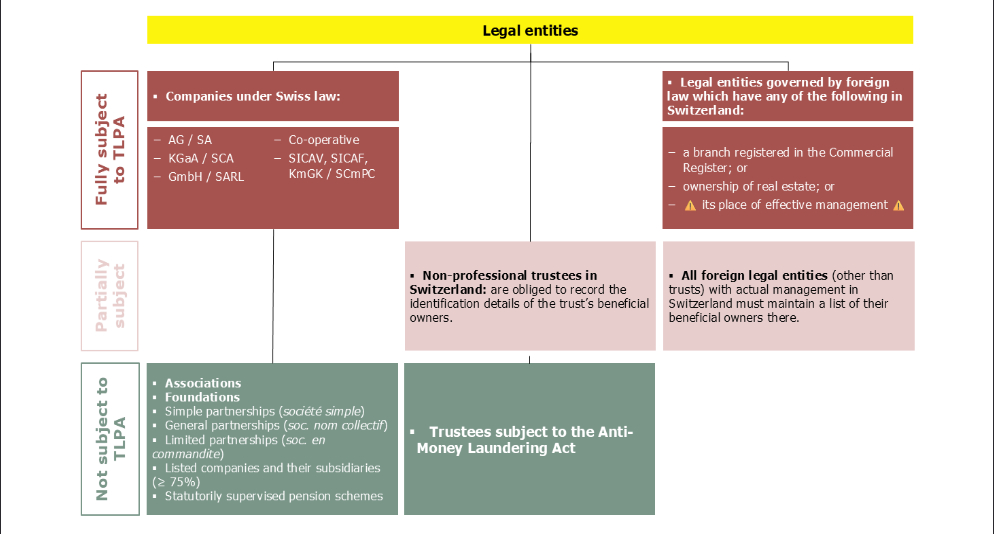
In practice, the scope of application must be carefully examined, particularly in the case of group, holding, private equity, family office and property structures, as the legal form, registered office, actual management, chain of ownership and property links may be relevant to the reporting obligation with the Transparency Register.
The beneficial owner (BO)
The beneficial owner is the natural person who ultimately holds a stake of at least 25% in the capital or voting rights of the company, or who otherwise controls the company directly or indirectly. What is decisive, therefore, is not the formal legal form, but the person at the top of the ownership or control chain. Companies, organisations or other legal entities cannot themselves be beneficial owners. This definition is essentially based on the existing concept of the beneficial owner under money laundering legislation. If no person meets these criteria, the most senior member of the governing body is deemed to be the BO. Which role this exactly refers to depends on the concrete structure of the entity concerned.
Control may also be exercised jointly by several persons if they coordinate their actions amongst themselves for this purpose. They are then all deemed to be BOs in respect of a combined holding. This requires, cumulatively, a common objective of control at the internal level and an organisation at the external level. Compared with the draft ordinance that was sent out for consultation, the final wording has been refined: the words ‘by means of a contract or other measures taken in an organised manner’ in the draft have been replaced by the more concise wording ‘to exercise control (...) through a shareholding or by other means’, thereby refocusing the provision more strongly on the purpose of control and less on the formal means of coordination. A simple shareholders’ agreement is therefore only to be taken into account if it enables the exercise of actual control over the company, for example through the right to appoint the majority of the members of the board of directors.
For this reason, the analysis of beneficial ownership should not be carried out in a schematic manner. In particular, shareholder agreements, trust or nominee arrangements, voting agreements, veto rights and intra-group control mechanisms may be relevant to the assessment.
In the case of trusts, the following persons are regarded as BOs: the settlor, the trustee, the protector, the beneficiary and any other natural person who controls the trust directly or indirectly. However, trusts are not subject to the obligation to register with the transparency register – their transparency obligations are fulfilled via the trustee.
The Transparency Register
The register is maintained at federal level by the Federal Office of Justice (FOJ). It is separate from the Commercial Register and is not publicly accessible. Access is restricted to a number of criminal and administrative authorities (including the tax authorities for the purposes of international mutual assistance in tax matters) as well as to financial intermediaries and advisers subject to the AMLA for the fulfilment of their due diligence obligations. Registered persons are not informed when their data is accessed.
The register is linked to other existing registers (the UID Register, cantonal commercial registers, etc.).
Companies cannot freely view the register data online; however, once the data has been published, they may order register extracts or confirmations containing the information relating to them.
KEY OBLIGATIONS
Identification and verification. Every legal entity must identify its BOs and record the following information for each of them: surname and first name, date of birth, nationality, address and country of residence. The identity and status as a BO must be verified on the basis of supporting documents “with the due diligence required in the circumstances”. A level of due diligence originally established for the financial sector is thus being extended to many other entities outside of it.
The practical risk lies primarily in unclear control structures, missing evidence, outdated internal information or changes that are not identified in good time. Companies subject to reporting requirements should therefore not only prepare the initial report but also establish an update process.
The TLPA imposes independent, criminally sanctioned reporting and documentation obligations on shareholders and BOs themselves vis-à-vis the company, in order to ensure the flow of information to the company.
Recording and retention. The legal entity must record this information and ensure that it is kept up to date and accessible in Switzerland at all times.
Reporting to the transparency register. The company must report the identity of its BOs to the new transparency register within one month of its entry in the commercial register or, in the case of a foreign company, of it entering the scope of the TLPA, subject to the transitional provisions for existing legal entities. The reporting is made electronically via an AGOV account on the federal government’s EasyGov e-government platform or, under certain conditions, via the relevant cantonal commercial register office. Natural persons are identified by their AHV (pension insurance) number; if they do not have such a number, an AHV number is assigned to them on the basis of a copy of their passport.
It should also be noted that:
- in the case of an indirect shareholding involving more than one intermediate level, the intermediate entities in the chain of control between the reporting entity and its BOs will likely need to be reported in many cases; given the requirement that each entity subject to the reporting obligation must submit its own report, and the obligation to report discrepancies, this means that groups of companies with several subsidiaries in Switzerland must ensure that the various reports they submit to the transparency register are coordinated and consistent with one another, to the extent relevant;
- the shareholding of each BO is reported in bands (from 25 to 50%, more than 50 to 75%, over 75%), which reduces the need for constant updates in the event of minor fluctuations in shareholding percentages, but requires that any crossing of these thresholds, either upwards or downwards, is continuously monitored within the company.
For practical reasons, we recommend that all affected companies and organisations obtain digital AGOV access as soon as possible via (www.agov.admin.ch). With this access, they can then submit their declaration to the Transparency Register – either directly or via an authorised representative. Given the short deadlines, a high volume of applications is expected immediately after the Act comes into force. A pilot programme for pre-registration should be available this summer on a voluntary basis.
Transitional periods for existing entities. These deadlines are relatively short.
For existing legal entities under Swiss private law, the registration must be made by the earlier of the following two dates (A) and (B):
(A) within one month of the first amendment to the entry in the Commercial Register that takes place after the TLPA comes into force (i.e. from 1 October 2026);
(B) if all BOs are already entered in the Commercial Register as shareholders or members of a governing body, the transitional period for reporting is two years (2 October 2028); and in all other cases, notification must be made no later than:
- for public limited companies (AGs) subject to statutory audit: within 3 months (2 January 2027);
- for limited liability companies (GmbH) and other companies subject to statutory audit: within 4 months (1 February 2027);
- for all other public limited companies (AGs): within 5 months (1 March 2027);
- for other limited liability companies (GmbH) and other legal entities: within 6 months (1 April 2027).
For existing foreign legal entities, the notification must be made within 6 months of the legislation coming into force, i.e. by 1 April 2027.
Companies should not delay implementation until the next commercial register amendment (A). Anyone who only begins the effective control analysis when a transaction, restructuring or registration with the register takes place risks time pressure and incomplete documentation.
Notification of discrepancies. Banks and financial intermediaries subject to the Anti-Money Laundering Act (AMLA) may have to notify any discrepancies between the results of their own due diligence procedures and the contents of the transparency register to the register (see below). The authorities are also obliged to report such discrepancies.
SUPERVISION AND SANCTIONS
Control mechanism. The FOJ annotates entries where a discrepancy has been reported or where the entry is incomplete or questionable. In addition to a formal check to ensure that the reports are complete, compliant and consistent, the TLPO also provides for control through risk profiling across three categories, based on criteria such as the legal form of the entity, the location of its registered office, the nationalities and places of residence of the beneficial owners, the nature of the control exercised, the existence of fiduciary relationships or trusts in the chain of control, and the number and type of annotations. The Swiss system, which is modelled on its Austrian counterpart, is one of the first in Europe to have formalised its risk criteria. This monitoring is the responsibility of the Federal Department of Finance (FDF).
Sanctions. Intentional breaches of the reporting or cooperation obligations are punishable by a fine of up to 500,000 Swiss francs, which is imposed by the FDF in accordance with the Federal Act on Administrative Criminal Law (VStrR / DPA).
In the event of repeated breaches or breaches that are not remedied despite a request to do so, the FDF may also suspend the voting and financial rights of the shareholder concerned or even order the dissolution and liquidation of the legal entity.
SIMULTANEOUS ENTRY INTO FORCE OF THE TLPA AND THE AMENDED AMLA – SIGNIFICANCE OF THE TRANSPARENCY REGISTER FOR BANKS, FINANCIAL INTERMEDIARIES AND ADVISERS
The extension of the AMLA to ‘advisers’ will affect a large number of service providers for businesses (fiduciaries, lawyers, transaction advisers, real estate brokers, etc.), particularly where they are involved in transactions or where their clients are, or make use of, domiciliary companies or non-operating companies. In such cases, the ‘advisers’ themselves must fulfil the AMLA due diligence obligations in respect of the clients concerned and thus – amongst other things – determine the BOs of such clients. Provided they have quickly familiarised themselves with the requirements of the new TLPA and revised AMLA, advisers will be able to simultaneously assist their clients in fulfilling the reporting obligations set out in the TLPA, which will help to reduce the costs associated with complying with these new regulatory requirements.
For banks, financial intermediaries and advis- ers, the Transparency Register does not replace the anti-money laundering due diligence on the BO. The obligations under the AMLA, the AMLO, the FINMA Anti-Money Laundering Ordinance (AMLO-FINMA), the Swiss Banking Association’s Guidelines (VSB) etc., and internal KYC requirements must still be fulfilled independently. The register will serve as an additional source of information in the KYC process. It may be particularly relevant when establishing a business relationship, during periodic reviews, in the event of changes in control, in cases of complex group structures, or for high-risk clients.
The management of discrepancies is also of significant importance. If a financial intermediary identifies relevant discrepancies between the information in the register and the data at its disposal (in particular as a result of carrying out its own due diligence obligations), it must assess whether these discrepancies give rise to doubts as to the accuracy, completeness or timeliness of the information in the register. If a material discrepancy persists after clarification with the client, this may give rise to an obligation to report the discrepancy to the transparency register within 30 days and to set out the reasons for doing so.
Financial intermediaries should therefore establish internal processes for register enquiries, plausibility checks, escalation, client enquiries, reporting discrepancies and documentation in the client file.
The mechanical transfer of register data without independent assessment must absolutely be avoided. The transparency register enhances the information base but does not relieve financial intermediaries of their obligation to carry out a risk-based assessment of the client relationship.
CHECKLIST FOR BUSINESSES
1. Check the scope and determine deadlines: clarify whether the legal entity falls under the TLPA or is exempt from the reporting obligation; check transition periods, changes to the commercial register and special cases;
2. Prepare for EasyGov: set up your AGOV login, UIDlinkage and authorisations in good time;
3. Map the structure: record shareholdings, voting rights, rights within governing bodies, shareholder agreements, fiduciary relationships and other control mechanisms;
4. Identify BOs: analyse shareholdings and voting rights of 25 per cent or more, indirect control, joint control and control exercised in other ways;
5. Trace and document the chain of control: in the case of multi-tiered structures, check right down to the natural persons behind the structure; record the nature, scope and basis of control in a clear manner;
6. Obtain personal data: collect the necessary personal details, all nationalities, residential addresses and supporting documentation;
7. Consider the financial intermediary’s perspective: in the case of relationships with banks, financial intermediaries and advisers, ensure consistency between register data and KYC documentation;
8. Take organisational measures: define triggers, processes and governance for changes (changes in shareholdings, changes in voting rights, new control agreements, restructurings, M&A transactions and property acquisitions...) and determine responsibility for reporting, updating, providing evidence and internal approval.
CONCLUSION
The TLPA establishes a new transparency framework for BOs. For companies, the focus is on the accurate identification, verification and documentation of BOs. Start-ups and SMEs are particularly challenged, especially in the context of capital increases and company law transactions involving changes of ownership, to maintain efficient processes for obtaining, verifying and submitting the necessary information and supporting documents within the tight deadlines.
For banks and other financial intermediaries, the register will be relevant primarily as an additional reference source in the KYC process, without replacing their own responsibilities under anti-money laundering legislation.
By reviewing ownership and control structures at an early stage, preparing for EasyGov access and embedding update obligations within the organisation, you can reduce implementation risks and avoid unnecessary time pressure once the regulations come into force. Our expert team regularly supports companies in the implementation of complex projects. Should you require assistance, particularly with regard to:
- assessing the scope of application of the TLPA in relation to your company;
- mapping the shareholding structure and identifying the chain of control;
- preparing internal processes and documentation;
- planning and carrying out the initial reporting to the Transparency Register and/or subsequent notifications; we would be delighted to assist you with our expertise.
The content of this article is intended to provide a general guide to the subject matter. Specialist advice should be sought about your specific circumstances.
[View Source]
