

The disputed "low-profile over-the-range microwave-hood combination" at the center of Whirlpool's lawsuits against Samsung, LG, Midea, and Haier is more than a space-saving kitchen innovation. It represents a technological barrier built through Whirlpool's long-term and carefully structured patent portfolio strategy. In the preceding article, the PurpleVine Team dissected the commercial motives behind Whirlpool's dual-track litigation. This article examines Whirlpool's patent architecture, breaks down the technological barrier underpinning the 300mm design — a strategy built over eight years, and explores how Chinese manufacturers might navigate or overcome it.
1. Core Analysis: How Patents "Lock Down" Spatial Design
Whirlpool's core asserted patent, US12289819B2, does not rely on groundbreaking conceptual innovation, but rather on the precise spatial engineering of its internal components — compressing all essential components into a vertical space of under 300 millimeters. Its two independent claims create a multi-layered protection structure for this design from different perspectives.
In its complaint, Whirlpool asserts claims 1-18, 21-22, and 24-30 of US12289819B2, with claims 1 and 30 being independent claims. The patent underwent a relatively expedited examination process, obtaining authorization after only one office action response — overcoming an initial rejection on grounds of obviousness.
A. Blockade Path 1: Extreme Compression of Positional Relationships (Claim 1)
Claim 1 does not focus on the structural design of the fan itself, but instead defines its positional arrangement within the appliance.
Claim1:
A microwave oven having
a low profile configuration, comprising:
an external enclosure including:
a first side portion;
a second side portion;
a top portion extending from the first side portion to the second side portion;
a bottom portion extending from the first side portion to the second side portion; and
a door;
a cooking cavity located within the external enclosure, wherein the door is operable to enclose the cooking cavity;
a cooking component located inside the external enclosure and outside the cooking cavity;
at least one recirculation vent outlet located proximate an edge of the top portion;
at least one vent inlet located on the bottom portion of the external enclosure;
at least one hood fan located inside the external enclosure, wherein the at least one hood fan is configured to:
draw air through the at least one vent inlet; and
expel the air vertically through the at least one recirculation vent outlet;
a cooling air inlet;
a cooling air outlet in fluid communication with the cooling air inlet; and
a cooling fan configured to:
draw air through the cooling air inlet;
direct the air through the cooking cavity; and
expel the air vertically through the cooling air outlet, wherein each of the cooling fan and the at least one hood fan is located vertically below a top surface of the cooking cavity and vertically above a bottom surface of the cooking cavity.
Independent Claim 1 defines the invention primarily through positional relationships between key components.
"The cooling fan and the at least one hood fan are each positioned vertically below the top surface and vertically above the bottom surface of the cooking cavity."
Through this claim formulation, the patentee established that two fans with distinct functions — the cooling fan and the hood fan — are jointly housed within the vertical space of the cooking cavity itself. This enables the overall unit to achieve an ultra-slim profile without requiring additional vertical clearance above or below the cavity. The arrangement was ultimately recognized as a non-obvious technical solution.
B. Blockade Path 2: The 300mm "Dimensional Ceiling " (Claim 30)
Where Claim 1 governs component positioning, Claim 30 goes further by imposing a hard dimensional ceiling:
Claim30:
A microwave oven, comprising:
an external enclosure including:
a first side portion;
a second side portion;
a top portion extending from the first side portion to the second side portion;
a bottom portion extending from the first side portion to the second side portion; and
a door;
a cooking cavity located within the external enclosure, wherein the door is operable to enclose the cooking cavity;
a cooking component located inside the external enclosure and outside the cooking cavity;
at least one recirculation vent outlet located proximate an edge of the top portion;
at least one vent inlet located on the bottom portion of the external enclosure;
at least one hood fan located inside the external enclosure, wherein the at least one hood fan is configured to:
draw air through the at least one vent inlet; and
expel the air vertically through the at least one recirculation vent outlet;
a cooling air inlet;
a cooling air outlet in fluid communication with the cooling air inlet; and
a cooling fan configured to:
draw air through the cooling air inlet;
direct the air through the cooking cavity; and
expel the air vertically through the cooling air outlet, wherein each of the cooling fan, the at least one hood fan, and the cooking component are located in a component space defined between exterior vertical surfaces of the cooking cavity and vertical surfaces of the external enclosure resulting in a vertical dimension of less than about 300 mm.
Independent Claim 30 defines the invention through dimensional constraints, with its key authorized feature being:
"The cooling fan, the at least one hood fan, and the cooking component are all positioned within a component space defined between the exterior vertical surfaces of the cooking cavity and the vertical surfaces of the external enclosure, with the overall vertical dimension of this space being less than about 300 millimeters."
While earlier microwave designs may incorporate similar components, their overall height typically exceeds 300mm, or their internal components are distributed across different sections of the appliance — rather than being consolidated within a single, dimensionally constrained space housing all three functional elements: the cooling fan, hood fan, and cooking component.
2. Portfolio Architecture: The Eight-Year Patent Buildup
The patent family of US12289819B2 reveals that Whirlpool did not stop at a single patent, but systematically built a coherent portfolio spanning nearly eight years. This was not a one-off invention — it was a demonstration of clear strategic intent from a seasoned industry player.
- April 2016: Filed a provisional application to secure priority rights.
- April 2017: Filed a PCT international application on the eve of the provisional application's expiration, paving the way for market entry worldwide.
- 2019-2023: After entering the US national phase, Whirlpool systematically leveraged the continuation system to file divisional and continuation applications progressively enriching technical details and expanding the protection scope, and ultimately assembling an interlocking patent portfolio.
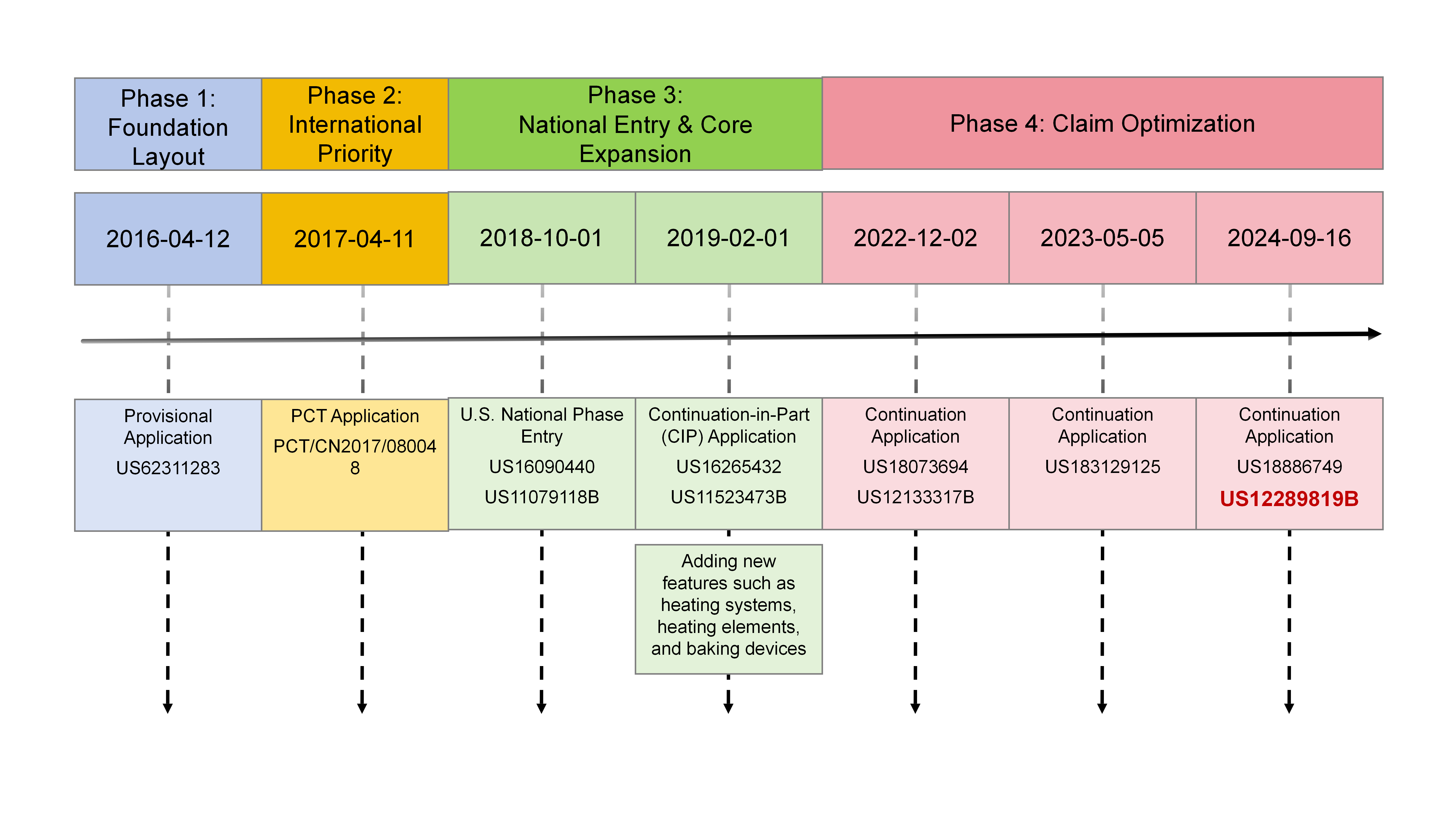
This strategy embodies the sophisticated IP management capabilities of multinational enterprises. At its core, it uses a parent application to establish a priority date and basic protection scope, then refines and expands that protection through divisional and continuation applications — all within legally permitted procedures.
Through this approach, the patentee can closely track competitors' evolving product features, and strategically incorporate those solutions into subsequent applications by amending claims or adding dependent claims — progressively building a dynamically evolving, multi-layered patent barrier.
For Chinese companies, the challenge is structural: competitors' patent portfolios are not static documents, but dynamic legal tools that evolve over time and respond to market developments. Even if an enterprise successfully circumvents the designs of early patents, it is highly likely to fall within the scope of carefully optimized claims developed later based on market feedback.
The result is a tightly interlocking patent portfolio that is difficult to circumvent in isolation. This nearly eight-year patent strategy demonstrates the ability of multinational companies to integrate technological R&D, legal rules, and market strategies, and also erects a high threshold for competitors to imitate and circumvent. Circumventing such a patent thicket often requires massive R&D resources and time costs — an investment that may mean missing market opportunities in the rapidly iterating home appliance industry.
3. Strategic Response: From Passive Defense to Integrated IP Strategy
Faced with an increasingly complex international patent landscape, Chinese home appliance makers must shift from passive response to proactive positioning — building an integrated IP strategy that combines robust defensive capabilities with the capacity to mount effective countermeasures.
A. Strengthening Early Patent Risk Detection
Proactive risk identification is the first line of defense against patent conflicts. Enterprises should move IP risk assessment to earlier stages of product development.
- Dynamic Tracking: Rely on professional analysis institutions to continuously track competitors' patent developments and strategies.
- FTO Front-Loading: Conduct Freedom to Operate (FTO) analysis at the initial stage of R&D project approval to draw a clear "patent map".
- Mitigating Treble Damage Risk: In high-risk jurisdictions such as the United States, an FTO opinion signed by locally licensed counsel serves not only as a technical reference, but also a critical evidentiary record in litigation — one that can rebut allegations of "willful infringement" and reduce exposure to treble damages.
- Address High-Risk Patents at the Source: Conduct stability assessments on high-risk patents identified in FTO analysis; for patents with a solid legal basis, promptly initiate design-around efforts to reduce infringement risks from the source.
B. Build a High-Quality Patent Layout System
Chinese enterprises should move beyond a "circumvention" mindset and towards building an independent, high-quality, and forward-looking patent portfolio.
- Deep Analysis and Strategic Differentiation: Conduct in-depth deconstruction of leading enterprises' patent families and continuation strategies to understand the underlying logic of their technological evolution and legal layout. On this basis, identify gaps and weaknesses in their technical routes, and potentially leapfrog incumbents by developing high-value innovations and deeper patent coverage — building on gaps in competitors' existing portfolios — ideally securing improved patents that offer greater technical advancement or broader commercial applicability.
- Secure Priority Rights: Flexibly use provisional applications, PCT international applications, etc., to secure the earliest possible priority date for core technical concepts.
- Integrate R&D and Production: Integrate patent work into the entire product R&D cycle, continuously optimize the structure of the patent portfolio, and support both technological protection and market expansion.
Such a systematic patent layout can not only effectively protect an enterprise's own technological achievements, but also provide sufficient "litigation leverage" and "bargaining power" when facing patent litigation or negotiations.
C. Cultivate Offensive and Defensive Litigation Response Capabilities
Once sued overseas, enterprises should respond proactively, adopt a strategy of responding assertively through litigation, and turn the courtroom into a battlefield for asserting and protecting their legal rights.
- Rapid Defense Construction: Immediately retain patent attorneys with profound technical backgrounds and trial experience, and form a core response team consisting of internal legal, R&D, and marketing personnel to ensure information synchronization and efficient decision-making.
- Comprehensive Assessment: Clarify the scope of the involved patents and the focus of infringement allegations, and evaluate the potential impact of the litigation on business, supply chains, and brand reputation to provide a basis for formulating an overall offensive and defensive strategy.
- Multi-Path Defense and Counterattack:
a. Initiate Invalidation Proceedings: File inter partes review (IPR) and other invalidation proceedings with the Patent Trial and Appeal Board (PTAB) to undermine the opponent's legal foundation by mining prior art.
b. Challenge Jurisdiction: Timely challenge the jurisdiction of the trial court and promote the case to be heard in a more neutral judicial district.
c. Public Interest Defense: In USITC investigations, actively assert the "public interest defense" to demonstrate that a ban on sales would harm US consumers and market competition.
- Seize the Initiative: When facing potential threats, proactively file a declaratory judgment action of non-infringement to control the litigation timeline.
- Patent Leverage: Systematically assess its own patent portfolio, proactively search for potential infringement points in the opponent's product lines, and file counterclaims accordingly to disrupt the opponent's offensive rhythm, shift from a defensive to an assertive posture, and establish leverage toward a cross-licensing resolution. Enterprises may also consider strategic patent asset acquisition, focusing on business areas and technical weaknesses of litigation opponents to accurately acquire key patents from external sources.
4. Conclusion
Whirlpool's patent strategy illustrates a broader reality: intellectual property has evolved beyond a back-office R&D function and has become a strategic asset capable of shaping market competition.
For Chinese manufacturers integrating patent strategies — both defensive and offensive — into their global business planning is critical. Done well, this integration enables them not merely to manage litigation risk, but to actively influence the competitive rules of international markets.
The content of this article is intended to provide a general guide to the subject matter. Specialist advice should be sought about your specific circumstances.
