
Falling behind on a Toronto property tax bill is stressful enough on its own. It becomes more complicated when an unrelated debt, such as an unpaid water bill, a by-law fine, or a local improvement charge, suddenly shows up added to the same tax account.
Many Toronto property owners are surprised to learn that the City can fold non-tax debts into a property tax account and then use its full tax collection machinery, including a lien on title and an eventual tax sale, to recover the combined balance. Understanding how this works, and what limited options exist to reduce the damage, matters for any Toronto property owner or landlord managing a tenant-occupied building.
This is a common situation for landlords in particular. A tenant’s unpaid water usage does not stay a tenant problem. In Toronto, the utility account is tied to the property, not the occupant, so an unpaid water bill eventually becomes the owner’s tax debt. An experienced tax lawyer in Canada can help a property owner understand where they stand once that transfer happens and what, if anything, can still be done about it.
Background: How Non-Tax Debts End Up on a Toronto Property Tax Account
Toronto operates under the City of Toronto Act, 2006, rather than the Municipal Act, 2001 that governs most other Ontario municipalities, though the two statutes contain closely parallel provisions. Under section 3 of the City of Toronto Act, 2006, where an amount payable to the City is given priority lien status by that Act or any other Act, the City may add the amount to the tax roll for the property against which it was imposed. Water and wastewater charges are the most common example, but the same mechanism can apply to other municipal fees and charges, local improvement levies, and certain by-law enforcement costs.
Once added to the tax roll, the transferred amount is treated, for collection purposes, almost identically to a property tax itself. It may be collected in the same manner as taxes; it may be recovered as a debt from the owner at the time it was added and from any later owner; it becomes a special lien on the property with priority status; and it can be folded into the cancellation price if the property later proceeds to a tax sale.
For utility accounts specifically, the City’s practice is to send overdue notices at set intervals before the balance is transferred. If a utility bill remains unpaid after the notice period, the outstanding amount, plus an administrative fee, moves onto the property tax account and is added to the assessment roll under the owner’s roll number rather than the utility account. From that point forward, the debt is subject to the same penalty and interest regime, and the same enforcement tools, as unpaid property tax.
For landlords with tenant-occupied buildings where the utility account remains in the landlord’s name, this creates real exposure. A tenant who stops paying water charges does not create a debt the tenant alone answers for. The City’s remedy runs against the property, which means it ultimately runs against the owner.
Toronto property owners and investors will recognize the same lien-against-the-property logic from the city’s Vacant Home Tax. An unpaid VHT assessment also attaches to the property rather than to the individual who owned it at the time, which is why a purchaser who skips a VHT status check before closing can end up inheriting a prior owner’s liability, much as they can with unresolved tax or utility arrears.
Key Issues: The City’s Collection Powers Once Amounts Reach the Tax Roll
Penalty and interest.
Once an amount is on the tax roll, whether it is the original tax levy or a transferred utility charge, late payment penalty and interest accrue at a rate set by City by-law under the City of Toronto Act, 2006, currently 1.25 percent added on the first day of default and again on the first day of every subsequent month the balance remains unpaid. That works out to an effective rate in the range of 15 percent annually if a balance sits unpaid for a full year, compounding as each month’s penalty is itself added to the arrears base for the next month’s calculation.
To make that concrete, a transferred water balance of $4,000 left unpaid for fourteen months does not simply accumulate at a flat $50 a month. With 1.25 percent compounding onto the growing balance each month, the arrears grow to roughly $4,750 to $4,800 by month fourteen, an increase of close to 19 percent of the original balance, and that trajectory keeps accelerating the longer the account sits untouched. This is why acting in the first month or two of default matters so much more than it might for an ordinary unsecured debt.
Priority lien status.
Amounts added to the tax roll rank ahead of most other claims against the property, including mortgages. This is one of the most significant differences between municipal tax debt and ordinary unsecured debt. A mortgage lender who might otherwise have first claim on a property in a shortfall scenario is, for these purposes, subordinate to the City’s lien.
David J. Rotfleisch, founding tax lawyer and CPA at Rotfleisch & Samulovitch, and a Law Society of Ontario Certified Specialist in Taxation, points out that priority lien status is often the biggest surprise for lenders and purchasers, not just for the property owner who fell behind. “A mortgage that would ordinarily rank first in a default scenario gets no protection here,” he says. “That is exactly why every purchase and refinance on a Toronto property should confirm the tax account status directly with the City before closing, rather than assuming title insurance alone will catch a gap of this kind.”
“A mortgage that would ordinarily rank first in a default scenario gets no protection here.That is exactly why every purchase and refinance on a Toronto property should confirm the tax account status directly with the City before closing, rather than assuming title insurance alone will catch a gap of this kind”
Tax arrears certificate and tax sale.
If property tax, including any transferred utility or other charges, remains unpaid for at least two years, the City may register a tax arrears certificate against title under Part XIV of the City of Toronto Act, 2006. That registration starts a one-year clock. During that year, the owner, or anyone with a registered interest in the property, can stop the process entirely by paying the cancellation price, defined under section 343(1) of the Act as the full amount of tax arrears, current taxes, accrued interest and penalty, and the City’s reasonable costs. The City may also agree to an extension agreement rather than proceed to sale, though it is not obligated to do so. If the cancellation price remains unpaid at the end of the one-year period and no extension agreement is in place, the City must offer the property for public sale by public auction or public tender.
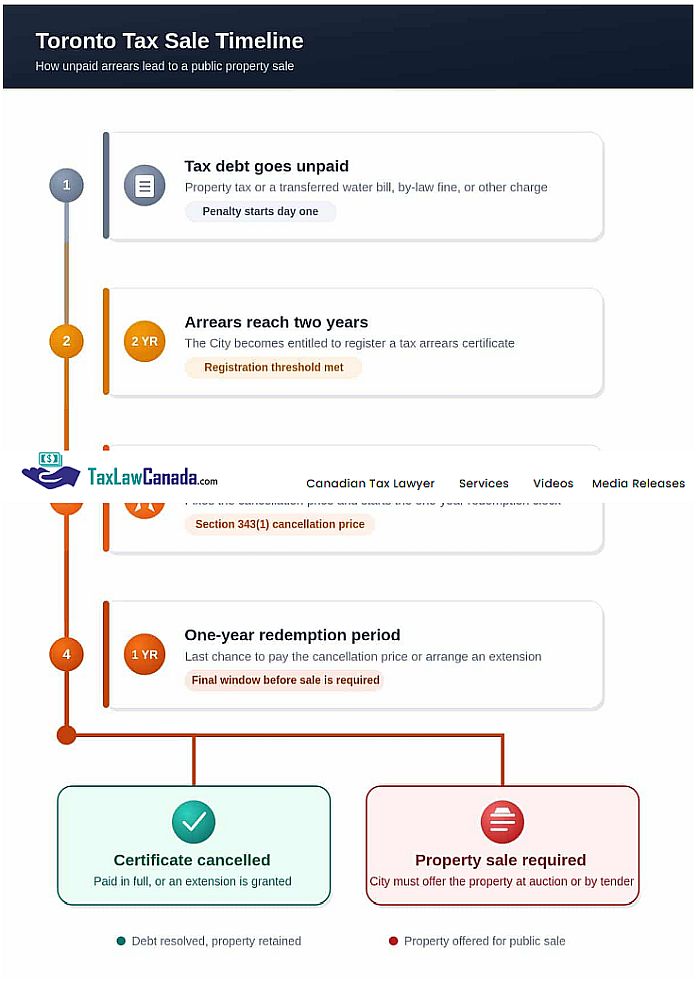
Figure 1: Tax sale procedure timeline, from arrears to either a cancelled certificate or a public property sale.
Bailiff recovery and seizure of goods.
A tax sale is not the City’s only enforcement tool, and it is not always the first one used. The City can engage a bailiff to serve a Warrant to Distrain for Taxes, which allows the bailiff to physically seize and remove goods or chattels from the property and sell them to recover the tax arrears, including any transferred utility or other charges. This route is generally faster than a tax sale and is commonly used against commercial and rental properties before arrears reach the two-year tax sale threshold.
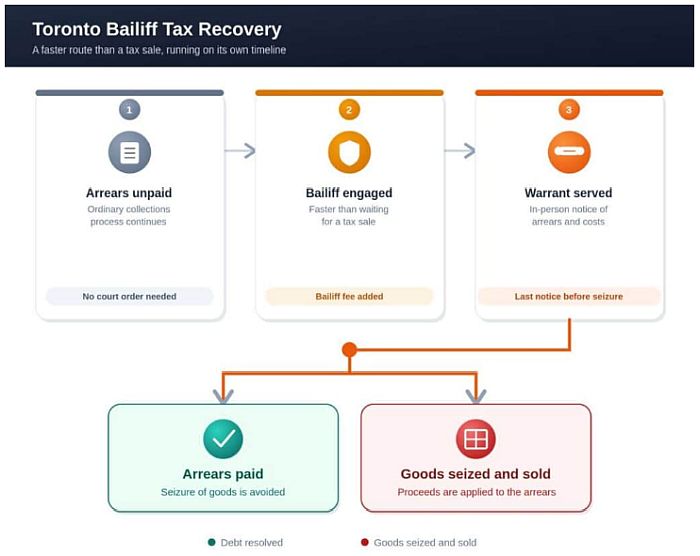
Figure 2: Bailiff tax recovery process, from a served warrant to either payment or seizure and sale of goods.
Collection outside a tax sale.
The City can also pursue arrears through ordinary debt collection, including legal action against the person who was the assessed owner when the amount was added, and that liability follows the debt even after a change in ownership if the arrears were not cleared before closing. This is one of the reasons a purchaser’s lawyer requests a tax certificate before closing on any Toronto property, since unpaid amounts on the tax roll are not automatically wiped out by a sale of the land in the ordinary course.
Condominium unit owners face a related but distinct exposure.
Where a condominium corporation’s shared utility account goes unpaid, the City transfers the corporation’s overdue balance to individual unit owners’ property tax accounts, with each owner’s share calculated the same way as their share of common expenses. A unit owner who has never missed a personal utility payment can still see a transferred balance appear on their tax account if the corporation as a whole falls behind, which makes it worth confirming the building’s utility account status, not just the unit’s own tax certificate, before purchasing a condominium.
Implications for Canadian Taxpayers: Can Interest or Penalty Be Waived
This is where property owners are often disappointed. The City’s own published collection policy states plainly that penalty and interest charges on overdue property tax and utility amounts cannot be waived or altered through the ordinary billing and collections process. Call centre staff and account representatives have no discretion to reduce or forgive interest or penalty simply because a taxpayer disputes the charge, missed a notice, or is facing a temporary cash flow problem. Payment plans can sometimes be arranged, but the interest and penalty already accrued, and continuing to accrue on any unpaid balance, are not open to negotiation at that level.
There is a narrower statutory avenue, but it is important to be precise about what it covers. Section 323 of the City of Toronto Act, 2006 allows an owner to apply to have “all or part of the taxes levied on land” for a specific year cancelled, reduced, or refunded, on defined grounds including inability to pay because of sickness or extreme poverty, a gross or manifest clerical or factual error, property that became exempt or ceased to be taxable at the assessed rate, and a few other narrow categories such as property destroyed by fire or rendered unusable for at least three months due to repairs. Applications on sickness or extreme poverty grounds are not decided by City staff or City Council. They are forwarded to the Assessment Review Board, which holds a hearing and reviews financial evidence, sometimes referencing Statistics Canada low income cut-offs, before deciding whether to cancel or reduce the taxes for that year and by how much.
The phrase “taxes levied on land” is doing real work here. It refers to the real property tax itself, as levied under Part XI of the Act. Water and wastewater charges, local improvement levies, and other fees that later get added to the tax roll are not levied as taxes in the first place. They reach the roll through a separate mechanism, the priority lien status provision in section 3, and that provision preserves their character as fees and charges even while directing that they be collected in the same manner as taxes. A section 323 application therefore has no application to a transferred water bill or other transferred charge, or to the interest and penalty that has accrued on it. Where a successful section 323 application does eliminate interest and penalty is on the portion attributable to the actual property tax for the year in question, since there is no longer an outstanding tax balance for that period to which the charges attach. That relief simply does not extend to the non-tax amounts riding on the same account.
For a transferred utility charge, the correct point of attack is different, and it has to happen on the utility side of the ledger rather than through a tax cancellation application. Toronto Water maintains its own adjustment process for water bills driven by an unexplained or uncontrollable consumption spike, a confirmed leak, or a meter or meter transmission unit malfunction, and a successful adjustment reduces the underlying charge and, with it, the interest and penalty calculated on that charge. This is a dispute of the bill itself, decided by Toronto Water or Revenue Services rather than the Assessment Review Board, and it is realistically only available before or shortly after the balance is transferred to the tax roll, not as a way to unwind interest on an old, settled arrears balance. Once a utility charge has been sitting on the tax account for an extended period without being disputed on its merits, the routine collections position, that penalty and interest cannot be waived or altered, applies to it just as it does to the property tax portion of the account.
A separate and more commonly used form of relief exists for low-income seniors and low-income disabled homeowners, who may qualify for a property tax increase deferral or cancellation and, where the property has metered water service and consumption below 400 cubic metres per year, a water rate rebate. These programs address the ongoing cost of taxes and water going forward, and they are covered in more detail in our guide to municipal property tax relief in Toronto. They are not a mechanism for erasing interest or penalty already charged on a debt that has gone into arrears, on either the tax or the utility side of the account.
The application deadline for a section 323 cancellation, reduction, or refund, including the sickness or extreme poverty stream, is the last day of February of the year following the year to which the application relates. Missing that window generally forecloses relief for that tax year, regardless of the underlying merits. Utility billing disputes and adjustment requests are not governed by that deadline, but they need to be raised promptly, ideally before the unpaid balance is transferred to the tax roll, since the City’s own collection process treats a transferred balance as settled and due rather than as an open billing question.
David Rotfleisch notes that the transfer of utility debt onto a tax account catches many landlords off guard. “They assume a tenant’s unpaid water bill is the tenant’s problem to resolve,” he says. “Once that debt lands on the property tax roll, it is governed by the same priority lien and tax sale rules as the property tax itself, but it does not become the property tax itself, and that distinction determines which relief mechanism actually applies. A property owner who tries to use the sickness or extreme poverty application to attack a transferred water bill is applying to the wrong body under the wrong section. The water bill has to be challenged as a water bill, through Toronto Water’s own adjustment process, and that has to happen before the City treats the balance as settled arrears rather than an open billing dispute.”
A property owner who tries to use the sickness or extreme poverty application to attack a transferred water bill is applying to the wrong body under the wrong section. The water bill has to be challenged as a water bill, through Toronto Water’s own adjustment process, and that has to happen before the City treats the balance as settled arrears rather than an open billing dispute.”
Takeaway
The City of Toronto has considerable leverage once a debt, whether it originated as unpaid tax or an unpaid utility charge, lands on a property tax account. The amount becomes a priority lien against the property, ranking ahead of most other claims, and the City can pursue it through bailiff seizure of goods or, if left unpaid for two years, through registration of a tax arrears certificate and ultimately a public tax sale. Routine interest and penalty on overdue amounts are not something a taxpayer can simply ask the City to waive.
For the property tax portion of an account, the only real path to that kind of relief runs through a formal application under section 323 of the City of Toronto Act, 2006 on narrow statutory grounds, decided in most cases by the Assessment Review Board rather than City staff, and subject to a firm annual filing deadline. That section has no application to a transferred water bill or other transferred charge, which is not a “tax levied” within the meaning of the Act. Relief for those amounts has to come from disputing the underlying utility bill directly with Toronto Water, and generally has to happen before the balance is transferred to the tax roll.
Top Tax Tips
- Property owners who receive a Property Tax Account Statement showing a transferred utility balance should not treat it as routine mail. The moment for negotiation, whether that means arranging a payment plan or assessing eligibility for statutory relief, is before the balance compounds another month of penalty and interest, not after a tax arrears certificate has already been registered.
- Landlords with tenant-occupied properties should build utility account monitoring into their property management practices, since the City’s mechanism does not distinguish between an owner who personally ran up water charges and an owner whose tenant did.
- Anyone considering an application based on sickness or extreme poverty should gather supporting financial and medical documentation early, because the Assessment Review Board hearing will expect concrete evidence, not a general assertion of hardship, and the February deadline does not bend for a slow-moving application.
- A purchaser buying any Toronto property, particularly one that has changed hands recently or shows signs of deferred maintenance, should always request a tax certificate before closing, since arrears with priority lien status can follow the property regardless of who caused them.
- Where a dispute involves whether a charge was properly added to the tax roll at all, as opposed to whether it should be forgiven, a taxpayer may have stronger grounds to challenge the transfer itself rather than seeking discretionary relief that the City has limited authority to grant.
- A property owner facing an unusually high water bill should raise it with Toronto Water immediately rather than waiting to see whether it can later be addressed as part of a tax relief application, since the section 323 process has no authority over a transferred utility charge and a billing dispute becomes far harder to win once the City considers the balance settled arrears rather than an open account question.
- Given how quickly penalty compounds at 1.25 percent per month, and how little room exists to have it reversed once assessed, addressing an account the first month it falls into arrears is far more effective than trying to negotiate a resolution once the debt has grown and a lien is already in place.
- It is also worth distinguishing two different conversations a lawyer can have with the City on a client’s behalf. One is asking for forgiveness of interest or penalty already assessed, which the City’s own policy forecloses outside the narrow section 323 process. The other is arranging a payment plan on a balance the City still considers valid, or challenging whether a charge was correctly added to the tax roll in the first place, for example because the utility account was never properly transferred, the notice requirements were not met, or the amount includes charges that do not have priority lien status. That second conversation remains open even after a balance has been sitting on the tax account for some time, and it is often the more realistic path once the window for a straightforward billing dispute has closed.
- Speaking with an experienced Canadian tax lawyer early, rather than after a tax arrears certificate has been registered, preserves options that narrow considerably as the City’s timelines advance.
FAQs About Toronto Property Arrears Collection Powers
Can the City of Toronto really add my tenant’s unpaid water bill to my property tax account?
Yes. Utility accounts in Toronto are tied to the property, and if a balance remains unpaid after the City’s notice period, the outstanding amount plus an administrative fee is transferred to the property tax roll under the owner’s assessment roll number, regardless of who incurred the charge.
What is priority lien status and why does it matter?
Priority lien status means an amount added to the tax roll ranks ahead of most other claims against the property, including a mortgage. It gives the City a stronger legal position than an ordinary creditor would have.
How long can property tax or transferred charges go unpaid before the City can register a tax arrears certificate?
At least two years of unpaid taxes, which can include transferred utility and other charges, before the City becomes entitled to register a tax arrears certificate against title under the City of Toronto Act, 2006.
What happens after a tax arrears certificate is registered?
The owner or any person with a registered interest in the property has one year from registration to pay the full cancellation price or arrange an extension agreement with the City. If neither happens, the City must offer the property for public sale.
What is included in the cancellation price?
All outstanding tax arrears, current taxes owing, accrued interest and penalty, and the City’s reasonable costs incurred in the tax sale proceedings, as defined under section 343(1) of the City of Toronto Act, 2006.
Can I negotiate a lower interest rate or ask the City to waive penalty charges informally?
No. The City’s published collection policy states that penalty and interest charges on overdue property tax and utility amounts cannot be waived or altered through the regular billing and collections process.
Is there any legal way to have interest or penalty reduced or eliminated?
For the property tax portion of an account, the main avenue is an application under section 323 of the City of Toronto Act, 2006 to cancel, reduce, or refund the underlying tax for a specific year on defined grounds such as sickness or extreme poverty or a gross or manifest error. If the tax itself is cancelled, the interest and penalty attached to that portion generally falls away as well.
Does section 323 relief also apply to a transferred water bill or other transferred charge?
No. Section 323 only reaches “taxes levied on land,” meaning the real property tax itself. A water bill or other fee added to the tax roll gets there through a separate priority lien provision and keeps its character as a fee rather than becoming a tax, so it falls outside section 323 entirely. Relief for a disputed water bill has to go through Toronto Water’s billing adjustment process, not an Assessment Review Board application, and generally needs to be raised before the balance is transferred to the tax roll.
Who decides an application based on sickness or extreme poverty?
The Assessment Review Board, not City Council or City staff. The Board holds a hearing, reviews financial and medical evidence, and decides whether to cancel or reduce the tax and by how much.
What is the deadline to apply for a cancellation, reduction, or refund under section 323?
The last day of February of the year following the year the application relates to. Applications received after that deadline generally cannot be considered.
Does a low income senior or low income disabled water rebate help with a debt already in arrears?
Not directly. Those programs reduce ongoing water rates and can defer or cancel a property tax increase going forward, but they do not retroactively erase interest or penalty already accrued on a balance that fell into arrears.
If I buy a Toronto property, can I be held responsible for the previous owner’s unpaid tax or utility arrears?
Amounts with priority lien status attach to the property and can be recovered from a subsequent owner, which is why a tax certificate should always be reviewed before closing on a purchase. The city’s Vacant Home Tax works on the same principle, an unpaid VHT assessment is a lien on the property rather than a personal debt of the prior owner, so a VHT status check belongs on the same pre-closing checklist as a tax certificate.
If I buy a condo, can I inherit the building’s unpaid utility charges?
Yes. If a condominium corporation’s shared utility account falls into arrears, the City transfers the overdue amount to individual unit owners’ tax accounts based on each unit’s common expense share, regardless of whether that particular owner’s own payments were current. A pre-purchase check should cover the building’s utility account status, not just the individual unit’s tax certificate.
Can the City sell my property over unpaid utility charges alone, even if my actual property tax is current?
Yes, once the utility charge is transferred to the tax roll it is treated the same as property tax for collection purposes, including the two year threshold for registering a tax arrears certificate and the eventual tax sale process.
Is an extension agreement guaranteed once a tax arrears certificate is registered?
No. The City may agree to an extension rather than proceed to sale, but it is not required to, and the decision is made on a case by case basis.
Can the City send a bailiff before it starts a tax sale?
Yes. The City can engage a bailiff to serve a Warrant to Distrain for Taxes and seize goods or chattels from the property to recover arrears, including transferred utility charges. This is a separate, generally faster enforcement route than a tax sale and does not require the two-year arrears threshold that applies to registering a tax arrears certificate.
If I think my water bill is wrong, is it too late once it has been moved to my tax account?
Practically, yes in most cases. Toronto Water’s adjustment process for unexplained consumption spikes, leaks, or meter malfunctions is meant to be used while the utility bill is still an open utility account matter. Once the balance has been transferred to the tax roll, the City treats it as settled arrears rather than a live billing dispute, so a property owner who suspects a billing error should raise it with Toronto Water as soon as the high bill arrives, not after the transfer notice.
The content of this article is intended to provide a general guide to the subject matter. Specialist advice should be sought about your specific circumstances.
[View Source]